Figuring out capacitor value

Tonyr1084

Joined Sep 24, 2015
9,744
I've drawn a circuit using one IC and some resistors and capacitors. The IC is a Hex Inverter Buffer set as an oscillator. Five caps can be built in with known values and the sixth is the test cap (Ct). For greater range you can make the five fixed caps modular (plug-in) so you can swap in any known value and match it to the test cap. As for power supply, I'd opt for 5V. This way you're not running the risk of over-voltage on a cap. Match one and you have your value regardless of what voltage you apply later on in life.
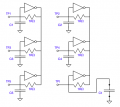
Screen Shot 2024-02-26 at 7.57.29 AM.png
 

WBahn

Joined Mar 31, 2012
32,836
View attachment 316215

If you look at the start of the waveform, you can see how it curves upward initially. An ideal first order response would be a sharp transition from flat to a line at a slope that would result in it reaching full charge in one time constant (if it continued at that slope). So picking the correct placement of the initial curser is problematic because the waveform is being dominated at that point by non-ideal behavior. These are largely suppressed by the time you get to the 10% point. Similarly, past the 90% point things become mushy because the waveform has flattened out enough that small errors in amplitude determination result in large errors in time determination. Yet you want points that are as far apart as possible in order to give the best resolution. Using 10% and 90% provide a reasonable tradeoff between these factors.

Measuring charging time isn't the only way to get at capacitance and it is far from the most accurate.
 

Thread Starter

PsySc0rpi0n

Joined Mar 4, 2014
1,786
If you have cursors, then you don't need the lines, just use the cursors to set one line at 10% and one line at 90% the same way that you are using them to set one of your cursors at 63% now.
ok, and then, what should I get from that method?
I'll get a time frame. What am I supposed to do with that time frame? Will that give me the capacitance of the cap? Even if it's not even a very close value?
 

Thread Starter

PsySc0rpi0n

Joined Mar 4, 2014
1,786
View attachment 316215

If you look at the start of the waveform, you can see how it curves upward initially. An ideal first order response would be a sharp transition from flat to a line at a slope that would result in it reaching full charge in one time constant (if it continued at that slope). So picking the correct placement of the initial curser is problematic because the waveform is being dominated at that point by non-ideal behavior. These are largely suppressed by the time you get to the 10% point. Similarly, past the 90% point things become mushy because the waveform has flattened out enough that small errors in amplitude determination result in large errors in time determination. Yet you want points that are as far apart as possible in order to give the best resolution. Using 10% and 90% provide a reasonable tradeoff between these factors.

Measuring charging time isn't the only way to get at capacitance and it is far from the most accurate.
Ok, so I tried that on a known 22uF SMD capacitor but this time through a 324Ω resistor (real value from the dmm) and this is what I get:
DS1Z_QuickPrint5.png

time to charge from 10% to 90% is 10ms.
Now, I'm not sure what to do with this value. I guess it's not to use in C = ζ/R, because this is more than 1 time constant.
 
Last edited:

k1ng 1337

Joined Sep 11, 2020
1,038
Ok, so I tried that on a known 22uF SMD capacitor but this time through a 324Ω resistor (real value from the dmm) and this is what I get:
View attachment 316237

time to charge from 10% to 90% is 10ms.
Now, I'm not sure what to do with this value. I guess it's not to use in C = ζ/R, because this is more than 1 time constant.
It looks like you are not treating the RC constant as intended. Consider the following:

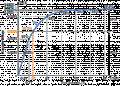
According to this graph, the RC constant is the independent variable and cap voltage is the dependent variable. This means that for a capacitor of capacitance value X, it will take 1RC worth of time for the voltage to reach 63.2% of its maximum value regardless of the input voltage. After that, each discrete RC step up is another 63.2% increase in what is the difference from the previous calculation. The result is a characteristic charge / discharge profile and the only thing that changes is the initial charge / discharge current as given by Ohm's law.

RC2.gif
RC3.png

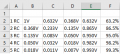
Even though calculus was used to derive the relationship, we can use simple math to confirm the discrete changes of RC:

Untitled.png

The results are close to what is on the graph aside from a bit of rounding error. I suspect your problem is you are not taking your timing measurements at the correct intervals as dictated by the RC constant.

Try using pen, paper and a stopwatch to replicate the findings of the first image by using the circuit in the second image. Make a table to see if you end up with the correct percentages for each discrete change in RC constant. Start your experiment with a 1000uF capacitor to make it easier to sample the voltage reliably. The time it takes to go from 1RC to 2RC (0.632V -> 0.865V) should be the same amount of time it takes to go from 2RC to 3RC (0.865V -> 0.950V).

Keep in mind, a 10nF capacitor holds such a tiny amount of energy that it is often swamped by parasitic elements resulting in significant measurement error. It may be the case that your jumper wires or other interference is adding parasitic capacitance and resistance to your results.

Edit: I looked over my results I made a few reporting errors in excel.. ...be sure to double and triple check your work!
 
Last edited:

WBahn

Joined Mar 31, 2012
32,836
ok, and then, what should I get from that method?
I'll get a time frame. What am I supposed to do with that time frame? Will that give me the capacitance of the cap? Even if it's not even a very close value?
As has been stated a couple of times in this thread, the 10-90 rise time is equal to ln(9) (about 2.2) times the RC time constant.
 

WBahn

Joined Mar 31, 2012
32,836
Ok, so I tried that on a known 22uF SMD capacitor but this time through a 324Ω resistor (real value from the dmm) and this is what I get:
View attachment 316237

time to charge from 10% to 90% is 10ms.
Now, I'm not sure what to do with this value. I guess it's not to use in C = ζ/R, because this is more than 1 time constant.
If the 10-90 rise time is 10 ms, then the time constant is about 4.55 ms. If the resistance is 324 Ω, then the estimated capacitance is about 14 µF.
 

k1ng 1337

Joined Sep 11, 2020
1,038
If the 10-90 rise time is 10 ms, then the time constant is about 4.55 ms. If the resistance is 324 Ω, then the estimated capacitance is about 14 µF.
I'm not familiar with this method but I'd like to test it. Can you provide an experiment similar to what I suggested in my previous post? I'll sample a bunch of values and use Python to graph the output.
 

MrAl

Joined Jun 17, 2014
13,704
ok, and then, what should I get from that method?
I'll get a time frame. What am I supposed to do with that time frame? Will that give me the capacitance of the cap? Even if it's not even a very close value?
ln(x) is the natural log of x.

As mentioned, if you look at the time 't' from 10 percent to 90 percent the time would be:
t=ln(9)*R*C
which is approximately:
t=2.2*R*C

and so you can solve for RC, or just solve for C:
C=t/(2.2*R)


Maybe you need to read all the posts after yours not just one or two.
 

Audioguru again

Joined Oct 21, 2019
6,826
I've drawn a circuit using one IC and some resistors and capacitors. The IC is a Hex Inverter Buffer set as an oscillator. Five caps can be built in with known values and the sixth is the test cap (Ct). For greater range you can make the five fixed caps modular (plug-in) so you can swap in any known value and match it to the test cap. As for power supply, I'd opt for 5V. This way you're not running the risk of over-voltage on a cap. Match one and you have your value regardless of what voltage you apply later on in life.
View attachment 316231
Your inverters do not oscillate unless they are Schmitt-Trigger ones.
 
Top