Feeding 4x ESP32-cam

Thread Starter

PsySc0rpi0n

Joined Mar 4, 2014
1,786
NO COMMENT ABOUT THAT!! If you do not understand a common abbreviation and THEN want to challenge it. Oh Well.
My native language is not english. So no wonder I don't know all your common abbreviations. Or maybe I misunderstood you. I'm not sure. I'm sorry.
And I wasn't the one asking about the difference betweem 'uF' and 'mF'. I'm not sure why @ericgibbs posted an image of someone asking the difference between 'uF' and 'mF'. If it was me somewhere in time, it must have been quite some time ago!
 

MisterBill2

Joined Jan 23, 2018
27,571
Mfd has been a standard abbreviation for a whole lot of years in much of what I read regarding electronics. So it is not a modern term, but a common older term. I did not intend to be confusing, but I did neglect to go to the effort of using a special character. Sorry about being a bit lazy, that happens some times.
 

Thread Starter

PsySc0rpi0n

Joined Mar 4, 2014
1,786
Mfd has been a standard abbreviation for a whole lot of years in much of what I read regarding electronics. So it is not a modern term, but a common older term. I did not intend to be confusing, but I did neglect to go to the effort of using a special character. Sorry about being a bit lazy, that happens some times.
I understand that but if I seen it in the past, I just don't remember.
But why do you call 'uF' or 'mF' special characters? I would call a special character something like Ω or μ.
 

Thread Starter

PsySc0rpi0n

Joined Mar 4, 2014
1,786
Morning Psy,
I guess you know that there is a pop-up menu of symbols on the posting box.?
How is the project progressing?

E
Yes, I know about the special characters pop-up box. That's why I said to @MisterBill2 that one wouldn't need any special chars (at least on the keyboard) to type the capacitance of a component.

The project is just waiting for the components to get on a perf board. I think I'm missing the capacitors of the correct values!
And also, I never know when to use one type of caps or another type.

For instance I only have these:
1x 25V 47μF SMD polarized cap or 1x 35V 47μF THT cap
1x 25V 22μF SMD polarized cap
like these:


Then:
2x disc ceramic 100nF capacitors

And I'm missing the fuse!
 

Thread Starter

PsySc0rpi0n

Joined Mar 4, 2014
1,786
I just got anothre question about the circuit.
Regarding the fuse:
Knowing that each esp32-cam module can consume up to 310mA (when streaming with flash light at max), times 4, I may have up to 1240mA going through this circuit.
In a first thought, this would mean at least a fuse of 1.25 * 1240mA, going for 125% of the max current rating of the 4x esp32-cam module. However, this won't protect any of the esp32-cam individually, right?
But I can't also choose a 1.25 * 310mA because it will blow if more than one esp32-cam start streaming with flash at max.

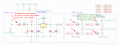
So, without complicating the circuit too much, what could I do? Use a single fuse at the input of each esp32-cam of 1.25 * 310mA and a 1.25 x 1240mA at the circuit input as I did it in the schematic?
 

MisterBill2

Joined Jan 23, 2018
27,571
A fuse is to protect first the the upstream wiring, not the load, since in the event of an overload something downstream of the fuse has already failed. The wiring and load already have some damage!
Individual fusing of the various loads will provide system protection and is a good idea.
 
Last edited:

Thread Starter

PsySc0rpi0n

Joined Mar 4, 2014
1,786
A fuse is to protect first the the upstream wiring, not the load, since in the event of an overload something downstream of the fuse has already failed. The wiring and load already have some damage!
Individual fusing of the various loads will provide system protection and is a good idea.
I'm sorry but I'm not sure if I understand the meaning of upstream wiring. Could you be more specific or rephrase?

Hi Psy,
If you use a single 3Amp fuse, if any of the 4 ESP32 Cams have a short out, you will lose all 4 cameras.
I would use a 1Amp 20mm, inline fuse for each camera, located as close as possible to the 12V car battery.
E

https://www.google.com/search?clien...biw=1147&bih=644&dpr=1.4#imgrc=ssnxk89yzylCAM
@ericgibbs I never mentioned a 3A fuse.
I mean something like this:
1708284573088.png


And why would you use a 1A fuse for a device that is rated at 310mA max? 1A is like 3 times more! Wouldn't I lose the modules with anything above like 400mA or so? I mean, 400mA is already 77.5% above the max rated current!
 

MisterBill2

Joined Jan 23, 2018
27,571
MisterBill2 said:
A fuse is to protect first the the upstream wiring, not the load, since in the event of an overload something downstream of the fuse has already failed. The wiring and load already have some damage!
Individual fusing of the various loads will provide system protection and is a good idea.
PsySc0rpi0n

"I'm sorry but I'm not sure if I understand the meaning of upstream wiring. Could you be more specific or rephrase?"

Have you never seen a small stream of water flowing by??
It flows downhill as a matter of nature. So "Upstream" means "from the source direction."
Or is there some translation software altering the phrases that I use to the extent that they no longer make sense? I am aware that translation software will do that.
I also see that you have made your information unavailable, for some reason.
 
Last edited:

ericgibbs

Joined Jan 29, 2010
21,448
Hi Psy,
You never rate your protection fuses at the maximum operating current, they will most likely blow every time you power up.
Depending on the application, I choose 25% to 50% fuse rating above the operating current
That's why I mentioned a 3A main fuse

Regarding your 7805 regulator.
Your battery supply may vary between 12V and 14V, so if it 14V, that means you have 14Vbty - 5Vreg drop
ie: across the 7805, 9V at 1.55Amps which gives a dissipation of 14 Watts,!!!
even at 12V, it becomes ~11 Watts.

The 7805 is rated in air at 2 Watts maximum.
E
 

Thread Starter

PsySc0rpi0n

Joined Mar 4, 2014
1,786
PsySc0rpi0n

"I'm sorry but I'm not sure if I understand the meaning of upstream wiring. Could you be more specific or rephrase?"

Have you never seen a small stream of water flowing by??
It flows downhill as a matter of nature. So "Upstream" means "from the source direction."
Or is there some translation software altering the phrases that I use to the extent that they no longer make sense? I am aware that translation software will do that.
I also see that you have made your information unavailable, for some reason.
I'm not using any translation software. I simply couldn't understand the meaning of that sentence in this context of electronics! That's all. And I still don't. I mean, the current comes from the car battery into the circuit. This would maybe be "downstream"? When I think in "upstream" in this context I can only think about current going back to the car battery! Not sure if this is what you meant!

Hi Psy,
You never rate your protection fuses at the maximum operating current, they will most likely blow every time you power up.
Depending on the application, I choose 25% to 50% fuse rating above the operating current
That's why I mentioned a 3A main fuse
Why will they blow up every time we power up the circuit? Is it because of instantaneous peak of current?

In this case, the worst case scneario is that all 4x ESP32-cams are working at the same time and all using the flash light, consuming up to 310mA each. So, this would ve the operating current in that scenario. Why we don't consider this scenario to chose the correct fuse?
And I still don't understand the 3A. How 25% to 50% above the operating current means 3A.

Regarding your 7805 regulator.
Your battery supply may vary between 12V and 14V, so if it 14V, that means you have 14Vbty - 5Vreg drop
ie: across the 7805, 9V at 1.55Amps which gives a dissipation of 14 Watts,!!!
even at 12V, it becomes ~11 Watts.

The 7805 is rated in air at 2 Watts maximum.
E
Hum, this makes total sense and I didn't think of it this way for sure. But that means I can't use this voltage regulator? At least without proper heat dissipation?
 

ericgibbs

Joined Jan 29, 2010
21,448
Hi Psy,
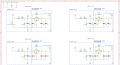
For the low cost of the 7805 you could consider a regulator for each ESP32Cam.
12V-5V = 7V *0.31 = ~2.2 Watts and a 1Amp fuse.

E
 

MisterBill2

Joined Jan 23, 2018
27,571
I'm not using any translation software. I simply couldn't understand the meaning of that sentence in this context of electronics! That's all. And I still don't. I mean, the current comes from the car battery into the circuit. This would maybe be "downstream"? When I think in "upstream" in this context I can only think about current going back to the car battery! Not sure if this is what you meant!


Why will they blow up every time we power up the circuit? Is it because of instantaneous peak of current?

In this case, the worst case scneario is that all 4x ESP32-cams are working at the same time and all using the flash light, consuming up to 310mA each. So, this would ve the operating current in that scenario. Why we don't consider this scenario to chose the correct fuse?
And I still don't understand the 3A. How 25% to 50% above the operating current means 3A.


Hum, this makes total sense and I didn't think of it this way for sure. But that means I can't use this voltage regulator? At least without proper heat dissipation?
As for "upstream" and "downstream", consider that POWER ALWAYS flows from the power source toward the load, which receives the power. And the flow direction is always defined as "downstream".
In the instance of a battery being charged, the battery is then the LOAD because the charger is the POWER SOURCE. In that instance the POWER FLOW is reversed.
 

Ya’akov

Joined Jan 27, 2019
10,240
Given that you protecting four independent devices, it would make more sense to fuse them individually since any one of them can be damaged if the maximum for all four is chosen for the fuse.

You might also consider using a resettable fuse, like a PolySwitch, so you don’t have to replace a fuse every time you make a mistake or there is an anomaly.
 

MisterBill2

Joined Jan 23, 2018
27,571
Really, fuses are to protect against additional damage or failures, because they are not supposed to clear unless there is a fault current, At least that is the main reason I use circuit protection devices. They protect the wiring UPSTREAM of the fault. (between the power source and the protection device location) They also protect the items beyond against additional failure damage. (downstream circuitry)
 
Last edited:

Thread Starter

PsySc0rpi0n

Joined Mar 4, 2014
1,786
Hi Psy,
For the low cost of the 7805 you could consider a regulator for each ESP32Cam.
12V-5V = 7V *0.31 = ~2.2 Watts and a 1Amp fuse.

E
Ok, that seems to me the best solution.
But bare with me, I still didn't understand how you compute the fuse at 1A.
If I chose a 1A fuse, am I not going way beyond the ESP32-cam 310mA max operating current?
Let's say there is some problem and a current of 600mA go from the car battery into the circuit. The fuse won't blow up because it's rated at 1A but my ESP32-cam will be damaged because it's getting too much current, no? Am I seeing things completely wrong?

Given that you protecting four independent devices, it would make more sense to fuse them individually since any one of them can be damaged if the maximum for all four is chosen for the fuse.

You might also consider using a resettable fuse, like a PolySwitch, so you don’t have to replace a fuse every time you make a mistake or there is an anomaly.
Yes, I'm considering one fuse for each ESP32-cam. Regarding the resettable fuse, I'll have to check if it worth for this application. But it makes sense, for sure!

...
They protect the wiring UPSTREAM of the fault. (between the power source and the protection device location) They also protect the items beyond against additional failure damage. (downstream circuitry)
In practice, the circuit before the ESP32-cam devices, right? From the car battery until the input of my circuit at the 7805 regulator, right?
 

ericgibbs

Joined Jan 29, 2010
21,448
Hi Psy,
The purpose of the fitting fuse before the actual circuit is to prevent a short circuit failure of the circuit damaging the incoming wiring and supply, not your circuit.

You do not rate the fuse to the operating current of your circuit, else as you switch On, any surge in current due to starting up load will blow the fuse.

E
 

ericgibbs

Joined Jan 29, 2010
21,448
Hi Psy,
Looks OK to me, keep the 100n's close to the 7805.
The #2 Ground should be connected directly to the grounds of the 7805 ground line.

Have you considered a simple Resistor/LED power indicator on the 5Vout?
E
 
Top