Feedback Loop with TL431 with optocoupler - Duty cycle modulation

Thread Starter

mishra87

Joined Jan 17, 2016
1,063
Hi Guys,
I am trying to understand the Feedback loop using voltage control Mode using TL431 with optocoupler.
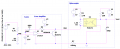
I created the circuit in ltspice and tried to simulate it. I have few doubts which i couldn't understand ?

1. I do not understand how TL431 works as a error amplifier and amplifying the error signal ??

As per my understand it is comparator which will compare the output signal with reference signal. The comparator output is either high or low so i do not understand how the error signal is being amplified. The output of opamp is drving NPN BJT an driving it into saturation region because of comparator high and low signal.

2. Since Q1 base current is not changing so PC817 LED forward current is not changing and hence PC817 output voltage is not changing. And in the next step this signal will be compared with carrier signal internal within PWM chip and generate the modulated PWM.

Can one one help me to understand the concept behind it
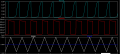
1719582561288.png

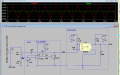
1719582911402.png
 

Attachments

crutschow

Joined Mar 14, 2008
38,316
I am trying to understand the Feedback loop using voltage control Mode using TL431 with optocoupler.
Normally Vfb is the DC output of the regulator and the feedback is a DC signal to the regulator control input.
Why are you showing it as a sawtooth?

The duty-cycle modulation is done internally by the regulator based upon it's control input voltage.
 

ronsimpson

Joined Oct 7, 2019
4,645
R7 has no function. It connects GND to GND

The "TL431" is not how it works. C1R6 is not feeding back from output to input. They are really from output to GND.
The TL431 is comparing V3/2 to 2.5V. With less C1 it will give a square wave out.
 

ronsimpson

Joined Oct 7, 2019
4,645
Removed R7.
Made R5=1 to remove it.
Changed the location of C1 . Made C1 larger to slow down the amplifier. R1/R2 made 10x larger. Time constant of C1 &(R1//R2) sets the speed of the amplifier.

Do not understand what you want. If Vout effected the voltage of V3 you will have feedback.
1719585123967.png
 

crutschow

Joined Mar 14, 2008
38,316
R7 has no function. It connects GND to GND
R7 is show ground isolation from one side of U2 to the other.
It's a dummy resistor, since LTspice won't simulation with a totally floating ground.

As I stated, V3 is normally the DC output voltage from the regulator, not a sawtooth.
 

Thread Starter

mishra87

Joined Jan 17, 2016
1,063
R7 is show ground isolation from one side of U2 to the other.
It's a dummy resistor, since LTspice won't simulation with a totally floating ground.

As I stated, V3 is normally the DC output voltage from the regulator, not a sawtooth.
Yes, V3 should be DC....but I wanted to show the output variation between those ranges.
Still my question is unanswered
How TL431 with optocoupler modulate The duty.
 
Last edited:

Thread Starter

mishra87

Joined Jan 17, 2016
1,063
Did you not understand what I said?
It doesn't directly modulate the duty-cycle of the regulator, only gives it a DC error signal.
The sawtooth you show is internal to the regulator.
Hi...I understood what you said. The signal should be DC.

Can you little bit explain how comparator+npn inside the TL431 gives error signal. This is not clear to me.

Thanks
 

ronsimpson

Joined Oct 7, 2019
4,645
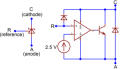
wikipedia
The TL431 is shown having a transistor output because it pulls down and does not have the ability to pull up.
1719608885337.png
Here is the schematic.
1719608949489.png
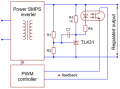
This is how it is used in a power supply. R1, R2 divides the output voltage down to 2.5V. (just like what you did)
C1 slows down the amplifier. (not like what you did)
When the output voltage is too little, the TL431 opens up, reducing the current in the opt0-isolator. The opens up the isolator's transistor. When the output voltage is too high the TL431 pulls more current. Lighting the LED and causing the isolator's transistor to pull more current. When the output voltage is just right the TL431's output will not change.
None of this directly makes a PWM signa. It only watches the output voltage.
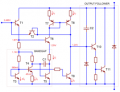
1719609010604.png
In the diagram the PWM makes a PWM signal. The amount of current from the isolator's transistor tells the PWM to increase or decrease the duty cycle. In the PWM block there is a ramp generator/oscillator that you do not have.

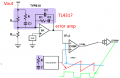
The error amp, which might be a TL431, is shown here.
At the bottom is a ramp generator that makes the red waveform.
The COMP turns on the output when red is below blue and off when red is above blue.
The RC sets the frequency of oscillation.
1719610178227.png
 
Top