How heavy would you guesstimate that contactor to be? Just thinking about how much weight it might add and whether it'd be overkill or not for my use case. I'm hoping to keep this thing hand-portable by one person, with a second needed only for the dragging of it up the steps into the cab. Thinking of putting some shallow Unistrut 'skis' along the bottom of it to help it slide easily along steel surfaces for that reason.
...Failing that, I can just do the intelligent thing and use long jumper cables I suppose.
We once blew both of the ships generators out heading to Hawaii from San Diego (that ship was in horrible shape at the start of a 6 month deployment). The ships engineers used all of the starting air for the emergency diesels when we went cold iron blackout for steam condenser repairs. One of the big CH-53 helicopters we had transported a huge pressurized air bladder from another ship to start the diesels for power to behind the total restart process of the SSTG that was fixed.
Any pointers as to where to start designing a polarity detector circuit with an output which can be used to interlock the signal controlling the power contactor?
Any pointers as to where to start designing a polarity detector circuit with an output which can be used to interlock the signal controlling the power contactor?
The most likely polarity error is IMO the jumper ends being swapped on the device being jumped or less likely, at the energy source connection. If there is residual voltage (not completely dead) on the remote device connection terminals, that can be used to interlock the charging contactor with something as simple as a diode and low voltage DC relay with a voltage limiting device like a zener and series resistor. The energy source side can have a similar interlock or it can be just an indicator LED being GREEN for the correct polarity connection.
The most likely polarity error is IMO the jumper ends being swapped on the device being jumped or less likely, at the energy source connection. If there is residual voltage (not completely dead) on the remote device connection terminals, that can be used to interlock the charging contactor with something as simple as a diode and low voltage DC relay with a voltage limiting device like a zener and series resistor. The energy source side can have a similar interlock or it can be just an indicator LED being GREEN for the correct polarity connection.
Interlocking is important here because the knife switches on older locomotives are not marked for polarity. Very easy to get it backwards if you're not paying attention.
Interlocking is important here because the knife switches on older locomotives are not marked for polarity. Very easy to get it backwards if you're not paying attention.
Right now we just test the polarity with a voltmeter before applying jumper leads. That works, but does not eliminate the opportunity for human error.
The challenge I am facing here is that I am trying to test the polarity of an unknown, variable voltage between 0 and 74 volts DC. It's difficult for me to come up with a solution which would work for that.
I have seen some diagrams depicting the use of a FET, a zener diode and a pull-up/down resistor that should work on variable voltage, but the challenge then becomes turning that variable voltage "go/no-go" signal into a useful output, either in the form of a regulated logic-level output or a dry contact. (A relay coil is wound for a definite voltage, and so probably won't play nice here.)
Another consideration is the voltage drop during cranking. The logic output of this circuit needs to be maintained even if the battery voltage tanks to some absurdly low level, like 6 volts.
Right now we just test the polarity with a voltmeter before applying jumper leads. That works, but does not eliminate the opportunity for human error.
The challenge I am facing here is that I am trying to test the polarity of an unknown, variable voltage between 0 and 74 volts DC. It's difficult for me to come up with a solution which would work for that.
I have seen some diagrams depicting the use of a FET, a zener diode and a pull-up/down resistor that should work on variable voltage, but the challenge then becomes turning that variable voltage "go/no-go" signal into a useful output, either in the form of a regulated logic-level output or a dry contact. (A relay coil is wound for a definite voltage, and so probably won't play nice here.)
Another consideration is the voltage drop during cranking. The logic output of this circuit needs to be maintained even if the battery voltage tanks to some absurdly low level, like 6 volts.
Using passive devices example: Just a starting point for possible solutions.
Use a small 3v signal relay as the interlock dry contact with a 3v zener voltage limiter for the relay coil (a energy storage/filter capacitor across the coil to handle power glitches), with a bipolar jumper input voltage limiter stage to clip the 74v max input to something lower to feed the relay limiter. With a diode polarity detector in series with the relay drive limiter, that should give about 5v as the low voltage detection limit.
I guess what I really need is just a diode, a linear voltage regulator to clamp the voltage and either a relay or transistor to act as a switch.
Finding a linear regulator that is good for 80+ volts across it's input is fun though. Many of them have a minimum input voltage in excess of 13 volts. I may have to add a small capacitance across the relay to ride out the brief dip in voltage that will occur during the time between the closing of the locomotive's start contactor and the power relay inside this boost pack pulling in to supply boost power.
(Thinking of extreme cases where the batteries are totally worthless for starting and their voltage tanks hard. I've had a few instances where the crankshaft doesn't even budge and the voltage drops low enough that the points on the start contactor begin to arc and burn from chatter.)
Unrelated:
Here's a cool video showing the difference in performance between lead-acid diesel starting batteries and a supercap bank cranking a commercial truck engine.
I guess I'll see what my total weight looks like between the capacitors, enclosure and wiring and see how much allowance I have left to work with, lol. That, and see how well the forklift relay I have on order works.
I'd love to use that big chunky Vapor contactor, but I need to be able to lift the finished unit!
...At the same time, it's also hard not to want a spare start relay on hand for these old locomotives "just in case" when the price is right like this. The oldest one I work on is a prewar EMC SW-1 that is older than Jesus. (Back when the 567 was bleeding edge technology and dinosaurs like the Winton 201A still roamed the rails!) Who knows when a spare part like that might come in handy?
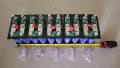
Well I got the capacitors today. Everything I need for the bank itself appears to be present, but the seller decided to ship them immersed in styrofoam packing peanuts so I need to bench test each and every one of the balance boards to make sure they haven't been killed by ESD during transit.
the seller decided to ship them immersed in styrofoam packing peanuts so I need to bench test each and every one of the balance boards to make sure they haven't been killed by ESD
If the boards came in Velostat (metalized bags) they should be OK, provided you opened them in a static safe environment. If they came in Pink Polly bags - while PP doesn't generate static it doesn't protect against it either.
Oh, and building on a rug is never a good ESD practice.
If the boards came in Velostat (metalized bags) they should be OK, provided you opened them in a static safe environment. If they came in Pink Polly bags - while PP doesn't generate static it doesn't protect against it either.
Oh, and building on a rug is never a good ESD practice.
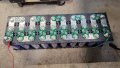
So I got all of the balance boards tested (all good) and the caps assembled into an 80 volt bank... then did some testing!
I connected my arc welder up to it, dialed the sucker up to 11 and recorded the time, current and voltage values until it reached 80 volts.
At 0 seconds, I had a resting voltage reading of 1 and an instantaneous current of 338 amps.
At 15 seconds, I had a voltage reading of 41 volts and an instantaneous current of 165 amps.
Performing a simple average (erroneous but close enough,) I calculated an average current of 251.5 amps over 15 seconds for a change of 40 volts.
(I anticipate a typical locomotive will crank normally from 80 volts down to about 40 volts, give or take. Anything below that will be a bonus.)
Dividing 15 by 3, and multiplying 251.5 by 3 to approximate the cranking current I roughly anticipate, I get 754.5 amps for 5 seconds - which jives with my earlier math! An encouraging result for my intended usage!
I've got a live test on a real locomotive tentatively scheduled for this weekend, depending on how the weather cooperates. Despite the math being supportive, I want to make sure I can in fact crank it with these capacitors before I invest in further R&D.
I'll upload a video of my arc welder test when I get a chance to sit down at my computer.
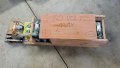
I assembled a crude test bed using whatever random bits and bobs I had handy. The goal was to create a low budget prototype that can be carried onto a locomotive, connected to it's battery knife switch using jumper cables and rapidly discharged into it's 74 volt electrical system at the push of a button. I also wanted it relatively enclosed to reduce the likelihood of an accidental short circuit during testing.
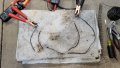
My test consisted of discharging the bank from a fully charged state through four pieces of steel baling wire twisted together as a makeshift resistor.
As can be seen in the video, my 400 amp clamp meter was immediately overloaded. A discharge current in excess of 400 amps at 80 volts is at least 30 kilowatts, or 40+ horsepower. Not a terrible start for the goal of cranking a locomotive. But from the video I can gather a few more facts and interpolate beyond the capabilities of my instrumentation.
Note during the first pulse:
1.) The voltage dropped from 79 to 75, for a total change of 4 volts.
2.) Current was applied for approximately half a second.
Doing the math on a 100 farad capacitor bank, those three figures together translate to a discharge current of 800 amps - right on target! 800 * 75 = 60 kW, or 80 horsepower! That is plenty of juice with which to crank a diesel locomotive!
The only test left to be seen now is how long the bank is able to sustain cranking current under real-world test conditions. I am willing to call 5 seconds or longer a qualified success, and 8 or more seconds a complete success.
Here's some of the aftermath from the test to highlight just how much energy was released in a mere second:
If this doesn't serve as a clear demonstration as to why the utmost care must be taken when handling, working near or storing charged supercapacitors then I don't know what is!

 Facebook
 Google
 GitHub
 Linkedin