Facebook
 Google
 GitHub
 Linkedin

I'm looking for some inspiration here:
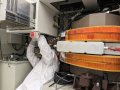
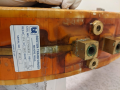
I would like to assemble some large 3 kF supercapacitors in series (with appropriate off-the-shelf balance boards, etc.) to build an 80 volt portable jump-start pack for boosting dead locomotives. (New batteries are $20,000, whereas a few dozen supercaps can be had second-hand for 1/20th that price.)
At 800 cranking amps my napkin math suggests I'll likely get around 5-8 seconds of cranking out of an 80 volt, 100 farad capacitor bank, depending on how much current the batteries contribute in parallel while cranking. This time frame - while brief - is generally sufficient to start a locomotive when the fuel injector racks are manually held in the wide-open position during cranking.
The problem I am faced with is that I do not want the capacitors to discharge before the engine start contactor closes. Given I only have 100 farads to work with, the fuel pump, other ancillary equipment and even the weak batteries themselves will quickly drain down the charge on the capacitors before it can serve it's intended purpose if it is delivered before the precise moment it is needed.
The idea I have is to employ a falling-edge trigger on the boost pack's output terminals to fire an internal starter relay. I would tune the trigger to activate in a latching mode when the battery voltage on the load side of the relay is drawn down below, say... 40-50 volts or so during starting?
Can anyone suggest a circuit architecture that might work for this purpose? I am a licensed electrician but I haven't dealt with board-level electronics much since tech school years ago. I could use some pointers as to where to begin.
Obviously level-shifting is going to be an issue considering locomotive electrical systems run at 74 volts DC. (The nominal float voltage for a 32 cell battery.) I think a voltage divider should suffice for voltage sensing purposes.
Input & ideas?
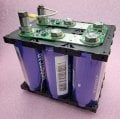
I would like to assemble some large 3 kF supercapacitors in series (with appropriate off-the-shelf balance boards, etc.) to build an 80 volt portable jump-start pack for boosting dead locomotives. (New batteries are $20,000, whereas a few dozen supercaps can be had second-hand for 1/20th that price.)
At 800 cranking amps my napkin math suggests I'll likely get around 5-8 seconds of cranking out of an 80 volt, 100 farad capacitor bank, depending on how much current the batteries contribute in parallel while cranking. This time frame - while brief - is generally sufficient to start a locomotive when the fuel injector racks are manually held in the wide-open position during cranking.
The problem I am faced with is that I do not want the capacitors to discharge before the engine start contactor closes. Given I only have 100 farads to work with, the fuel pump, other ancillary equipment and even the weak batteries themselves will quickly drain down the charge on the capacitors before it can serve it's intended purpose if it is delivered before the precise moment it is needed.
The idea I have is to employ a falling-edge trigger on the boost pack's output terminals to fire an internal starter relay. I would tune the trigger to activate in a latching mode when the battery voltage on the load side of the relay is drawn down below, say... 40-50 volts or so during starting?
Can anyone suggest a circuit architecture that might work for this purpose? I am a licensed electrician but I haven't dealt with board-level electronics much since tech school years ago. I could use some pointers as to where to begin.
Obviously level-shifting is going to be an issue considering locomotive electrical systems run at 74 volts DC. (The nominal float voltage for a 32 cell battery.) I think a voltage divider should suffice for voltage sensing purposes.
Input & ideas?
Last edited: