extremely strange circuit behavior - looking for an advice

Thread Starter

thor21

Joined Sep 29, 2024
435
I can confirm that solution works perfectly as expected,,, without any need to pulse detection.

I just take - pole from led strip (which is switching by pwm switch module)
on the relay board i changed jumper from H to Low. and i control the relay module with the - pole from the led strip.

Ie once the strip is on and led is producing light - relay module is "on",
once the strip goes off ... relay module got disconnected ie "off"

therefore i can control other devices via relay module based on the state of the led strip ... what was expected.


thanks
 

Thread Starter

thor21

Joined Sep 29, 2024
435
@BobTPH i just dimmed it and its not working,
any view why? so its only working while its not dimmed?
:(

when i measure V on + (intput to the relay) and - GND on signal part of the relay board... while stripe is off ... 0.3V ;
once stripe is on dimmed 8V


When pwm switch is solely on ... the Voltage between + from psu a - from stripe oscilating between 12-0V
once i dim it ... it stops to oscilate or oscilates in long intervals and is almost constantly 8V


edit:
so there is no additional circuit that can make from oscillating 0-8V -> to lets say 0V?

thanks!
 
Last edited:

BobTPH

Joined Jun 5, 2013
11,533
Of course I know why, that is why I suggested you check it.

Basically, the dimmer is “dimming” the relay as well as the lights. It will work at high duty cycles but not at low ones. Somewhere in between you can probably get it to “chatter.”

I would suggest you read up on PWM. I don’t think you understand it very well.

What is controlling the dimming? is it a pot on the controller board, is an input signal to it?
 

Thread Starter

thor21

Joined Sep 29, 2024
435
@BobTPH
yeah... i see you were far more steps ahead of me. :)

What is controlling the dimming? is it a pot on the controller board, is an input signal to it?
what do you mean by that?
what is pot on the controller board?
There is a spring on board and if u touch it and hold it control the dimming. Is that what are you asking?

thanks
 

wraujr

Joined Jun 28, 2022
260
Going back to your question in post #1.
You are switching on/off the negative terminal (typically you switch the positive terminal).
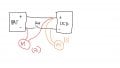
I have added your two meter connections, denoted (1) and (2), should match your numbering.
In (1) with switch open, there is no current flowing thru the LED module, so meter reads 0V.
In (2) you have moved the - lead on the meter to the negative terminal of battery and now you are simply measuring across battery terminals (red).
A picture/schematic (even crudely drawn) is helpful.measure.jpg lways better,
 
Last edited:

BobTPH

Joined Jun 5, 2013
11,533
Is that required or import for something? Thanks!
If it was some other signal, there might have been a simpler solution. But it is not, so you only have the PWM output to use.

Your relay module could be made to work with the addition of a diode, capacitor and resistor. Are you interested? Could you assemble it? Do you have soldering skills? Electronic, not plumbing.
 

boostbuck

Joined Oct 5, 2017
1,045
Your relay module could be made to work with the addition of a diode, capacitor and resistor.
A PWM averaging circuit? It will only work at intermediate or higher brightness levels, surely? Maybe that is a constraint that is acceptable to the TS - for them to say what is light 'on' or 'off'.

But if they are going down the track of electronic soldering assembly, might as well pull up a 555 and do the job properly.
 

Thread Starter

thor21

Joined Sep 29, 2024
435
Your relay module could be made to work with the addition of a diode, capacitor and resistor. Are you interested? Could you assemble it? Do you have soldering skills? Electronic, not plumbing
Hello,
Yes. Can assemble, have the skills. Thanks!
 

BobTPH

Joined Jun 5, 2013
11,533
I started looking at this, but I need to know the details of the relay board before I can design anything. Particularly, what are the threshold voltages for the input, both high and low, and the PWM frequency and range of duty cycles.
 

Thread Starter

thor21

Joined Sep 29, 2024
435
Got it, will try to find out. Maybe won't be able to get the details. Will let you know during the week, appreciate your help
 

Thread Starter

thor21

Joined Sep 29, 2024
435
@BobTPH
hello there, so i got the following info

PWM module:
frequency: 24 Khz
range: 1.5% ~ 99.6%

relay module:

A jumper (switch) installed on the board changes the logic of the control input IN.

  • If set to H (high), the relay can be activated by applying a positive voltage to the IN terminal, with a minimum of 3V. However, depending on the specific optocoupler and the board's configuration, the control voltage might be lower—it is hard to say exactly.
  • If set to L (low), the input is controlled by ground. An internal pull-up resistor is connected to the input terminal. If you connect a voltmeter, you will find a measurable voltage between the IN terminal and the DC- terminal. A relay set in this way can be activated by connecting the IN terminal to DC- (GND).
In any case, if you need to know the maximum and minimum control voltage of the IN terminal, the data from the optocoupler itself will be more useful:
https://www.alldatasheet.com/html-pdf/473348/TENAND/LTV-354T/1109/5/LTV-354T.html,
which is directly connected to the IN terminal and the switch for Low-High.


Do we need more inputs? thanks!
 
Last edited:
Top