Facebook
 Google
 GitHub
 Linkedin
If you bias the opamps at 1/2 vcc, then the AC signal will be centered at 1.5v for VCC=3V (just like you did for the buffer to your ADC) and you won't need dual supplies. If centered at 1.5v, the signal can still swing negative up to 1.5v (for 3v supply). Whether or not this will work for your design depends on the required voltage swing. But RR opamps that can swing close to VCC/gnd (for single supply opamp) would be best. Since I converted the ripple value to a DC value (using and RMS-to-DC converter), I didn't have to do this.Hello EE,
Thank you for the above message. First of all could I ask, why do you suggest single supply devices rather than rail to rail dual supply devices? Could you describe the benefits when working with AC signals that can swing positive and negative? How do you ensure that the negative part of an AC signal is preserved?
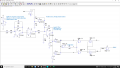
BUF_Out on my diagram is the output of an RMS-to-DC converter chip (AD536), a chip that's been around for a long time. It's input is AC coupled thru a cap to the output of the SMPS. Its job is to read the AC ripple signal and convert it to an RMS DC voltage equivalent value. I've attached a datasheet if you want more info.I assume BUF_OUT is where the voltage ripple is after extraction and amplification. My question then is why are the limits 300mV and 150mV - these seem quite low. I think maybe I am missing part of the schematic which would explain what is happening. Would you mind sending the .asc file so that I can simulate it on my SMPS?
The ripple limits are arbitrary, you'll need to determine those yourself.
Sounds like your using the LTspice native digital "A" devices, which is ok, but you have to use them correctly or they will fool you. They are not models of any particular vendors components. You have to take the time to set all the necessary parameters. The components I use are from digital libraries modeled after specific family of devices.I actually managed to get something similar working today on my computer. Instead of a JK Flip flop (I couldn’t find one on my LTSpice - you must be using a custom model?) I used an SR flip flop with an ENABLE input. The S and R inputs are from the comparators which tell me whether the minimum ripple or the maximum ripple has been exceeded. Buy only allowing the state of the SR flip to enable a change of state when the window comparator gives an output of 0, the output of the flip flop latches ON until the max voltage ripple is exceeded and latches OFF until the minimum is exceeded. You are right in that I need to use hysteresis for my comparators. When I am back at my labs tomorrow I will attach the .asc file that I created today to compare the solutions.
Thanks again for your help, it is appreciated.
SiC
Somewhere on this site there is a link to "Bordodynov" spice library that is pretty extensive. You might want to download it.
Attachments
-
337.7 KB Views: 2