Explanation needed for schematics

Thread Starter

Dario Antunović

Joined Jun 27, 2018
3
Hello, I'm new to this forum, so I don't know if this is the right section to ask such a question but lets give it a try.
I'm kinda new in this field, so I was wondering how these capacitors C24-C31 are affecting this circuit and how to calculate their capacity ?
Thanks in advance.
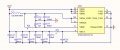


upload_2018-6-27_21-36-39.png
 

WBahn

Joined Mar 31, 2012
32,725
Since this is homework help, you need to make your best attempt, even if it's only a rough guess.

What do you know about power supply bypassing?

As for why there are so many, consider that you have multiple Vdd/Vss pins.

As for the values, first look at the data sheet for the IC and see what they recommend.
 

MrChips

Joined Oct 2, 2009
34,641
What you are looking at was probably snipped from a larger circuit schematic.

What the designer is showing are seven 100nF capacitors, C25 to C32 that are mounted at various locations across VDD and GND, at various locations on the PCB. The schematic is drawn this way to satisfy the PCB layout software which will ensure that all components required for the design are properly accounted for.

The seven 100nF capacitors in parallel do not add up to 700nF.
 

Thread Starter

Dario Antunović

Joined Jun 27, 2018
3
Thank You both for your answers. So if I understand it correctly, the capacitors are needed for maintaing the correct voltage when voltage drops happen due to internal switching (the capacitors with bigger capacity) and can be placed a bit more far from the power pin. The smaller ones are there for short circuiting the hf oscillations to the ground so they don't make problems in internal circuit logic level and need to be placed as near as possible to the power pins due to inductivity of traces. The capacitors C25 to C32 are there for a power pin each and are not arranged as on this schematics but it can be shown as this because they are all connected between Vdd and GND, and the C24 is there for all the power pins ?
 

MrChips

Joined Oct 2, 2009
34,641
Thank You both for your answers. So if I understand it correctly, the capacitors are needed for maintaing the correct voltage when voltage drops happen due to internal switching (the capacitors with bigger capacity) and can be placed a bit more far from the power pin. The smaller ones are there for short circuiting the hf oscillations to the ground so they don't make problems in internal circuit logic level and need to be placed as near as possible to the power pins due to inductivity of traces. The capacitors C25 to C32 are there for a power pin each and are not arranged as on this schematics but it can be shown as this because they are all connected between Vdd and GND, and the C24 is there for all the power pins ?
You got it right, almost.

Allow me to expand a bit further.

C25 - C32 (minus C26) are high-frequency power supply decoupling capacitors. Every time a digital gate switches state, it takes power from the supply rails for a very short period, of the order of nano-seconds. This causes the VDD rail to spike lower during that time. At the same time, the GND rail will spike upwards. This is called GROUND BOUNCE. The high-frequency decoupling capacitors are there to mitigate these high-frequency glitches. To be effective, they have to be located between the VDD and GND pins of every chip, as close as possible to the pins with little intervening tracks. (Yes, you got this right).

In critical analog circuitry, you may find multiple decoupling capacitors installed instead of a single capacitor, with different values such as 1nf, 10nf, 100nf, 1000nf. This is because each capacitor is most effective at a different frequency. Thus multiple capacitors can reduce the power supply noise over a wider frequency range.

R34 and C24 are there for a slightly different reason. Note that R34 is stated as 0Ω. What gives?
R34 and C24 constitute a low pass filter LPF, i.e. to reduce high frequency noise, going into the VBAT pin. The designer included R34 so that the PCB installer may choose a different LPF time-constant if required. Hence the time-constant of R34/C24 is much longer than nano-seconds. This LPF is typical when one wants to reduce low frequency fluctuations. This would be desirable if a battery was used to supply VBAT. The designer choose R34 = 0Ω in this application since no battery is being used.

L1 and R31 are there for the similar reasons.
 
Top