You (in almost all tuations) do not want to derive a power supply using a resistive voltage divider. In order to get good regulation, the current through the resistors needs to be 10x to 20x the max current drawn from the supply, which is generally death to a battery operated system.
You (in almost all tuations) do not want to derive a power supply using a resistive voltage divider. In order to get good regulation, the current through the resistors needs to be 10x to 20x the max current drawn from the supply, which is generally death to a battery operated system.
Yeah, and for a lot of things that will work. As long as your 3.3V devices don't draw more than a couple dozen milliamps and as long as they draw enough minimum current to keep you up on the knee a bit, which they probably do. I imagine that even at very low quiescent current draw when, in theory, you have significantly higher voltage than 3.3V being applied that few devices would be damaged since most damage paths require at least some current flow and that would quickly bring you up the knee. You could definitely damage unprotected low voltage CMOS gates with a static 5V, but I doubt any commercial IC would let you get into that situation.
You (in almost all tuations) do not want to derive a power supply using a resistive voltage divider. In order to get good regulation, the current through the resistors needs to be 10x to 20x the max current drawn from the supply, which is generally death to a battery operated system.
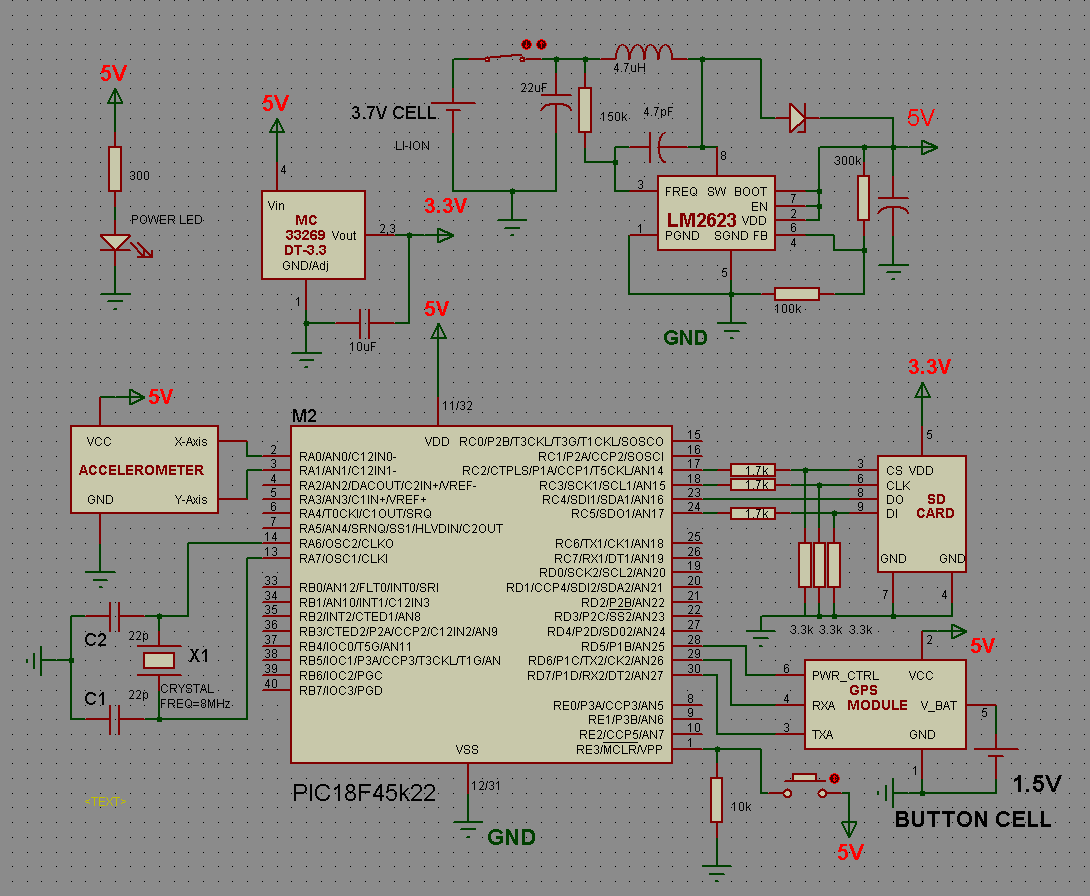
I have updated the schematic and think this will be my final design. (Hope is probably more accurate)
A 3.7V 18350 or 18650 provides the power to the lm2623 switching boost regulator to provide 5V for the micro the gps and the accelerometer.
A low drop out regulator takes this 5V and drops it to 3.3V for the SD card.
The sd card has a voltage divider on it to interface it with 3.3V from the 5V output of the micro.
The gps module and accelerometer are use for tracking acceleration and direction of travel.
I did consider a magnetometer but i felt that GPS was better, i would certainly be keen to hear peoples opinions on alternative methods of determining heading.
I am hoping to use the RTC from the GPS to timestamp the collected data and store it in the SD card.
The accelerometer has a buffered output to enable its interfacing with the ADC of the PIC.
The GPS module uses UART to interface the PIC while the SD card operates in SPI mode.
I will do some sums to determine the battery life from a decent cell, but i need to ensure more than ten hours operation with a recording frequency of 10s.
I guess i could get better power efficiency with a magnetometer over the gps as i wouldn't need to keep the module active constantly to maintain a frequency of 0.1Hz for heading acquisition.

 Facebook
 Google
 GitHub
 Linkedin