Erratic Current Source

Thread Starter

jbord39

Joined Mar 31, 2010
41
Hey guys,

I am working on a variable 0-2A current source. The current source needs to be free from any spikes (because I have burned out too many laser diodes already). Here is the schematic I am using. The 1080KOhm resistor is actually a 80Kohm with a 1Meg potentiometer. When I power on the circuit the potentiometer is turned all the way up, so that the voltage at the noninverting input is very low. When the potentiometer is all the way down, it applies 1V at the noninverting input.

The bias voltages and currents on this schematic isn't updated with the present resistor values. (They are for when 1080kohm is changed to 80kohm)
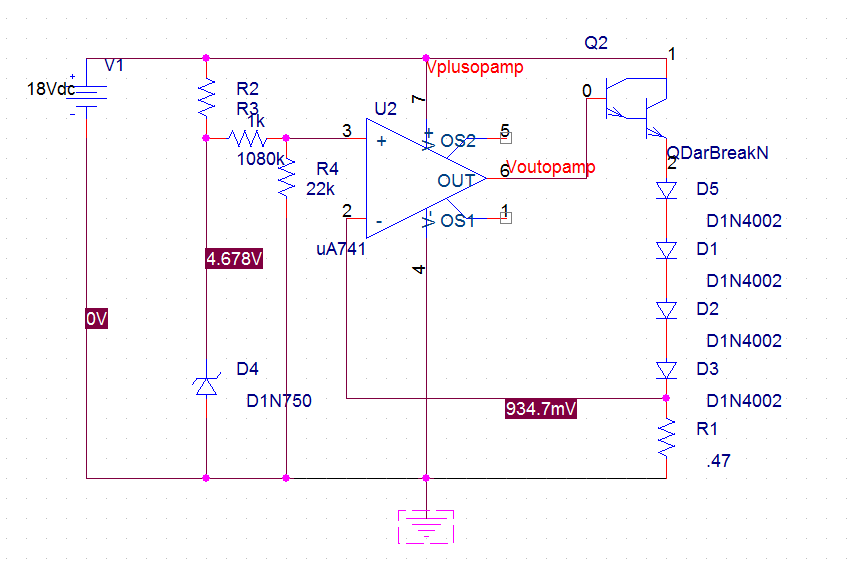

Here is what I have measured so far:
The voltage at the zener diode is 4.8V. As I turn the potentiometer the voltage at the noninverting input DOES change just as it should.

However, the biggest problem is that while I (very briefly) plug the circuit in to test the current, it is reading 9.3 AMPS. The potentiometer doesn't seem to be doing anything either, as I read 9.3 amps with the pot all the way up and down. It is definitely changing the voltage at the noninverting input, though.

The darlington I am using is the TIP-120.

I have also measured the resistance from the inverting input of the opamp to ground, and it is between .4 and .5 ohms.

I am very confused because I thought the feedback would cause the particular transistor and op-amp parameters to be less important, but something is clearly wrong.


Sorry for the long post, I am hoping to give as much info as possible.

Thanks so much,

John
 
Last edited:

wayneh

Joined Sep 9, 2010
18,104
... the resistance from the noninverting input of the opamp to ground, and it is between .4 and .5 ohms.
I'm pretty sure that means it's toast. The op-amp input impedance should be very high, too high to measure, not a short to ground.
 

beenthere

Joined Apr 20, 2004
15,819
You have a 741 op amp feeding the base of a Darlington with no limiting resistor. That may have destroyed one or both devices.
 

kubeek

Joined Sep 20, 2005
5,796
Like I said in the previsous thread, 741 is archaic opamp and you shouldn´t use it. With that low voltage on the inputs you are risking locking the opamp´s output to one of the rails, possibly making the tranistor fully on without any control.

Use some modern opamp with rail-to-rail outputs and inputs. And the base resistor wouldn´t hurt too.
 

Thread Starter

jbord39

Joined Mar 31, 2010
41
I'm pretty sure that means it's toast. The op-amp input impedance should be very high, too high to measure, not a short to ground.
But there is a .47 ohm resistor to ground. In parallel with the internal resistance the lower dominates.
 

Thread Starter

jbord39

Joined Mar 31, 2010
41
Like I said in the previsous thread, 741 is archaic opamp and you shouldn´t use it. With that low voltage on the inputs you are risking locking the opamp´s output to one of the rails, possibly making the tranistor fully on without any control.

Use some modern opamp with rail-to-rail outputs and inputs. And the base resistor wouldn´t hurt too.
Thanks for the info. I have a lot of the more common op-amps; are there a few you could recommend?

Do you think that this is most likely the problem? What resistor on the base would you recommend, like 10kOhm?

Thanks a bunch,

John
 

kubeek

Joined Sep 20, 2005
5,796
Well, the inverting should be 0.47ohm, not the noninverting. And you didn´t answer the question about measuring a powered circuit.

You can also use a larger sense resistor and load resistance and make the circuit work with smaller currents first.
 

kubeek

Joined Sep 20, 2005
5,796
Maybe more like 2k2. You need to see what your suppliers have, searching for rail generally works, I have here only one for a reasonable price and it is only for up to 12V supply.
 

Thread Starter

jbord39

Joined Mar 31, 2010
41
Well, the inverting should be 0.47ohm, not the noninverting. And you didn´t answer the question about measuring a powered circuit.

You can also use a larger sense resistor and load resistance and make the circuit work with smaller currents first.
You're right, I meant inverting. Sorry that was probably confusing.

And no I didn't measure the resistance with a powered circuit.

BTW I have ran many PSpice simulations for the circuit diagram shown and cannot figure out why it works on PSpice but not even close to those results in actuality.

Thanks again,

John
 

Audioguru

Joined Dec 20, 2007
11,248
An old 741 opamp has inputs that do not work when they are within 4V to 5V from its negative supply which is ground in your circuit. Both inputs are less than 1V in your circuit so a different opamp must be used.
Use an old LM358 dual opamp instead. Its inputs work perfectly all the way down to ground.
 

kubeek

Joined Sep 20, 2005
5,796
I am not using a PSpice simulator, but probably it doesn´t account for a lot of real-word behavior of the opamp. You could try using a pot on both inputs and see if the output does what it should when the inputs are close to ground.
 

Audioguru

Joined Dec 20, 2007
11,248
PSpice doesn't know that an old 741 opamp inputs do not work when near the negative supply voltage which is 0V in that circuit. PSpice assumes that there is a positive supply and negative supply.
 

Thread Starter

jbord39

Joined Mar 31, 2010
41
Hey guys I just tried making the modifications you suggested.

I added a 2.2kOhm resistor into the base of the darlington. I also switched to the HA17458 op-amp. It is still giving me the same 9.65 AMPS, and the potentiometer doesn't seem to be doing anything. If my darlington burned out, would this be something to expect, or is it most likely some other problem?

Thanks again for the help,

John
 

SgtWookie

Joined Jul 17, 2007
22,230
AG, that's not quite the case - however, the PSpice model does perform better than the datasheets' specification.

With a +/-15v supply, National's datasheet says +/-12v minimum, +/-13v typical for common mode, but the PSpice model goes to +/-14v - so it's misleading.
 

SgtWookie

Joined Jul 17, 2007
22,230
jbord39,
Your Darlington appears to be shorted.
Try disconnecting the base from the opamp, and connecting it to the emitter.
You should then measure no current from the emitter.
 

Thread Starter

jbord39

Joined Mar 31, 2010
41
jbord39,
Your Darlington appears to be shorted.
Try disconnecting the base from the opamp, and connecting it to the emitter.
You should then measure no current from the emitter.
By shorted do you mean broken, or that it is shorted from wiring?

If I measure current does it mean that it is broken?

Thanks,

John
 
Last edited:

SgtWookie

Joined Jul 17, 2007
22,230
By shorted do you mean broken, or that it is shorted from wiring?
It is shorted internally due to too much current.
Search for a datasheet for the TIP120. Look at the specifications. You will find that 5A is the maximum collector current, and you're reading almost double that much. If the maximum ratings of a component are exceeded, they will at minimum be damaged, and at worst destroyed. I'm betting on the latter in your case.

If I measure current does it mean that it is broken?
If the base is connected to the emitter, the transistor should be in cutoff (no current flow from the collector to the emitter). If you measure any current (beyond ~250uA, or 0.25mA), it's fried.

You're asking for the transistor to dissipate a lot of power. You can use a current limiting power resistor between the collector and +V to take some load off the transistor.
 

Thread Starter

jbord39

Joined Mar 31, 2010
41
It is shorted internally due to too much current.
Search for a datasheet for the TIP120. Look at the specifications. You will find that 5A is the maximum collector current, and you're reading almost double that much. If the maximum ratings of a component are exceeded, they will at minimum be damaged, and at worst destroyed. I'm betting on the latter in your case.


If the base is connected to the emitter, the transistor should be in cutoff (no current flow from the collector to the emitter). If you measure any current (beyond ~250uA, or 0.25mA), it's fried.

You're asking for the transistor to dissipate a lot of power. You can use a current limiting power resistor between the collector and +V to take some load off the transistor.
Guys thanks a lot for the help.

I just replaced the TIP-120 and changed to TL082 op-amp (which says on it's datasheet to be single supply). I have not added any resistor between V+ and the collector yet, but Vce on the TIP-120 is rated much higher than 20V and up to 65W.

I am STILL getting the exact same 9.65 A. I am very confused!!

Any help is appreciated,

John
 

SgtWookie

Joined Jul 17, 2007
22,230
Although the TL082 is much better than a 741, it cannot "see" within about 3v of the negative rail. You should download the datasheets for the components, and try to learn how to read them.

If you're shopping at Radio Shack, pick up an LM324 quad opamp; it's the only one they stock that has an I/O range that includes the negative rail (in your case, ground).

You will have 3 unused opamp channels.
For each unused channel, connect the inverting input to its' respective output, and ground the non-inverting inputs.
Be certain to use a 0.1uF cap across the power pins.
 
Top