Equivalent Resistance Help

WBahn

Joined Mar 31, 2012
32,833
Aarghh!!! You're right, of course.
My error was in misconstruing the circuit to be something other than a Wheatstone bridge. Thanks for the reality check.
Glad you saw the light!

We all get blinders on from time to time and tend to see what we expect to see and not what is really there.

I'm frequently telling students (and sometimes myself) to read what you wrote, not what you think you wrote. But it's hard to leave our preconceptions at the door and pretend we are looking at something written by someone else for the first time, but that's the best way to approach situations like this.
 

dannyf

Joined Sep 13, 2015
2,197
I am looking for the process to continue getting this circuit down to a single equivalent resistor.
It is a bridge configuration. So the typical delta-y transformation would work if you want to a quick answer.

equivalently, thevenin equivalency will work as well: imagine the circuit being powered by two identical 12v sources, one for the left arm and one for the right arm. The connections between the two sites, top of r1/r4 and bottom of r2/r5, have no current flowing through them as they are at equal potential. You can convert the left 12v source + r1 (serial) into a current source (=12v/R1) + R1 (parallel). The R1(parallel) is in parallel with R2 so you can convert that back into a voltage source......

in the end you will get to the same place.
 

WBahn

Joined Mar 31, 2012
32,833
It is a bridge configuration. So the typical delta-y transformation would work if you want to a quick answer.

equivalently, thevenin equivalency will work as well: imagine the circuit being powered by two identical 12v sources, one for the left arm and one for the right arm. The connections between the two sites, top of r1/r4 and bottom of r2/r5, have no current flowing through them as they are at equal potential. You can convert the left 12v source + r1 (serial) into a current source (=12v/R1) + R1 (parallel). The R1(parallel) is in parallel with R2 so you can convert that back into a voltage source......

in the end you will get to the same place.
No, you can't. Please review what I have already explained about trying to do so. You are making the mistake of assuming that a Thevenin equivalent is equivalent to the portion of the circuit it replaces in all respects -- it ISN'T!!!!
 

WBahn

Joined Mar 31, 2012
32,833
How about this solution?
Once again, the TS is not asking about the voltage across, the current through, or the resistance seen by R3 (the bridge resistor).

This is simply a problem of a bunch of resistors connected to a power supply and the TS asking how to find what the equivalent resistance of that bunch of resistors is.

Why is it so hard to see that these are VERY different and almost completely independent questions?
 
My purpose in post #32 was to show how to find Req without using any specialized network theorems--just superposition.

It has been suggested a few times to use Thevenin's theorem, without showing the details of how this would work. Links to web pages showing use of Thevenin were given, but those pages only showed how to calculate the current through R3, which is not what the problem posed in post #1 asked for. It's to be expected that bare suggestions to use Thevenin would seem to imply that it would be used to find the current through R3.

However, Thevenin CAN be used to find Req, but some more work beyond just finding the current in R3 is needed.

See: http://www.hallikainen.com/rw/theory/theory6.html

The paragraph just to the left of Figure 4 mentions using superposition which is what I did in post #32.

Continuing further, the author shows that finding the voltages at the left and right ends of the middle resistor (R5 there, R3 in post #1 of this thread) gives knowledge all the node voltages in the circuit. From this we can find the currents in R1 and R4 (of this thread), and thence Req.

So, using Thevenin we can find Req, but simply saying use Thevenin, IMHO, doesn't go far enough--more details should be shown.
 

dannyf

Joined Sep 13, 2015
2,197
Did a quick calculation. Forr Ri=i, IE. R1 is 1, R2 is 2, ...., I got current through R1 is 4.151, and current through R4 1.208. Soo equivalent resistance of 2.239ohm.

Current through the middle resistor is 0.226. Once you have that, the rest is easy.

Hope it helps. Also, it isn't difficult to get a closed form solution.
 
Did a quick calculation. Forr Ri=i, IE. R1 is 1, R2 is 2, ...., I got current through R1 is 4.151, and current through R4 1.208. Soo equivalent resistance of 2.239ohm.

Current through the middle resistor is 0.226. Once you have that, the rest is easy.

Hope it helps. Also, it isn't difficult to get a closed form solution.
The TS asked this: "I am not really looking for an answer as much as I am looking for the process to continue getting this circuit down to a single equivalent resistor."

Your hope is unrequited.

I gave a procedure to solve the problem, ending with a closed form solution in post #32.
 

WBahn

Joined Mar 31, 2012
32,833
My purpose in post #32 was to show how to find Req without using any specialized network theorems--just superposition.

It has been suggested a few times to use Thevenin's theorem, without showing the details of how this would work. Links to web pages showing use of Thevenin were given, but those pages only showed how to calculate the current through R3, which is not what the problem posed in post #1 asked for. It's to be expected that bare suggestions to use Thevenin would seem to imply that it would be used to find the current through R3.
Some are implying that. But others are claiming that if you find the Thevenin equivalent resistance and add that to the load resistance (R3) that you have then found the equivalent resistance of the entire actual network. In short, they are claiming that the overall equivalent resistance seen by the actual voltage source is identical to the effective total resistance seen by the Thevenin source. Few things could be further from the truth. You can't relate ANYTHING internal to a Thevenin equivalent circuit to ANYTHING external to it -- only the V-I characteristic at the terminals is useful.

However, Thevenin CAN be used to find Req, but some more work beyond just finding the current in R3 is needed.

See: http://www.hallikainen.com/rw/theory/theory6.html

The paragraph just to the left of Figure 4 mentions using superposition which is what I did in post #32.

Continuing further, the author shows that finding the voltages at the left and right ends of the middle resistor (R5 there, R3 in post #1 of this thread) gives knowledge all the node voltages in the circuit. From this we can find the currents in R1 and R4 (of this thread), and thence Req.

So, using Thevenin we can find Req, but simply saying use Thevenin, IMHO, doesn't go far enough--more details should be shown.
This still has the problem that I could tack on a low valued resistor directly across the supply and it would dictate the overall equivalent resistance and nothing related to the middle resistor will be affected. As I noted very early on, you can use Thevenin to tease out information about the currents in specific resistors and then use THAT information to piece together either the total current (or the total power) and then use THAT to find Req (and this is what that author does).
 

dannyf

Joined Sep 13, 2015
2,197
If you go through a series thevenin equivalency as I suggested earlier, you will come to an equivalent circuit consisting of two voltage sources, two equivalent resistors and R3, all in serial.

V1 is V x R2 / (R1 + R2),
First equivalent resistance is R1//R2,
R3 is R3.
Second equivalent resistance is R4//R5,
V2 is V x R5 /R4 + R5)

From that, it is easy to calculate the current through R3, and the voltage on the left and right terminals of R3.

Once you have that, calculating tthee current through R1 and R4 is ready.

The voltage V decided by thee sum of current through R1 and R4 gives you the equivalent resistance.

Using delta-y transformation is faster but the essence is the same: thevenin equivalency. So as long as you remember thevenin equivalency, you are golden.
 
If you go through a series thevenin equivalency as I suggested earlier, you will come to an equivalent circuit consisting of two voltage sources, two equivalent resistors and R3, all in serial.

V1 is V x R2 / (R1 + R2),
First equivalent resistance is R1//R2,
R3 is R3.
Second equivalent resistance is R4//R5,
V2 is V x R5 /R4 + R5)

From that, it is easy to calculate the current through R3, and the voltage on the left and right terminals of R3.

Once you have that, calculating tthee current through R1 and R4 is ready.

The voltage V decided by thee sum of current through R1 and R4 gives you the equivalent resistance.

Using delta-y transformation is faster but the essence is the same: thevenin equivalency. So as long as you remember thevenin equivalency, you are golden.
Now you've given enough detail that I can see the method you're describing is the one explained more fully at the link I gave earlier: http://www.hallikainen.com/rw/theory/theory6.html

I hope the TS has followed all this and now knows several ways to solve his problem.
 

dannyf

Joined Sep 13, 2015
2,197
Did a quick calculation. Forr Ri=i, IE. R1 is 1, R2 is 2, .......

Current through the middle resistor is 0.226.
since I was only 99.9999999% sure, I did a simulation in ltspice and it turned out that I was wrong. The current throught he middle resistor is not 0.226 but 0.2264.

:)

So hooray to thevenin equivalency.
 

WBahn

Joined Mar 31, 2012
32,833
If you go through a series thevenin equivalency as I suggested earlier, you will come to an equivalent circuit consisting of two voltage sources, two equivalent resistors and R3, all in serial.

V1 is V x R2 / (R1 + R2),
First equivalent resistance is R1//R2,
R3 is R3.
Second equivalent resistance is R4//R5,
V2 is V x R5 /R4 + R5)

From that, it is easy to calculate the current through R3, and the voltage on the left and right terminals of R3.

Once you have that, calculating tthee current through R1 and R4 is ready.

The voltage V decided by thee sum of current through R1 and R4 gives you the equivalent resistance.

Using delta-y transformation is faster but the essence is the same: thevenin equivalency. So as long as you remember thevenin equivalency, you are golden.
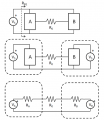
Okay, so what is the equivalent resistance, Req, seen by the voltage source, Vs, in the following circuit?

ThevBridge.png

Let's keep the math as simple as possible:

Vs = 10 V
Ro = 10 kΩ
Va = Vb = 5 V
Ra = Rb = 5 kΩ

What is Req?

Whatever answer you get, I will absolutely guarantee you that you are off by more than an order of magnitude.

.
 

EM Fields

Joined Jun 8, 2016
583
Huh?

Do you know what it means for two components to be in series?

They are in series if and only if whatever current that flows in one MUST flow in the other.


Wrong. Because only reference designators were provided it is only reasonable to assume that the values are unknown -- and that includes having no knowledge about any relationships between any of them.

Consider any of the many very common schematic diagrams that often give only reference designators, such as a voltage divider or any of the classic simple op-amp circuits. It is not reasonable to assume that the different resistors are the same in any of those situations.


But it can only work out if you actually work with the same circuit! You can't just go and take five resistors and hook them up in a completely different way and expect the result for your different circuit to be a valid solution to the original circuit.

Here is the original circuit with the nodes highlighted:
View attachment 107664
In order for R1 and R2 to be in series, then it MUST be true that whatever current is flowing in R1 would HAVE to then flow in R2. Look at the diagram! The current flowing in R1 is SPLIT between R2 and R3.

Look at that blue node. It connects R1, R2, and R3. Now look at YOUR diagram. You have a node that connects JUST R1 and R2. Where is the connection to R3?
Indeed. I misread the original post and failed to realize that the topology shown in the schematic is that of a Wheatstone bridge. Mea culpa.

However, I'll still stick to my guns about all of the resistors being equal valued since there's no hard evidence proving otherwise.

In that case, R1 and R2 will be in series, as will R4 and R5, since regardless of the value of R3 there'll be no current through R3 and the series string R1R2 will be in parallel with the series string R4R5, yielding a total resistance of R across the power supply.
 

WBahn

Joined Mar 31, 2012
32,833
Indeed. I misread the original post and failed to realize that the topology shown in the schematic is that of a Wheatstone bridge. Mea culpa.

However, I'll still stick to my guns about all of the resistors being equal valued since there's no hard evidence proving otherwise.

In that case, R1 and R2 will be in series, as will R4 and R5, since regardless of the value of R3 there'll be no current through R3 and the series string R1R2 will be in parallel with the series string R4R5, yielding a total resistance of R across the power supply.
So, if given a circuit with two resistors in series, R1 and R2, you would be comfortable assuming that the total resistance is 2*R1?

So, if given the classic inverting amplifier op-amp circuit with feedback resistor Rf and input resistor Ri, you would be comfortable assuming that the gain of the amplifier is -1?
 

EM Fields

Joined Jun 8, 2016
583
So, if given a circuit with two resistors in series, R1 and R2, you would be comfortable assuming that the total resistance is 2*R1?

That would depend on the context, of course.
In this instance the assumption is warranted becausef the OP was asking to be taught how to fish (and still may be) instead of just begging for a fish.

So, if given the classic inverting amplifier op-amp circuit with feedback resistor Rf and input resistor Ri, you would be comfortable assuming that the gain of the amplifier is -1?

If the non-inverting input was connected to 0 volts, and if the opamp supply was bipolar and provided enough headroom for the output not to be railed, and if Rf and Ri were the same resistance, then yes, but I fail to see the relevance with respect to this thread.

Just as an aside, there seems to be some kind of undercurrent / game running here which has little to do with the technical aspects of this thread. Am I wrong?
 
Last edited:
Top