Equivalent Resistance Help

EM Fields

Joined Jun 8, 2016
583
How can you possibly claim that your diagram is the same as the one in the first post? You don't have a single node that matches the original circuit. Not one! Zilch, zero, nada!
The connections don't show up in the OP's thumbnail.
In order to justify your unwarranted argumentative position, you should expand the thumbnail, study it, and then admit to your error.
 

EM Fields

Joined Jun 8, 2016
583
The very first diagram in your series of diagrams is not the same as the one given by the TS.

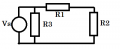
You have R3 connected between the (junction of R1 and R4) and the (junction of R2 and R5). That's not how it is in post #1.

Also, your diagram is finding the resistance as measured across R3, which is not what the TS must find.
Indeed. That was an error on my part. Thanks for the reality check.
 

WBahn

Joined Mar 31, 2012
32,823
Actually, the left end of R3 is connected to the junction of R1 and R2 and its right end connected junction of R3 and R4 .
That is the way that it is in the ORIGINAL problem (and which proves that R1 and R2 are NOT in series, and that neither are R3 and R4).

Now look at YOUR circuit. It is EXACTLY as The Electrician said.

Edit_2016-06-13_2.png

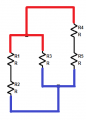
One side of R3 is connected to the junction of R1 and R4 (the red node) and the other end of R3 is connected to the junction of R2 and R5 (the blue node).

Your circuit simply does not match the original circuit.
 

WBahn

Joined Mar 31, 2012
32,823
The connections don't show up in the OP's thumbnail.
In order to justify your unwarranted argumentative position, you should expand the thumbnail, study it, and then admit to your error.
Who gives a flip about what does or doesn't show up in the thumbnail?

I opened the .jpg file before I ever responded early in the thread.

I COPIED the contents of the .jpg file and HIGHLIGHTED all of the nodes and explained in detail why YOUR circuit simply does not match the original circuit and why NONE of the resistors in the original circuit are in either series or parallel.

I invite YOU to actually LOOK at the original circuit AND yours and COMPARE them instead of simply continuing to declare that they are the same just because you WANT them to be the same.
 

TheBigPablo

Joined Nov 22, 2008
10
This is just the classic (possibly) unbalanced Wheatstone bridge. In 1947 somebody worked out the symbolic solution to the problem and published it here (page 6): http://www.clever4hire.com/throwawa...ngineering-notes/Weston2-5.pdf?attredirects=0

Agreed...I believe this is a wheatstone bridge. assume center resistor is the load resitor in question, remove it, get thevinin eq resitance then voltage divider, now you can get the current..

I believe R1 series R2 since R3 removed and R4 series R5. Then R12 is || R45 gives Req
 
Last edited:

WBahn

Joined Mar 31, 2012
32,823
Agreed...I believe this is a wheatstone bridge. assume center resistor is the load resitor in question, remove it, get thevinin eq resitance then voltage divider, now you can get the current..

I believe R1 series R2 since R3 removed and R4 series R5. Then R12 is || R45 gives Req
The problem with this is that it answers a question that wasn't asked (and doesn't help answer the question that WAS asked). The TS is trying to find the equivalent resistance of all five resistors (as seen by the voltage supply), not the current in a particular resistor.

See the last paragraph of http://forum.allaboutcircuits.com/threads/equivalent-resistance-help.124949/#post-1008825
 

TheBigPablo

Joined Nov 22, 2008
10
The problem with this is that it answers a question that wasn't asked (and doesn't help answer the question that WAS asked). The TS is trying to find the equivalent resistance of all five resistors (as seen by the voltage supply), not the current in a particular resistor.

See the last paragraph of http://forum.allaboutcircuits.com/threads/equivalent-resistance-help.124949/#post-1008825


quote:
I am not really looking for an answer as much as I am looking for the process to continue getting this circuit down to a single equivalent resistor.
 
You do KVL loop equations.
Assign currents to clock wise loops arbitrarily starting at the lower right . I1, I2, I3
Resistors that are part of two loops get a positive loop current - a negative loop current.

Loop1: 0=(your turn)
Loop 2: 12=(I2-I3)R3+(I2-I1)R2
Loop3: 0= (your turn)

Combine and solve. You will have 3 equations with I1, I2, and i3 and thus three unknowns. Make alll of the resistors R

Are you assuming all resistors are the same value?
 

TheBigPablo

Joined Nov 22, 2008
10
so Req is Rthevenin + Rload
quote:


Per the original post schematic and text:
I am not really looking for an answer as much as I am looking for the process to continue getting this circuit down to a single equivalent resistor.
To get a single equivalent resitance you can thevenize and add the R3 to the Thevenin resistance result, this should give the single equivalent resistor asked for. Req = ( R1+R2 || R4 +R5 ) + R3


This also may help..
http://ion.chem.usu.edu/~sbialkow/Classes/564/Thevenin/Thevenin.html


Since this isn't homework, there's no reason not to give a procedure including a result.

This problem can probably be solved most quickly and easily using a wye-delta transform: https://en.wikipedia.org/wiki/Y-Δ_transform

Of course, using various network solution methods such as the nodal and mesh methods always works.

Believe it or not, it can be solved using only series/parallel combinations. It's a real PITA to do it that way, but here it is:

WheatEqivResis.png
 

WBahn

Joined Mar 31, 2012
32,823
quote:
I am not really looking for an answer as much as I am looking for the process to continue getting this circuit down to a single equivalent resistor.
Exactly! He wants a single equivalent resistor (that is equivalent to the five original resistors).

He is NOT asking for the Thevenin equivalent as seen by a particular resistor (be it R3 or any of the others).

He is NOT asking for the current in a particular resistor (be it R3 or any of the others).
 

WBahn

Joined Mar 31, 2012
32,823
so Req is Rthevenin + Rload
NO! It will NOT!

I explained this exact point in detail in the last paragraph of http://forum.allaboutcircuits.com/threads/equivalent-resistance-help.124949/#post-1008825

Since you don't seem interested in reading it, I will show you the example that is illustrated there.

Thev2.png

Let's say that R1 and R2 are both 10 kΩ.

What is the Thevenin equivalent seen by R2 as the load? Simple, it is Vs in series with R1. R3 has ZERO influence on this. So, using YOUR recommendation, you would determine that the equivalent resistance seen by the source is simply R1+R2 = 20 kΩ and that R3 has no influence on this. Do you REALLY by that? What if R3 is 1 Ω.

As stating in the paragraph you won't read: "While this resistor (R3 in this case) would clearly dominate the equivalent resistance of the network as seen by the voltage source, it would have absolutely zero effect on the Thevenin equivalent circuit seen by any of the other resistors."

The reason why this approach will not work is also stated in that same paragraph: "the equivalent circuit is NOT equivalent as far as anything inside the equivalent is concerned." A Thevenin equivalent circuit is ONLY equivalent to the part of the circuit it is replacing as far as the voltage-current characteristic AT the terminals where it connects to the part of the circuit that was not replaced. It is not equivalent in ANY OTHER WAY!
 

WBahn

Joined Mar 31, 2012
32,823
Since this isn't homework, there's no reason not to give a procedure including a result.

This problem can probably be solved most quickly and easily using a wye-delta transform: https://en.wikipedia.org/wiki/Y-Δ_transform

Of course, using various network solution methods such as the nodal and mesh methods always works.

Believe it or not, it can be solved using only series/parallel combinations. It's a real PITA to do it that way, but here it is:
I keep forgetting about the trick of duplicating the supply and splitting the circuit like that (even though I have used similar tricks in much more complicated circuits). It annoys me because that is a very elegant way of approaching these types of circuits (though it is not necessarily the quickest or easiest).
 
I keep forgetting about the trick of duplicating the supply and splitting the circuit like that (even though I have used similar tricks in much more complicated circuits). It annoys me because that is a very elegant way of approaching these types of circuits (though it is not necessarily the quickest or easiest).
And I didn't even show the details of 3/4 of the algebra! For this circuit, it's a real PITA.
 

WBahn

Joined Mar 31, 2012
32,823
Given that she's your daughter, and with such a name, I'd guess that she is (or is going to be) a complicated woman. :D
She certainly has the potential. She's almost nine now and, I have to admit, she's an extremely well-behaved child 99% of the time. But the rest of the time she can be quite the drama queen (at least with her mother -- she doesn't seem to do much drama when I'm the only audience). I don't know what to expect when she hits her teens -- I tremble at the thought. At some point before then I think I will have to explain to her that there is no requirement that she actually survive her teen years and that she should keep in mind how far back in the woods we live.;)

We should probably leave it at that so as not to hijack the thread any further -- though I'm not seeing much indication that the TS is going to come back.
 
Last edited:

EM Fields

Joined Jun 8, 2016
583
Huh?

Do you know what it means for two components to be in series?

They are in series if and only if whatever current that flows in one MUST flow in the other.


Wrong. Because only reference designators were provided it is only reasonable to assume that the values are unknown -- and that includes having no knowledge about any relationships between any of them.

Consider any of the many very common schematic diagrams that often give only reference designators, such as a voltage divider or any of the classic simple op-amp circuits. It is not reasonable to assume that the different resistors are the same in any of those situations.


But it can only work out if you actually work with the same circuit! You can't just go and take five resistors and hook them up in a completely different way and expect the result for your different circuit to be a valid solution to the original circuit.

Here is the original circuit with the nodes highlighted:
View attachment 107664
In order for R1 and R2 to be in series, then it MUST be true that whatever current is flowing in R1 would HAVE to then flow in R2. Look at the diagram! The current flowing in R1 is SPLIT between R2 and R3.

Look at that blue node. It connects R1, R2, and R3. Now look at YOUR diagram. You have a node that connects JUST R1 and R2. Where is the connection to R3?
Aarghh!!! You're right, of course.
My error was in misconstruing the circuit to be something other than a Wheatstone bridge. Thanks for the reality check.
 
Top