Equivalent Resistance Help

ErnieM

Joined Apr 24, 2011
8,415
The drawing was kinda tricky to reduce but, once reduced, yielded a Wheatstone bridge which, in its simplest configuration, comprises four equally valued resistances for the legs of the bridge and another equally valued load across the junctions of the two legs.

Do you have a problem with that?
There are at least five false of fact statements in the above quote.

It's not very tricky to redraw (not reduce) into a bridge topology.

It's not a Wheatstone bridge as it lacks a galvanometer or other measurement device.

Such a bridge rairly has equal value resistors, instead it depends on equal ratios.

The center measuring device is chosen to have a high impeadance relative to the legs.

That is a list of my problems with your ex cathedral pronouncements. WBahn nailed a correct method of analysis way back at the 4th post. Stop trying to make sense out of the senseless.
 

EM Fields

Joined Jun 8, 2016
583
Correct me if I'm wrong.

Your "process" is to assume that all of the resistors are the same value, R, so that there is no current flowing in the bridge resistor. Then recognize that this results in the two vertical pairs being effectively isolated so that each vertical leg has resistance 2R and the two of these in parallel give a total resistance of R.

Then, because this "that process would be identical regardless of the values of the resistances", you claim to be able to use this "process" of yours regardless of what the actual values of the five different resistors turns out to be.

If that's your process, then I most definitely do NOT agree with it.
Hmm...

I thought I had made it quite clear earlier in the thread that the process applied when the bridge was balanced. In other words, when R1/R2 = R4/R5.

Under those conditions, R3 would vanish and REQ (the load the power supply would be looking at) would be equal to (R1+R2 * R4 + R5) /R1 + R2 + R4 + R5, regardless of the values of the resistors.

I apologize if I confused you.
 

EM Fields

Joined Jun 8, 2016
583
There are at least five false of fact statements in the above quote.

It's not very tricky to redraw (not reduce) into a bridge topology.

It's not a Wheatstone bridge as it lacks a galvanometer or other measurement device.

Such a bridge rairly has equal value resistors, instead it depends on equal ratios.

The center measuring device is chosen to have a high impeadance relative to the legs.

That is a list of my problems with your ex cathedral pronouncements. WBahn nailed a correct method of analysis way back at the 4th post. Stop trying to make sense out of the senseless.
If I were to stop trying to make sense out of the senseless, I'd have to stop responding to WBahn, et al. ;)
 
Last edited:

anhnha

Joined Apr 19, 2012
904
Hmm...

I thought I had made it quite clear earlier in the thread that the process applied when the bridge was balanced. In other words, when R1/R2 = R4/R5.

Under those conditions, R3 would vanish and REQ (the load the power supply would be looking at) would be equal to (R1+R2 * R4 + R5) /R1 + R2 + R4 + R5, regardless of the values of the resistors.

I apologize if I confused you.
What you did is the trivial and simplest case. It is not what the thread starter want to know. We don't have any info about weather the bridge is balanced or not.
So I believe that you should give a method to solve equivalent resistance in general not just a special case.
 

EM Fields

Joined Jun 8, 2016
583
What you did is the trivial and simplest case. It is not what the thread starter want to know. We don't have any info about weather the bridge is balanced or not.
So I believe that you should give a method to solve equivalent resistance in general not just a special case.
I posted a link to a YouTube video that shows exactly how to do it.
 

DGElder

Joined Apr 3, 2016
351
Unfortunately, I don't see any elegant solutions for this seemingly simple circuit if you try to solve it formally. In each case you end up with a very messy equation that requires tedious attention to detail to avoid an error. So you might as well just go through the well travelled rote method of mesh analysis. However if you do it stepwise with actual resistance values it's not so bad, but that makes it a rather boring puzzle. This is why we have computers.
 
Last edited:

EM Fields

Joined Jun 8, 2016
583
The very first diagram in your series of diagrams is not the same as the one given by the TS.

You have R3 connected between the (junction of R1 and R4) and the (junction of R2 and R5). That's not how it is in post #1.

Also, your diagram is finding the resistance as measured across R3, which is not what the TS must find.
You're right.
I made an error in redrawing the schematic, and I apologize for the late response to your critique.
 

dannyf

Joined Sep 13, 2015
2,197
In each case you end up with a very messy equation that requires tedious attention to detail to avoid an error.
I guess it depends on your definition of "messy".

To me, once you reduce it to two voltage sources, and three resistors in serial, you just need to calculate the voltage on the left and right of R3 and the rest is elementary.
 

dannyf

Joined Sep 13, 2015
2,197
The two voltage sources are

V1 = V * R2 / (R1 + R2), and V2 = V * R5 / (R4 + R5).

The three resistors are R12=R1//R2, R3, and R45=R4//R5. The current through them is I3 = (V1 - V2) / (R12 + R3 + R45)

So the voltage on the left of R3 is Va = V1 - R12 * I3,

and the voltage on the right of R3 is Vb = V2 + R45 * I3.

The current through R1 is I1 = (V - Va) / R1, and the current through R4 is I4 = (V - Vb) / R4.

The equivalent resistance is V / (I1 + I4). V will disappear magically, :)

thevenin equivalency is a beauty.
 
The two voltage sources are

V1 = V * R2 / (R1 + R2), and V2 = V * R5 / (R4 + R5).

The three resistors are R12=R1//R2, R3, and R45=R4//R5. The current through them is I3 = (V1 - V2) / (R12 + R3 + R45)

So the voltage on the left of R3 is Va = V1 - R12 * I3,

and the voltage on the right of R3 is Vb = V2 + R45 * I3.

The current through R1 is I1 = (V - Va) / R1, and the current through R4 is I4 = (V - Vb) / R4.

The equivalent resistance is V / (I1 + I4). V will disappear magically, :)

thevenin equivalency is a beauty.
You have hidden the messiness by substituting temporary equivalent resistors for more complicated subexpressions; for instance using R12 to represent R1||R2 and R45 to represent R4||R5. If you keep everything in terms of R1, R2, R3, R4 and R5, it will be messy.
 

EM Fields

Joined Jun 8, 2016
583
Huh?

Do you know what it means for two components to be in series?

They are in series if and only if whatever current that flows in one MUST flow in the other.


Wrong. Because only reference designators were provided it is only reasonable to assume that the values are unknown -- and that includes having no knowledge about any relationships between any of them.

Consider any of the many very common schematic diagrams that often give only reference designators, such as a voltage divider or any of the classic simple op-amp circuits. It is not reasonable to assume that the different resistors are the same in any of those situations.


But it can only work out if you actually work with the same circuit! You can't just go and take five resistors and hook them up in a completely different way and expect the result for your different circuit to be a valid solution to the original circuit.

Here is the original circuit with the nodes highlighted:
View attachment 107664
In order for R1 and R2 to be in series, then it MUST be true that whatever current is flowing in R1 would HAVE to then flow in R2. Look at the diagram! The current flowing in R1 is SPLIT between R2 and R3.

Look at that blue node. It connects R1, R2, and R3. Now look at YOUR diagram. You have a node that connects JUST R1 and R2. Where is the connection to R3?
 

Tesla23

Joined May 10, 2009
560
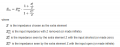
Just to throw another titbit in for those interested in fishing, this particular problem happens to resolve quite readily using Middlebrook's extra element theorem https://en.wikipedia.org/wiki/Extra_element_theorem

upload_2016-6-19_16-45-57.png

Choosing R3 as the extra element, you can write down by inspection:

\(
R_{eq}=( (R_1+R_2)||(R_4+R_5) ) \frac{R_3 + R_1||R_2 + R_4||R_5}{R_3 + (R_1+R_4)||(R_2+R_5)}
\)

which resolves quite readily to The Electrician's expression in a couple of lines of straightforward algebra.

This doesn't mean that this approach is better or worse in general, but is happens to work in a straightforward way here.
 
Top