Facebook
 Google
 GitHub
 Linkedin
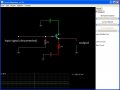
I'm reading "Practical Electronics" by Ralph Morrison. On p.99, he shows an Emitter-Follower circuit. See attached image for my rendition of it -- both voltage sources are 25V; the resistors are 10k and 2.7k; the transistor has Beta=100. The resistor is supposed to be a 2N3904 (NPN) transistor, although I used the simulator's default NPN transistor. (The graph shows the output voltage, according to the simulator. The "V=-862.05mV" refers to the simulator's calculation of voltage at Base of the transistor.)
Here is what he says: "Assume there is no input signal connected. The emitter current is about 10mA. It is determined by the emitter resistor and the minus power supply voltage. If the Beta of the transistor is 100, the base current is 100uA. This current flows in the 10kOhm resistor and the base voltage rises to 1V. This means that the emitter voltage is actually about 0.4V."
I do not understand why "the base voltage rises to 1V". By my calculations, it should be about -0.860V, which is reasonably close to the -0.862V that I found with the simulator. Specifically,
(0-v_Base)/10k = i_Base = (1/101)*[(v_Base - 0.7)-(-25)]/2.7k
This gives v_Base = -24.3/28.27 = -0.860V
What am I missing? (Is it possible that the author mistakenly concluded that the Base goes to 1V rather than -1V?)
Here is what he says: "Assume there is no input signal connected. The emitter current is about 10mA. It is determined by the emitter resistor and the minus power supply voltage. If the Beta of the transistor is 100, the base current is 100uA. This current flows in the 10kOhm resistor and the base voltage rises to 1V. This means that the emitter voltage is actually about 0.4V."
I do not understand why "the base voltage rises to 1V". By my calculations, it should be about -0.860V, which is reasonably close to the -0.862V that I found with the simulator. Specifically,
(0-v_Base)/10k = i_Base = (1/101)*[(v_Base - 0.7)-(-25)]/2.7k
This gives v_Base = -24.3/28.27 = -0.860V
What am I missing? (Is it possible that the author mistakenly concluded that the Base goes to 1V rather than -1V?)
Attachments
-
 49.4 KB Views: 62
Last edited: