Thank you for your answer.I see several problems:
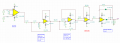
1. I believe your precision rectifier circuit is incorrect; the cathode of D2 should be connected to the anode of D1, not the cathode of D1. As it is now, the output of U5 will saturate negative when the signal coming from U4 is positive; this is not desirable.
2. Your circuit has a lot of end-to end voltage gain, making the TL072 a poor choice for an op amp because of its very large worst-case input offset voltage (± 10 mV). This offset voltage gets amplified along with your signal and could result in as much as several volts of offset on the output of your X220 gain stage. This offset very likely will render your precision rectifier circuit inoperative.
3. You've configured the INA128 to have a differential voltage gain of only 6, which is why you've had to put so much voltage gain downstream in the signal chain. You'd be better off putting as much gain as possible up front in the INA128, and reducing the gain of subsequent stages correspondingly. This should improve the noise performance.
4. Remember that you need a reference electrode connection to your test subject to keep your inputs from floating relative to circuit ground. (This isn't necessary for simulation, of course, but in actual use you will need one.)
This paper, Surface EMG Signal Amplification and Filtering, gives a lot of good information on EMG amplifier design.
Hope this helps a bit...
Maybe. Maybe not. I don't know. My own choice would be to discard the TL072 and use a much better op amp with lower input offset voltage.Problem 2 Will it work if i use TL072 but with a gain of around 100?
My choice would be to increase the gain of the INA to over 100.Problem 3 I will increase the gain of instrumentation amplifier by 10.
Read the paper I linked to; it shows how to make a proper reference electrode connection. Remember, the reference electrode is needed to establish your subject's potential relative to circuit ground; it has nothing to do with the connection between your circuit and the Arduino.Problem 4 is the main issue. I will be connecting the output from the precision rectifier to the arduino. Hence i will use arduino ground as my ground. So do i still need this reference electrode? If yes than will it work if i will directly connect it to ground?
That paper is very well written -- how refreshing.This paper, Surface EMG Signal Amplification and Filtering, gives a lot of good information on EMG amplifier design.
Is it will be good to use opa2131 in place of tl072. It has an offset voltage of 750 micro voltsMaybe. Maybe not. I don't know. My own choice would be to discard the TL072 and use a much better op amp with lower input offset voltage.
My choice would be to increase the gain of the INA to over 100.
Read the paper I linked to; it shows how to make a proper reference electrode connection. Remember, the reference electrode is needed to establish your subject's potential relative to circuit ground; it has nothing to do with the connection between your circuit and the Arduino.
There is no "best" op amp for that job, since many factors are involved (noise voltage, noise current, input offset voltage, input bias current, etc., etc., etc.) in determining how well a particular part will work in any given application.can someone suggest me the best op amp for emg signal extraction with less noise??