Facebook
 Google
 GitHub
 Linkedin
Electrons are electrons. Why are some elements different?
- Thread starter hp1729
- Start date

Scroll to continue with content

The topic has drifted. Sorry, so many similar topics on this forum. Let's go with why magnetic properties differ so greatly. Nickel and copper differ by only one electron yet their magnetic characteristics differ so greatly.The forces between the free electrons, and the atoms in the conductor, is Different when voltage is applied.
Which one do you want to talk about?
Last edited:

@hp1729
You are way too simplistic when trying to talk about "valence electrons". That only accounts for the principle quantum number. For each value of a quantum number (n), there are 1 to n (quantum number l). different types of orbitals (known as s, p, d, f, ...). There are -l to, 0, to l mathematical combinations to form orbitals of each type (e.g. The is only one s-orbital, three p-orbitals, five d-orbitals and seven f-orbitals. Ultimately, each orbital can hold two electrons (one of positive one-half spin and one negative one-half spin.
Now, that was all for isolated, individual atoms (in the gas phase). Once atoms are condensed and start interacting with each other, a few of the outermost orbitals in (even with different principle quantum bumber) start to hybridize. These hybrids (which can be described by geometric additions of the orbitals) direct electron density towards neighboring atoms for bonding orbitals (making a bond as electron density is shared). Additional mathematical combinations exist that are destructive "anti bonding" combinations which are slightly higher in energy than binding and, if occupied with electrons, subtract from the bond order of the two atoms (allowing determination of single, double or triple bonds). Bond order is calculated by pairs of electrons in bonding orbitals subtracted by pairs of electrons in anti bonding orbitals.
Now, we have atoms in the gas phase and bonds forming between atoms (which may have slightly different hybridized orbitals in gas phase vs condensed phase). Each overlap of orbitals has a specific (calculatable and measurable) energy.
Finally, since a crystal is not a single molecule, the overlapping orbitals start to develop a boltsman distribution of bonding energies in the bonding orbitals. As mentioned earlier, anti bonding orbitals exist and at slightly higher energy levels.
Here comes the interesting part.
An insulator (non-metal) has all the bonding orbitals full snd anti bonding orbitals are at a high enough energy gap (band gap) above the bonding orbitals that they remain empty at normal temperatures.
A semiconductor (metaloid) has the anti bonding orbitals closer to the bonding orbitals that some electrons will be thermally excited over the band gap in to the "fermi band" or "fermi level". The fact that the bonding orbital is no longer full and the anti bonding level is not full allows some possibility for conduction.
Conductors (metals) have partially filled bonding orbitals or anti-bonding orbitals in the non-excited (ground) state. Here electrons move easily and conduction is easy. Since many orbitals are both hybridized and partially (half) filled, the differentiation between bonding and anti bonding orbitals is not clear and there is a degeneration of bonding and anti bonding orbitals in metals, giving a band-gap of zero energy.
Differentiating silicon from tin from lead by op counting valance electrons give you essential the same view. You either need to measure energies or observe that some behave as metals and silicon (and graphite) as a metaloid. Diamond as an insulator.
This is wearing me out so I will leave it to you to think about how iron and nickel have lots do unpaired electrons as the orbital fills whereas copper seems to fill pairs yet have a completely empty anti bonding (conduction band) at the same energy as the filled orbitals.
Good night
NOTE: there are lots of ways to explain, most notably, valence band theory and molecular orbital theory. Then various analogies to describe how conduction occurs in the solid state. So, this is my method of explaining after not reviewing this in 25 years.
You are way too simplistic when trying to talk about "valence electrons". That only accounts for the principle quantum number. For each value of a quantum number (n), there are 1 to n (quantum number l). different types of orbitals (known as s, p, d, f, ...). There are -l to, 0, to l mathematical combinations to form orbitals of each type (e.g. The is only one s-orbital, three p-orbitals, five d-orbitals and seven f-orbitals. Ultimately, each orbital can hold two electrons (one of positive one-half spin and one negative one-half spin.
Now, that was all for isolated, individual atoms (in the gas phase). Once atoms are condensed and start interacting with each other, a few of the outermost orbitals in (even with different principle quantum bumber) start to hybridize. These hybrids (which can be described by geometric additions of the orbitals) direct electron density towards neighboring atoms for bonding orbitals (making a bond as electron density is shared). Additional mathematical combinations exist that are destructive "anti bonding" combinations which are slightly higher in energy than binding and, if occupied with electrons, subtract from the bond order of the two atoms (allowing determination of single, double or triple bonds). Bond order is calculated by pairs of electrons in bonding orbitals subtracted by pairs of electrons in anti bonding orbitals.
Now, we have atoms in the gas phase and bonds forming between atoms (which may have slightly different hybridized orbitals in gas phase vs condensed phase). Each overlap of orbitals has a specific (calculatable and measurable) energy.
Finally, since a crystal is not a single molecule, the overlapping orbitals start to develop a boltsman distribution of bonding energies in the bonding orbitals. As mentioned earlier, anti bonding orbitals exist and at slightly higher energy levels.
Here comes the interesting part.
An insulator (non-metal) has all the bonding orbitals full snd anti bonding orbitals are at a high enough energy gap (band gap) above the bonding orbitals that they remain empty at normal temperatures.
A semiconductor (metaloid) has the anti bonding orbitals closer to the bonding orbitals that some electrons will be thermally excited over the band gap in to the "fermi band" or "fermi level". The fact that the bonding orbital is no longer full and the anti bonding level is not full allows some possibility for conduction.
Conductors (metals) have partially filled bonding orbitals or anti-bonding orbitals in the non-excited (ground) state. Here electrons move easily and conduction is easy. Since many orbitals are both hybridized and partially (half) filled, the differentiation between bonding and anti bonding orbitals is not clear and there is a degeneration of bonding and anti bonding orbitals in metals, giving a band-gap of zero energy.
Differentiating silicon from tin from lead by op counting valance electrons give you essential the same view. You either need to measure energies or observe that some behave as metals and silicon (and graphite) as a metaloid. Diamond as an insulator.
This is wearing me out so I will leave it to you to think about how iron and nickel have lots do unpaired electrons as the orbital fills whereas copper seems to fill pairs yet have a completely empty anti bonding (conduction band) at the same energy as the filled orbitals.
Good night
NOTE: there are lots of ways to explain, most notably, valence band theory and molecular orbital theory. Then various analogies to describe how conduction occurs in the solid state. So, this is my method of explaining after not reviewing this in 25 years.
Ah, orbitals. Can we find a correlation between these orbitals and magnetic characteristics? I think your statements are correct. I just don't see it applying to magnetic characteristics. Can you point out a commonness between iron, cobalt and nickel that is different from copper?@hp1729
You are way too simplistic when trying to talk about "valence electrons". That only accounts for the principle quantum number. For each value of a quantum number (n), there are 1 to n (quantum number l). different types of orbitals (known as s, p, d, f, ...). There are -l to, 0, to l mathematical combinations to form orbitals of each type (e.g. The is only one s-orbital, three p-orbitals, five d-orbitals and seven f-orbitals. Ultimately, each orbital can hold two electrons (one of positive one-half spin and one negative one-half spin.
Now, that was all for isolated, individual atoms (in the gas phase). Once atoms are condensed and start interacting with each other, a few of the outermost orbitals in (even with different principle quantum bumber) start to hybridize. These hybrids (which can be described by geometric additions of the orbitals) direct electron density towards neighboring atoms for bonding orbitals (making a bond as electron density is shared). Additional mathematical combinations exist that are destructive "anti bonding" combinations which are slightly higher in energy than binding and, if occupied with electrons, subtract from the bond order of the two atoms (allowing determination of single, double or triple bonds). Bond order is calculated by pairs of electrons in bonding orbitals subtracted by pairs of electrons in anti bonding orbitals.
Now, we have atoms in the gas phase and bonds forming between atoms (which may have slightly different hybridized orbitals in gas phase vs condensed phase). Each overlap of orbitals has a specific (calculatable and measurable) energy.
Finally, since a crystal is not a single molecule, the overlapping orbitals start to develop a boltsman distribution of bonding energies in the bonding orbitals. As mentioned earlier, anti bonding orbitals exist and at slightly higher energy levels.
Here comes the interesting part.
An insulator (non-metal) has all the bonding orbitals full snd anti bonding orbitals are at a high enough energy gap (band gap) above the bonding orbitals that they remain empty at normal temperatures.
A semiconductor (metaloid) has the anti bonding orbitals closer to the bonding orbitals that some electrons will be thermally excited over the band gap in to the "fermi band" or "fermi level". The fact that the bonding orbital is no longer full and the anti bonding level is not full allows some possibility for conduction.
Conductors (metals) have partially filled bonding orbitals or anti-bonding orbitals in the non-excited (ground) state. Here electrons move easily and conduction is easy. Since many orbitals are both hybridized and partially (half) filled, the differentiation between bonding and anti bonding orbitals is not clear and there is a degeneration of bonding and anti bonding orbitals in metals, giving a band-gap of zero energy.
Differentiating silicon from tin from lead by op counting valance electrons give you essential the same view. You either need to measure energies or observe that some behave as metals and silicon (and graphite) as a metaloid. Diamond as an insulator.
This is wearing me out so I will leave it to you to think about how iron and nickel have lots do unpaired electrons as the orbital fills whereas copper seems to fill pairs yet have a completely empty anti bonding (conduction band) at the same energy as the filled orbitals.
Good night
NOTE: there are lots of ways to explain, most notably, valence band theory and molecular orbital theory. Then various analogies to describe how conduction occurs in the solid state. So, this is my method of explaining after not reviewing this in 25 years.
Ah, orbitals. Can we find a correlation between these orbitals and magnetic characteristics? I think your statements are correct. I just don't see it applying to magnetic characteristics. Can you point out a commonness between iron, cobalt and nickel that is different from copper?
The auf Bau principle states that electrons fill the lowest energy orbitals first (whether hybridized or non-hybridized). Furthermore, orbitals of equivalent energy are each filled with one electron (creating a half-filled orbital) before pairs are created (full orbital).
Hund's rule says that the first electrons into a given set of orbitals (on a single atom) will all have the same spin. This is important when we talk about copper.
So, take a look at how you would put the six electrons into the five d-orbitals, you end up with four unpaired electrons.
Three for cobalt and two for nickel. In a magnetic field. You can induce these electrons to align and become magnetic.
Although copper has one unpaired electron, the unpaired electrons across multiple atoms do not always (rarely) get oriented in the same direction of an applied field.
So, in case you haven't realized, spin, angular momentum and the Pauli Exclusion principle cause magnetism. Multiple unpaired electrons in an atom can lead to ferromagnetism.
Note, that orbitals get hybridized in some alloys and those can become non-magnetic, even if it is a majority of iron and nickel (e.g. 316 stainless steel). Likewise, Many non-magnetic stainless steels can become magnetic in certain circumstances - (e.g. 316 stainless steel - work hardening ).
Note also, that the periodic table indicates that iron, cobalt and nickel have a 3d orbital as their highest energy orbital. In fact, the 4s orbital is very close in energy. As these atoms lose electrons, an inversion occurs and the 4s orbital may be the highest energy orbital and, therefore, the 2+ oxidation state is quite stable and common for transition metals.

A converged magnetic field(a magnetic dipole) only has one source, rotating charge. The rotation may be open or closed. The rotation is not around another particle. Charge rotates with itself, not around an external reference.
If the rotation is closed, the dipole will be short and chubby.
If the rotation is open, the charge will rotate around it's own dipole. The dipole will be the length of the open rotation.
Current is an open rotation. Electrons do not flow straight down a conductor. This is because of the charge repulsion and magnetic field interaction when current flows. The electrons rotate around the conductor. This open rotation around the surface of the conductor, causes an internal magnetic field. This internal magnetic field, flows axially down the conductor. This internal flux, is the force and speed of electricity. This internal field also ejects any internal free electrons to the surface.
If you line up dipoles(of any length) in the correct manner, they can add into one dipole. If the atomic structure lines these up, the dipole field can become external and the atom is considered magnetic.
If the rotation is closed, the dipole will be short and chubby.
If the rotation is open, the charge will rotate around it's own dipole. The dipole will be the length of the open rotation.
Current is an open rotation. Electrons do not flow straight down a conductor. This is because of the charge repulsion and magnetic field interaction when current flows. The electrons rotate around the conductor. This open rotation around the surface of the conductor, causes an internal magnetic field. This internal magnetic field, flows axially down the conductor. This internal flux, is the force and speed of electricity. This internal field also ejects any internal free electrons to the surface.
If you line up dipoles(of any length) in the correct manner, they can add into one dipole. If the atomic structure lines these up, the dipole field can become external and the atom is considered magnetic.
Here is the order that orbitals are filled in atoms...
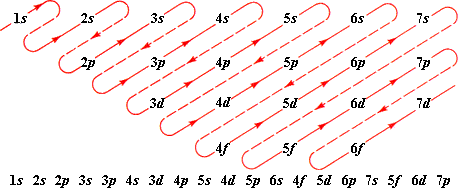
Note, that you can see this sequence by the organization of the periodic table. The elements with s-orbitals as their highest energy orbital are in the first two columns. An s-orbital has only one configuration so, can hold a maximum of two electrons.
Those with a p-orbital as their highest energy orbital (the six columns of the periodic table to the right) show that p-orbitals can exist in 3-different mathematic orientations (oriented along x, y and z-axis). There are five combinations for d-orbitals (10 columns of the transition metals) - these get funky looking to see how five items with two nodes of symmetry fit in 3-dimentional space. f-orbitals from the rare-earth series gets even worse.
Note, that you can see this sequence by the organization of the periodic table. The elements with s-orbitals as their highest energy orbital are in the first two columns. An s-orbital has only one configuration so, can hold a maximum of two electrons.
Those with a p-orbital as their highest energy orbital (the six columns of the periodic table to the right) show that p-orbitals can exist in 3-different mathematic orientations (oriented along x, y and z-axis). There are five combinations for d-orbitals (10 columns of the transition metals) - these get funky looking to see how five items with two nodes of symmetry fit in 3-dimentional space. f-orbitals from the rare-earth series gets even worse.
All very informative but you still have not found a common characteristic that fits our question.The auf Bau principle states that electrons fill the lowest energy orbitals first (whether hybridized or non-hybridized). Furthermore, orbitals of equivalent energy are each filled with one electron (creating a half-filled orbital) before pairs are created (full orbital).
Hund's rule says that the first electrons into a given set of orbitals (on a single atom) will all have the same spin. This is important when we talk about copper.
So, take a look at how you would put the six electrons into the five d-orbitals, you end up with four unpaired electrons.
Three for cobalt and two for nickel. In a magnetic field. You can induce these electrons to align and become magnetic.
Although copper has one unpaired electron, the unpaired electrons across multiple atoms do not always (rarely) get oriented in the same direction of an applied field.
So, in case you haven't realized, spin, angular momentum and the Pauli Exclusion principle cause magnetism. Multiple unpaired electrons in an atom can lead to ferromagnetism.
Note, that orbitals get hybridized in some alloys and those can become non-magnetic, even if it is a majority of iron and nickel (e.g. 316 stainless steel). Likewise, Many non-magnetic stainless steels can become magnetic in certain circumstances - (e.g. 316 stainless steel - work hardening ).
Note also, that the periodic table indicates that iron, cobalt and nickel have a 3d orbital as their highest energy orbital. In fact, the 4s orbital is very close in energy. As these atoms lose electrons, an inversion occurs and the 4s orbital may be the highest energy orbital and, therefore, the 2+ oxidation state is quite stable and common for transition metals.
Which question is still does not have enough supporting background for you to infer an answer?All very informative but you still have not found a common characteristic that fits our question.
Why is lead a conductor and carbon is not - even though they both have 4 valance electrons? Well, the biggest effect is that small atoms (first row(s) of periodic table) have well defined orbitals and, because of small size, they have fairly high electron density. The good overlap of orbitals makes nice strong bonds between atoms (even similar atoms). Therefore, boron, carbon, nitrogen and oxygen (even sulfur and phosphorus) form bonds with themselves. These are co-valent bonds. To form the bonds, the orbitals start to hybridize with orbitals above or below in energy and direct to the neighboring atom. This sharinng of unpaired electrons will fill the lower orbital and reduce conductivity. As you look at bigger and bigger atoms, two things happen, the orbital is less and less well defined and good overlap so bonding is weaker and weaker (practally non-existent on bigger atoms). Seondly, is shielding effects. In small atoms, the positive effect of protons in the nucleus are neutralized by the negative effects of each electron. However, in bigger atoms, the additional electrons are more and more dispersed and distant from the nucleus. Additionally, the electrons with higher principle quantum numbers are kind of cheated. Their corresponding positive charge is diluted a bit because of all the electrons between the "valence" electrons in lead and the nucleus. Therefore, the "effective charge" felt by those outer most electrons is much lower than the outer electrons in a smaller atom. Therefore, the valance electrons of lead's partially filled orbitals are much more less likely to from bonds with neighboring atoms (similar or not) and lead is going to creap into the realm of metal from non-metal or metalloid like the elements above it in the periodic table.
Re: leadWhich question is still does not have enough supporting background for you to infer an answer?
Why is lead a conductor and carbon is not - even though they both have 4 valance electrons? Well, the biggest effect is that small atoms (first row(s) of periodic table) have well defined orbitals and, because of small size, they have fairly high electron density. The good overlap of orbitals makes nice strong bonds between atoms (even similar atoms). Therefore, boron, carbon, nitrogen and oxygen (even sulfur and phosphorus) form bonds with themselves. These are co-valent bonds. To form the bonds, the orbitals start to hybridize with orbitals above or below in energy and direct to the neighboring atom. This sharinng of unpaired electrons will fill the lower orbital and reduce conductivity. As you look at bigger and bigger atoms, two things happen, the orbital is less and less well defined and good overlap so bonding is weaker and weaker (practally non-existent on bigger atoms). Seondly, is shielding effects. In small atoms, the positive effect of protons in the nucleus are neutralized by the negative effects of each electron. However, in bigger atoms, the additional electrons are more and more dispersed and distant from the nucleus. Additionally, the electrons with higher principle quantum numbers are kind of cheated. Their corresponding positive charge is diluted a bit because of all the electrons between the "valence" electrons in lead and the nucleus. Therefore, the "effective charge" felt by those outer most electrons is much lower than the outer electrons in a smaller atom. Therefore, the valance electrons of lead's partially filled orbitals are much more less likely to from bonds with neighboring atoms (similar or not) and lead is going to creap into the realm of metal from non-metal or metalloid like the elements above it in the periodic table.
That make sense.
I am still missing what "spin and all" are unique to easily magnetized metals.
Electrons have a unique quantum mechanical trait called SPIN with a quantum number of 1/2 or -1/2 (commonly drawn as up arrow or down arrow with one barb on the arrowhead. The spin of each electron filling an empty set of orbitals is the same (all pointing up, for example) until they are paired and an orbital is full.Re: lead
That make sense.
I am still missing what "spin and all" are unique to easily magnetized metals.
In the case of iron, the 4s and 3p orbitals look like this...
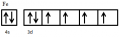
See all of those unpaired electrons? Those can easily be aligned with all the unpaired electrons in all the atoms to magnetize a mass of iron. Once aligned, they take some time to scramble and lose the magnetic character. Carbon steel is slightly faster than soft annealed iron. That is because iron carbides and carbon are not magnetic and the magnetic field of one atom is not supporting/sustaining the magnetic field of a neighboring atom.
Some iron-containing compunds (lodestone, iron oxides with mixed oxidation states, ...) can be permandent magnets because of the way the crystal lattices align and force alignment of the magnetic orientation of the orbitals in each atom.
There are lots of factors working together - magnetism and conductivity are not easy. To paraphrase BTO, "if it were easy as fishin' you could be a quantum mechanic!"
Re: ironElectrons have a unique quantum mechanical trait called SPIN with a quantum number of 1/2 or -1/2 (commonly drawn as up arrow or down arrow with one barb on the arrowhead. The spin of each electron filling an empty set of orbitals is the same (all pointing up, for example) until they are paired and an orbital is full.
In the case of iron, the 4s and 3p orbitals look like this...
View attachment 98685
See all of those unpaired electrons? Those can easily be aligned with all the unpaired electrons in all the atoms to magnetize a mass of iron. Once aligned, they take some time to scramble and lose the magnetic character. Carbon steel is slightly faster than soft annealed iron. That is because iron carbides and carbon are not magnetic and the magnetic field of one atom is not supporting/sustaining the magnetic field of a neighboring atom.
Some iron-containing compunds (lodestone, iron oxides with mixed oxidation states, ...) can be permandent magnets because of the way the crystal lattices align and force alignment of the magnetic orientation of the orbitals in each atom.
There are lots of factors working together - magnetism and conductivity are not easy. To paraphrase BTO, "if it were easy as fishin' you could be a quantum mechanic!"
Good, thank you. Is this consistent with other magnetic metals and non-magnetic metals.
Looking into these things myself.
(edited to add ...)
What do I search on to find info on such things as you have presented.
Last edited:
Yes,cobalt would get one more electron (3 unpaired electrons) and nickel would get one more (2-unpaired) - in simple terms.Re: iron
Good, thank you. Is this consistent with other magnetic metals and non-magnetic metals.
Looking into these things myself.
Super so far. I can't find a chart of the elements that shows this breakdown. So far what you have shown is common to all elements.Yes,cobalt would get one more electron (3 unpaired electrons) and nickel would get one more (2-unpaired) - in simple terms.
"They behave differently because they are different" doesn't answer the question. I am looking for a chart of the elements that shows those spin arrows for all the elements.
You are going to have to study and work a little bit, my friend. All the electron configurations are on Wikipedia in 1s2, 2s2, 2p3 type format. I gave you all the info you need to convert those to arrow format."They behave differently because they are different" doesn't answer the question. I am looking for a chart of the elements that shows those spin arrows for all the elements.
I also said there are other factors involved that create exceptions to the multiple unpaired electron trend. For example, ruthenium (below iron) does not have ferromagnetic properties. So, your statement above is correct and you can work on an MS in physics or physical chemistry to learn the exceptions and reasons for exceptions. This forum is not the forum (ha) to explain all. There are very good books and courses available.
That 1s, 2p ... format doesn't give me spin (up or down arrows). It is those "exceptions" that are the cause of my confusion. There doesn't seem to be any rule I can find for identifying ferromagnetic elements.You are going to have to study and work a little bit, my friend. All the electron configurations are on Wikipedia in 1s2, 2s2, 2p3 type format. I gave you all the info you need to convert those to arrow format.
I also said there are other factors involved that create exceptions to the multiple unpaired electron trend. For example, ruthenium (below iron) does not have ferromagnetic properties. So, your statement above is correct and you can work on an MS in physics or physical chemistry to learn the exceptions and reasons for exceptions. This forum is not the forum (ha) to explain all. There are very good books and courses available.
Why does temperature change this? Lithium gas cooled to 1K becomes ferromagnetic. How does this work into the spin story?
Some of the elements in the actinide series are ferromagnetic. ????
Last edited:
It does give you spin. Just draw one box for each s, three boxes for each p and five for each d orbital. Then, as I said above, if you see 3d6, that means the 3d orbital has 6 electrons. Just fill in each of the five boxes with one electron (all in the same direction) and then add the sixth to any box in the other direction to make a pair.That 1a, 2p ... format doesn't give me spin (up or down arrows). It is those "exceptions" that are the cause of my confusion. There doesn't seem to be any rule I can find for identifying ferromagnetic elements.
the post I made about filling order, those orbitals in a single line (without a curve) can be grouped as one "valence shell". So, Iron's valence shell is made up of a 4s and 3p orbitals. 2 in s, 6 in p.
PS, this seems a lot like a homework question, should it be relocated?