My understanding is that when electrons collide, a photon is emitted. So any domain where there is a greater than 0 probability of electrons colliding must have >0 potential of photon manifestation, right? Can electron co-exist with other electron in a field or domain where there is 0 potential for photon emission? I know I am using the singular and plural forms somewhat interchangeably but its all I know to do at the moment.
Charge particle accelerations (KE is gained) causes photon 'emission' as EM energy. Electrons exist (in bound quantum states to the atomic nucleus with random probabilities of being excited to some level and dropping back down due to random
fluctuations of the EM field) together in atoms so yes, there are conditions with a very low potential for photon emission unless some external field or force changes the ground state. For 'free' electrons at ground state something would need to make it energetically favorable (to have a higher to lower) for emission.
FAQ: When and why does an electron emit a photon?
When does an electron emit a photon? Electrons emit photons when they undergo a change in energy level. This can happen when they absorb energy from an external source, collide with other particles, or when they transition to a lower energy state.
Why does an electron emit a photon? An electron emits a photon because of the principles of quantum mechanics. According to the theory, electrons can only exist in certain energy levels and when they transition between these levels, they emit or absorb energy in the form of photons.
How does an electron emit a photon? Electrons emit photons through a process called spontaneous emission. This occurs when an electron in an excited state spontaneously transitions to a lower energy state, releasing a photon in the process.
What happens to an electron after it emits a photon? After emitting a photon, the electron transitions to a lower energy state. It can then remain in this state or absorb energy from an external source and transition back to a higher energy state, emitting another photon in the process.
Can an electron emit multiple photons? Yes, an electron can emit multiple photons if it undergoes multiple energy level transitions. This can happen in a process called stimulated emission, where an incoming photon causes an already excited electron to emit another photon with the same energy and direction.
If the emitted particle accelerates to the speed of light does that mean its initial velocity was less than the speed of light? If so, does it have a rest mass during the transition?
If the emitted particle accelerates to the speed of light does that mean its initial velocity was less than the speed of light? If so, does it have a rest mass during the transition?
No. Photons always travel at the 'speed of light' of the media (vacuum, air, etc ...). There is no transition, they are born moving at c. A photon is never at rest.
Photons have momentum (“moving energy” ) so rest mass is an equivalence with a mass-less particle that doesn't rest.
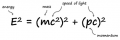
E^2= (mc^2)^2 + (pc)^2
Where m is the rest mass of the object in question.
P is it's momentum. And c well is the speed of light in vacuum.
Photons have zero rest (invariant) mass, with relativistic mass due to their motion.
The photon carries info about whatever structure its energy was riding in prior to the collision?
Does the theory predict that a change of some sort occurs in something within a time span of 5.39×10−44 s.?
The photon carries info about whatever structure its energy was riding in prior to the collision?
Does the theory predict that a change of some sort occurs in something within a time span of 5.39×10−44 s.?
You really won't get much understanding by asking disjointed questions here. Take the time and study the material from the basics up the level you desire. Your questions show interest in the subject, do it justice by learning the basics (online and informal at least) first.
You really won't get much understanding by asking disjointed questions here. Take the time and study the material from the basics up the level you desire. Your questions show interest in the subject, do it justice by learning the basics (online and informal at least) first.
I liked your statement that photons are born at c. That helped. My question arises out of my first study of Feynman diags. It was stated that emitted particles can accelerate to c. My understanding of acceleration is increments of instantaneous rate of change over time.
I liked your statement that photons are born at c. That helped. My question arises out of my first study of Feynman diags. It was stated that emitted particles can accelerate to c. My understanding of acceleration is increments of instantaneous rate of change over time.
Those diagrams are not a true alternative to the field theories, but rather an approximation to it for a much simpler visual imagination presentation of things we can't see. We can then build a complete model once the diagram makes sense.
“virtual quantum.” == “virtual photon” here as a simplification of detailed math needed for explain a 'real' photon exchange (without explaining how it traveled).
A second objection to FDs being pictures of the physical realm is based on their use of virtual particles. In many FDs, a process is depicted that could not be observed in any sense, because, for instance, it violates the conservation of energy. However, if this process lasts less than a given small time (i.e., does not violate the time-energy uncertainty relation), then its existence is not logically ruled out. A number of critics argue that such virtual entities do not exist. Two attitudes are possible in light of this objection. One is that physics should reject the use of virtual particles. The other is that they may be used but we should recognize their merely instrumental or fictional nature. In either case, diagrams with virtual entities do not picture reality. Of course, this objection to FDs being pictures is only as good as the objection to virtual particles, but the case against them is strong. We will not repeat these arguments, but instead refer readers to a sample from the literature. See, for instance, Bunge (1970) or Teller (1995).
Feynman: I can’t tell you when I first wrote them. [ … ] I probably made diagrams to help me think about [perturbation expressions]. [ … ] It was probably not any specific invention but just a sort of a shorthand with which I was helping myself think, which gradually developed into specific rules for some diagrams. [ … ]
Weiner: For helping you think physically? In other words, you were seeing in physical—
Feynman: No, mathematical expressions. Mathematical expressions. A diagram to help write down the mathematical expressions. (Quoted in Wüthrich 2010, p. 6)
The term “virtual particle” is an endlessly confusing and confused subject for the layperson, and even for the non-expert scientist. I have read many books for laypeople (yes, I was a layperson once myself, and I remember, at the age of 16, reading about this stuff) and all of them talk about virtual particles and not one of them has ever made any sense to me. So I am going to try a different approach in explaining it to you.
The best way to approach this concept, I believe, is to forget you ever saw the word “particle” in the term. A virtual particle is not a particle at all. It refers precisely to a disturbance in a field that is not a particle. A particle is a nice, regular ripple in a field, one that can travel smoothly and effortlessly through space, like a clear tone of a bell moving through the air. A “virtual particle”, generally, is a disturbance in a field that will never be found on its own, but instead is something that is caused by the presence of other particles, often of other fields.
"It refers precisely to a disturbance in a field that is not a particle" It's a shortcut for functions associated with equations. A calculation, not a wave or particle.
It is better, I think, for the layperson to understand that the electromagnetic field is disturbed in some way, ignore the term “virtual photons” which actually is more confusing than enlightening, and trust that a calculation has to be done to figure out how the disturbance produced by the two electrons leads to their being repelled from one another, while the disturbance between an electron and a positron is different enough to cause attraction.
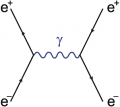
The language physicists use in describing this is the following: “The electron can turn into a virtual photon and a virtual electron, which then turn back into a real electron.” And they draw a Feynman diagram that looks like Figure 4. But what they really mean is what I have just described in the previous paragraph. The Feynman diagram is actually a calculational tool, not a picture of the physical phenomenon; if you want to calculate how big this effect is, you take that diagram , translate it into a mathematical expression according to Feynman’s rules, set to work for a little while with some paper and pen, and soon obtain the answer.
Does the universe have a perpetual tendency to seek equilibrium?
Are virtual particles said to be "made" of the same stuff as whatever medium in which they arise?
I'd be interested in your elaborating on your thinking when you ask these questions. Standing alone, they appear trite.
I have long held that it's an error to anthropomorphise physics, even inadvertently (".... a perpetual tendency to seek equilibrium") as it can cloud understanding.
Does the universe have a tendency toward equilibrium? I don't think the rather incomplete models we have to date allow that conclusion, although it seems an implicit necessity of the Big Bang model.

 Facebook
 Google
 GitHub
 Linkedin