Electronics 101 HELP

Thread Starter

Sberndt6853

Joined Nov 8, 2014
11
The OP opened his statement with "ALL RESISTORS ARE 1k."

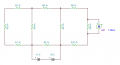
The OP's diagram does not reflect that tidbit of information.

Does the OP know ohms law? 1 volt across a 1kΩ resistor does not equal 1.4 mA. Did the OP measure the current? I doubt it.

Granted, there is a tolerance in real life. Did the OP measure the resistances before constructing the circuit? The information is scare.

I'm sure the OP's lab assignment had specific criteria. He did not share anything other than his diagram.
Ohm's law says that R=V/I so for resistor 1, 1Volt divided by .oo14 amps equals 714, so in the circuit for resistor1 = 714 Ohms even if it is a 1K ohm resistor. R1,2,3 are in a series whereas R4 is a parallel of R7. Again this is the readings I took with a multimeter and they are accurate enough. I need to figure out how to solve this circuit with Ohm and Kirchoff's laws without making a single multimeter reading.
 

shteii01

Joined Feb 19, 2010
4,644
Ohm's law says that R=V/I so for resistor 1, 1Volt divided by .oo14 amps equals 714, so in the circuit for resistor1 = 714 Ohms even if it is a 1K ohm resistor. R1,2,3 are in a series whereas R4 is a parallel of R7. Again this is the readings I took with a multimeter and they are accurate enough. I need to figure out how to solve this circuit with Ohm and Kirchoff's laws without making a single multimeter reading.
The problem is that for 1000 Ohm resistor with the tolerance of 5% you are looking at a resistor which could be betwen 950 Ohm and 1050 Ohm.

Your magic resistors are 714 Ohm. Which is less than 950 Ohm. Which means that your resistor IS NOT 1000 Ohms.

In times like this I tell people that I am not interested in playing game of 100 and 1 Questions. I am out of here. You have fun.
 

WBahn

Joined Mar 31, 2012
32,836
Ohm's law says that R=V/I so for resistor 1, 1Volt divided by .oo14 amps equals 714, so in the circuit for resistor1 = 714 Ohms even if it is a 1K ohm resistor. R1,2,3 are in a series whereas R4 is a parallel of R7. Again this is the readings I took with a multimeter and they are accurate enough. I need to figure out how to solve this circuit with Ohm and Kirchoff's laws without making a single multimeter reading.
And, again, HOW did you use your multimeter to measure the 1.4 mA? WHY won't you answer that question? Did you change the circuit in ANY way in order to make this measurement, or did you just touch the probe tips from your meter to certain points in the circuit?
 

Thread Starter

Sberndt6853

Joined Nov 8, 2014
11
And, again, HOW did you use your multimeter to measure the 1.4 mA? WHY won't you answer that question? Did you change the circuit in ANY way in order to make this measurement, or did you just touch the probe tips from your meter to certain points in the circuit?
Yes I touched the meter to all resistors. And before I started I measured all the resistors. It seems to agree with kirchoff, but I am still having some math issues.
 

KJ6EAD

Joined Apr 30, 2011
1,581
I suspect this is a problem of 10 1k resistors arranged as shown with a 10V supply (doesn't matter that it's made from two 5V supplies) where the student is tasked with using Kirschoff's laws and Ohm's law to determine the voltage across and current through each resistor. The figures on the diagram are then being produced by a simulator as the student tries to get to the answer without understanding. It's a colossal waste of effort if the instructor requires any semblance of "show your work" or gives any kind of meaningful test.

That's just my guess.
 
Last edited:

shteii01

Joined Feb 19, 2010
4,644
Yes I touched the meter to all resistors. And before I started I measured all the resistors. It seems to agree with kirchoff, but I am still having some math issues.
In order to measure current you have to place the current meter in series with the resistor. Which means that you have to break the circuit, insert current meter between the resistor and the next component, then apply power to the circuit and write down the reading from the current meter.

"Yes I touched the meter to all resistors." Good for you. Also waste of your time.
 

WBahn

Joined Mar 31, 2012
32,836
Yes I touched the meter to all resistors. And before I started I measured all the resistors. It seems to agree with kirchoff, but I am still having some math issues.
THANK YOU! FINALLY!

As I was coming to suspect, you are measuring the current the wrong way. In order to use a multimeter as a current meter, you MUST break the circuit and put the current in series with the component you are measuring the current for. An ideal current meter has zero resistance but real ones have a noticeable resistance, perhaps a few ohms and perhaps a few hundred ohms. It depends on the range. When you put your meter across the component, you are placing a low value resistance in parallel with your nominally 1 kΩ resistance and then your meter is telling you how much current is flowing through the low value resistance.

When you put your meter across R5, you essentially put a small valued resistor directly across the outputs of the Analog Discovery and immediately exceeded its current drive capability causing it to shut down.

Now do you see why I asked how you were making your measurements all the way back in Post #3? Why I asked again, while explaining the reason, in Post #6? And again in Post #10, and again in Post #11, and yet again in Post #12, and Post #17, and Post #23. A HUGE amount of everyone's time could have been saved if you had simply answered that question one of the six times it was asked.

Do you have the documentation for your meter? If not, what is the make and model number of the meter and what range are you making your current measurements on. The specs can probably be found online. WIth it being a cheap meter, the finite resistance will probably affect your results noticeably even once you take the measurements correctly.
 

JoeJester

Joined Apr 26, 2005
4,390
Ohm's law says that R=V/I so for resistor 1, 1Volt divided by .oo14 amps equals 714, so in the circuit for resistor1 = 714 Ohms even if it is a 1K ohm resistor. R1,2,3 are in a series whereas R4 is a parallel of R7. Again this is the readings I took with a multimeter and they are accurate enough. I need to figure out how to solve this circuit with Ohm and Kirchoff's laws without making a single multimeter reading.
When you initiated this thread, it would have been NICE if you had informed the membership of everything you've done and NOT just posted the diagram.

I'm sure your lab gave you a lot more instructions than you have given us ... the people you asked to help you.

So, what is the model number of the meter you've used to make these tests?

I do find it interesting that your claim the current is 1.4 mA. Didn't it strike you as unusual that you have 40 percent more current than what you should have read?

Do you know why you read 1.4 mA when you should have been closer to 1.0 mA?

Here is what YOU did .... the meter's may have been "accurate" enough, but the person operating it wasn't.
 

Attachments

Last edited:

Thread Starter

Sberndt6853

Joined Nov 8, 2014
11
THANK YOU! FINALLY!

As I was coming to suspect, you are measuring the current the wrong way. In order to use a multimeter as a current meter, you MUST break the circuit and put the current in series with the component you are measuring the current for. An ideal current meter has zero resistance but real ones have a noticeable resistance, perhaps a few ohms and perhaps a few hundred ohms. It depends on the range. When you put your meter across the component, you are placing a low value resistance in parallel with your nominally 1 kΩ resistance and then your meter is telling you how much current is flowing through the low value resistance.

When you put your meter across R5, you essentially put a small valued resistor directly across the outputs of the Analog Discovery and immediately exceeded its current drive capability causing it to shut down.

Now do you see why I asked how you were making your measurements all the way back in Post #3? Why I asked again, while explaining the reason, in Post #6? And again in Post #10, and again in Post #11, and yet again in Post #12, and Post #17, and Post #23. A HUGE amount of everyone's time could have been saved if you had simply answered that question one of the six times it was asked.

Do you have the documentation for your meter? If not, what is the make and model number of the meter and what range are you making your current measurements on. The specs can probably be found online. WIth it being a cheap meter, the finite resistance will probably affect your results noticeably even once you take the measurements correctly.
THANK YOU! FINALLY!

As I was coming to suspect, you are measuring the current the wrong way. In order to use a multimeter as a current meter, you MUST break the circuit and put the current in series with the component you are measuring the current for. An ideal current meter has zero resistance but real ones have a noticeable resistance, perhaps a few ohms and perhaps a few hundred ohms. It depends on the range. When you put your meter across the component, you are placing a low value resistance in parallel with your nominally 1 kΩ resistance and then your meter is telling you how much current is flowing through the low value resistance.

When you put your meter across R5, you essentially put a small valued resistor directly across the outputs of the Analog Discovery and immediately exceeded its current drive capability causing it to shut down.

Now do you see why I asked how you were making your measurements all the way back in Post #3? Why I asked again, while explaining the reason, in Post #6? And again in Post #10, and again in Post #11, and yet again in Post #12, and Post #17, and Post #23. A HUGE amount of everyone's time could have been saved if you had simply answered that question one of the six times it was asked.

Do you have the documentation for your meter? If not, what is the make and model number of the meter and what range are you making your current measurements on. The specs can probably be found online. WIth it being a cheap meter, the finite resistance will probably affect your results noticeably even once you take the measurements correctly.
Yes.
 

Thread Starter

Sberndt6853

Joined Nov 8, 2014
11
So the current splits at R1 and R4 and it goes through R1,2,3 and meets up with R4 going into R6? My volts for R1,2,3 should be 1.4 volts each and R4 should be 5.8 volts making a total of 10 volts?
 
Last edited:

WBahn

Joined Mar 31, 2012
32,836
So the current splits at R1 and R4. It goes through R1,2,3 and meets up with R4 going into R6. R6 is in parallel with R5?
Nope. In order to be in parallel, two branches have to have the exact same voltage across them. A simple test for this is to put your two index fingers at opposite ends of one of the branches (say R5 in this case). Now, without lifting your fingers and without going through any other components, can you move both of your fingers to the opposite ends of the other branch (R6 in this case)? If yes, they are in parallel, otherwise they are not.

So the branch made up of R1, R2, and R3 is in parallel with the branch consisting of R4. Call this effective resistance R14. The same for the branch containing R7, R8, and R9 being in parallel with R10. Call this effective resistance R710. Now you have R14, R6, and R710 that are all in series and you can combine them and call the equivalent resistance R11. Finally you have R11 which IS in parallel with R5 and can be combined to get the total effective resistance seen by the Analog Discovery.
 

WBahn

Joined Mar 31, 2012
32,836
So R14 would be 6 volts and 6mA which would be the same as R710. R6 would have to be 4 volts and 4mA?
It would sure be nice if you would show your work. Without it, all I can say is, "Nope." I don't even have to work out the answer because we've already said that R14, R6, and R710 are all in series. What do you know is required to be true of components that are in series?

Always, always, ALWAYS ask if the answer makes sense.
 

JoeJester

Joined Apr 26, 2005
4,390
I recommend you draw your circuit and compute the voltages across each resistor and the current through each resistor.

I also recommend you learn how to connect the test equipment properly to measure the voltage and current.

I can tell you now that how you connected the ampere meter, changed the circuit so that the 1.4 mA you read was within 2% of the value expected for that changed circuit, but it wasn't correct for this lab as I understand it.

Also, you really need to show your work if you expect help. This is post number 35. I suspect this is my last posting in this thread.
 
Top