Electronic Circuit Question.

Yes it is.
Note that post #113 asks you to determine the arrangement of the required reactors and the reactances thereof-- it also presents the complex impedance as a reactance in series with a resistance -- Ergo reactor value ↔ reactance conversion is not required - ergo specification of frequency is unnecessary:)

OK, it is already given the reactance then where to move i mean what to do?
Determine reactor configuration and values of reactance required to preform the transformation -- Again, owing to ambiguity in the stipulations, there are two correct 'answers':)

if we will connect port a to b what will happen?
If they are connected sans matching, they will be grossly mismatched... (As a loose mechanical analogy -- think of driving your car slowly up a steep hill in forth gear -- or at a rate of 100MPH in first gear:eek::eek::eek:)

Best regards
HP:)
 

Thread Starter

RRITESH KAKKAR

Joined Jun 29, 2010
2,829
If they are connected sans matching, they will be grossly mismatched... (As a loose mechanical analogy -- think of driving your car slowly up a steep hill in forth gear -- or at a rate of 100MPH in first gear:eek::eek::eek:)
This i can understand it will require more torque than rpm
 
What are the reactances of the network reactors and how are they connected?

6+4j 50+0j
You have correctly stated the impedance of the ports (i.e. the termination impedances) --- Thus the matching network must be so constructed that that the respective 'ends' present the conjugates of said impedances -- To wit: (6-4j) and 50 :)
 
Last edited:

Thread Starter

RRITESH KAKKAR

Joined Jun 29, 2010
2,829
With reference to the below attached schematic:
Reactor 1 (The capacitor) exhibits a reactance of -2πΩ @ a frequency of 100MHz
Reactor 2 (The inductor) exhibits a reactance of 2πΩ @ a frequency of 100MHz
Hence the circuit is said to be resonant @ 100MHz

Owing to their series connection, the net reactance = the sum of the reactances = 0Ω. Thus the net impedance = the value of R = 1Ω
Thus it is that the current through the circuit is determined by the EMF of the power supply (1oV Peak) and the resistance of R (1Ω) →10V (Peak)/1Ω= 10A (Peak)

Ohm's law tells us that the EMF across a pure reactance = I*X = 10A*2π ≈ 62.83V in the case of the inductor --- And 10A*2π ≈ -62.83V in the case of the capacitor (note that the signs indicate the respective phase shifts)
In theory any finite transformation ratio is possible via proper choice of the reactors and the resistor.
yes i got it..
(6-4j) and 50
we will add more resistance of 44ohm +4j
 

Thread Starter

RRITESH KAKKAR

Joined Jun 29, 2010
2,829
The transformation may be preformed via just two reactors (one inductor and one capacitor)
of value 0 +4j

to get maximum stable operation.
 
@RRITESH KAKKAR

I appreciate that you're making a genuine effort and thinking about this!:cool:

I must leave for now -- however I will try to post another 'illustrative hint' (before tomorrow) -- to assist you to 'find your way' in this regard!:):):)

Very best regards
HP:)
 
@RRITESH KAKKAR

By way of illustration, I have created the following example of a typical problem in impedance transformation/matching - with correct solutions -- Please note that, although I have chosen a low-pass transformation network, such is not mandatory for the exercise of post #113:)

Inasmuch as 'prompting' discovery of your existing ability to solve this sort of problem is the 'point' of post #113, I do not offer explicit instructions/formulae -- I do, however, offer insight into port reactance compensation as well as exact solutions (such that you may 'behold' the subject from a conceptual/intuitive standpoint:))

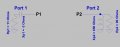
Here is the statement of the problem: Design an 'L-Network' to match port 1 to Port 2: --- (Scroll down to the next image to see the solution)
ExLnetExercise.jpg


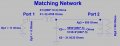
Here is a properly matched system: (Please see next image for some perspective on port reactance compensation)

LnetWithX.jpg

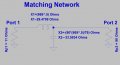
Here is the system sans port reactances -- What do the differences in the network reactances (by comparison to the above image) tell you about compensation of port reactance??? (Post continued below image)

LnetNoX.jpg

@RRITESH KAKKAR


Please explore the above examples! -- Further to that - a review of post #145 'through the lens' of your knowledge of resistance/reactance behaviour is highly advised!

Note that solution of the problem of post #113 is less involved than that of the above example in that only a single port is reactive and its impedance is in 'series form'...

This truly is very basic 'stuff'! -- the illusion of complexity owes to nothing more than 'misalignment' of perspective!:):):)

Please note: the below quoted 'hint' verges on exposition!:cool::cool::cool:
--Sledgehammer hint--
Re: Two reactor networks -- As may should be obvious:
System Quality Factor (Q) = √(transformation_ratio-1) {transformation_ratio|transformation_ratio>1}

Please 'dwell' on it! --- The implications of this are 'huge'!!!:cool::cool::D
As always, all questions and comments are both welcome and expected!:)

Very best regards
HP:)
 
@RRITESH KAKKAR

Post #113 presents an extremely basic problem which you are perfectly capable of solving!!! -- Hence I am left to conclude that you are either lazy and/or insincere!:mad: --- Difficulty with concentration is one thing --- larking about and feigning ignorance are quite another!:mad: --- As you may have noticed I neither yield to 'peer pressure' nor board 'band wagons' -- I draw my own conclusions based upon my own observations! ---That said, I'm sorry to say my opinion of your intent here is rapidly converging with those of your critics!:(:rolleyes:

If you wish to continue studying let me know --- But be prepared to remain focused on this thread during a lesson! -- and make a sincere effort!

I have been more than patient with you! --- I regard your abortive inattention annoying and your insincerity straight up rude!

Enough said!:rolleyes::mad:

Most sincerely

HP
 
Top