Electronic Circuit Question.

@RRITESH KAKKAR

It occurs to me that the 'block' you seem to be experiencing with the current exercise may owe to misapprehension as regards impedance transformation via networks (arrangements) of discrete reactors...
Here I present an example of transformation of 10v to over 60V via a series resonant RLC circuit --- While not directly applicable to the exercise, this is intended to set you upon the right path!:):):)
Note that, with some qualification, impedance may be thought of as EMF to current ratio!

Please note that following is not to be confused with other impedance transformation schemes/phenomena (i.e. mutual inductance, 'buck/boost', etc...)

I hope you find this helpful!!!
/////////////////////////////

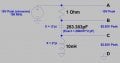
Within the confines of this discussion, resonance is a condition wherein 'opposite' reactor types exhibit reactances of equal magnitude but opposite sign and, hence, 'cancel' -- Below is a representation of a series RLC circuit at resonance -- Please consider the following:

Because EMF lags current by 90° in a purely reactive, net capacitive circuit, capacitive reactance is said to be negative.
Because EMF leads current by 90° in a purely reactive, net inductive circuit, inductive reactance is said to be positive.


With reference to the below attached schematic:
Reactor 1 (The capacitor) exhibits a reactance of -2πΩ @ a frequency of 100MHz
Reactor 2 (The inductor) exhibits a reactance of 2πΩ @ a frequency of 100MHz
Hence the circuit is said to be resonant @ 100MHz

Owing to their series connection, the net reactance = the sum of the reactances = 0Ω. Thus the net impedance = the value of R = 1Ω
Thus it is that the current through the circuit is determined by the EMF of the power supply (1oV Peak) and the resistance of R (1Ω) 10V (Peak)/1Ω= 10A (Peak)

Ohm's law tells us that the EMF across a pure reactance = I*X = 10A*2π ≈ 62.83V in the case of the inductor --- And 10A*2π ≈ -62.83V in the case of the capacitor (note that the signs indicate the respective phase shifts)
In theory any finite transformation ratio is possible via proper choice of the reactors and the resistor.

Illustration of a series RLC circuit at resonance -- Post continued below image...
SLCImg.jpg

As an aside please consider a parallel resonant circuit.

Via the technique of calculating the equivalent value of paralleled resistors or pure reactances:
1/(1/Xc+1/Xl)=Xnet but since Xc=-Xl at resonance: 1/(1/-x + 1/x) = 1/(0/x^2)=1/0 = (For these purposes)
Thus we see that a parallel LC circuit at resonance presents as an 'open circuit'

Again, hope to have been of help!

Best regards
HP:)
 
Last edited:

Thread Starter

RRITESH KAKKAR

Joined Jun 29, 2010
2,829
As an aside please consider a parallel resonant circuit.

Via the technique of calculating the equivalent value of paralleled resistors or pure reactances:
1/(1/Xc+1/Xl)=Xnet but since Xc=-Xl at resonance: 1/(1/-x + 1/x) = 1/(0/x^2)=1/0 = ∞ (For these purposes)
Thus we see that a parallel LC circuit at resonance presents as an 'open circuit'
 

Thread Starter

RRITESH KAKKAR

Joined Jun 29, 2010
2,829
Note that post #149 is excerpted from post #113
Inasmuch as the exercize deals exclusively with reactances specification of frequency is unecessary:)
Yes it is.

OK, it is already given the reactance then where to move i mean what to do?

if we will connect port a to b what will happen?
 
Top