Electromagnet waveform

Thread Starter

cmartinez

Joined Jan 17, 2007
8,762
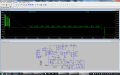
Me-no-like the way the 27K resistor between out and (+) behaves... it's too much hysteresis and the current through the coil oscillates too widely. So I changed the value to 330K and it looks a lot better now.
 

ronv

Joined Nov 12, 2008
3,770
It's just the coil. If you make the inductance higher the pulse will last longer. Same I think with higher current.
 

Thread Starter

cmartinez

Joined Jan 17, 2007
8,762
It's just the coil. If you make the inductance higher the pulse will last longer. Same I think with higher current.
Ok then... I'll get started with the PCB's design (using the SMT schottky that I mentioned) and then I'll come back with more news... Thanks for your help!
 

ronv

Joined Nov 12, 2008
3,770
Yes, If you leave the pot at 100k the resistor will need to be 270 or 333k. I'm just nit picking now.
The diode is a good one. very low Vf.

Edit:
I'm a slow typer. Our posts are crossing.
 

Thread Starter

cmartinez

Joined Jan 17, 2007
8,762
Yes, If you leave the pot at 100k the resistor will need to be 270 or 333k. I'm just nit picking now.
The diode is a good one. very low Vf.

Edit:
I'm a slow typer. Our posts are crossing.
Well, I did change the pot's value to 10K as you suggested, but if I use 27K for the feedback resistor then current through the coil becomes too jagged... just change its actual 330K and see for yourself.
 

Attachments

ronv

Joined Nov 12, 2008
3,770
Well, I did change the pot's value to 10K as you suggested, but if I use 27K for the feedback resistor then current through the coil becomes too jagged... just change its actual 330K and see for yourself.
Tie the top of the pot to +12 instead of PWM and set it for about 0.15.
I think we are both tired.
 

Thread Starter

cmartinez

Joined Jan 17, 2007
8,762
Alright... have been checking power dissipation at the mosfets, and the worst one seems to be M1, with an average of 1W ... so I guess large heat sinks are not critical here... gonna use the standard small ones
 
Last edited:

Thread Starter

cmartinez

Joined Jan 17, 2007
8,762
Little ones are ok... none of them dissipate more than 1/8 of a watt. BUT the diode array pair is dissipating roughly 2W !
 

Thread Starter

cmartinez

Joined Jan 17, 2007
8,762
Ron, I've placed 180V TVS diodes across drain and sink of M1 and M3, since they're working at 120V differentials. But I'm not sure about M2, since it's working at only 12V. And what about placing TVS's between gates and sources of the same mosfets, would you recommend it?
Also, the MPSA42 transistor has specs for 300V, and it's working at 120V, should I place another TVS in there, or would it be overkill?

EDIT: I see that M1 already has a zener between gate and source.
 

ronv

Joined Nov 12, 2008
3,770
I think M2 and the transistor are pretty safe. Maybe zeners on M3 and a 10 ohm or so in series with the gate drive.
In your layout try and keep the gate drive close to the gate and source.
 

Thread Starter

cmartinez

Joined Jan 17, 2007
8,762
My layout's already halfway there... now I just need to add the MCU and a couple of sensor interfaces (to let the MCU know what's going on with the other valves) and I'm all set... to program a couple of hundred lines of assembly code :confused:

Capture.JPG
 

Thread Starter

cmartinez

Joined Jan 17, 2007
8,762
Ron, take a look at this.

I've added the HP signal as an input to the second comparator (U3) so that now the initial pulses never reach zero, as in the original measurements. What do you think?
 

Attachments

Thread Starter

cmartinez

Joined Jan 17, 2007
8,762
Ron,

I'm thinking about using a DPDT relay switch to bypass the valve's original driver to the driver we've designed. This is because I want to make 100% extra sure that our driver's signals NEVER get mixed with the original computer's signals. Is there a way of doing this with mosfets and making it foolproof? That is, is there a solid state component that could act as a break-before-make switch for this application, and that if it ever fails it would NEVER short circuit both signals?
 

ronv

Joined Nov 12, 2008
3,770
Ron,

I'm thinking about using a DPDT relay switch to bypass the valve's original driver to the driver we've designed. This is because I want to make 100% extra sure that our driver's signals NEVER get mixed with the original computer's signals. Is there a way of doing this with mosfets and making it foolproof? That is, is there a solid state component that could act as a break-before-make switch for this application, and that if it ever fails it would NEVER short circuit both signals?
Looks good. I added a diode to turn off the pwm at the end and hooked it up to the +12.
How about just a dpst switch on the coil to switch it in and out.
 
Top