Electromagnet waveform

ronv

Joined Nov 12, 2008
3,770
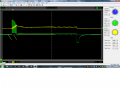
Sure, the thing that has bothering everyone is the 12 volts across the coil and only 3.8 amps.
If you move the 0 volt line down on the scope it will be more like 2 or 3 volts across the .62 ohms.
 

Attachments

Thread Starter

cmartinez

Joined Jan 17, 2007
8,761
Sure, the thing that has bothering everyone is the 12 volts across the coil and only 3.8 amps.
If you move the 0 volt line down on the scope it will be more like 2 or 3 volts across the .62 ohms.
You mean I'm getting confused because of the green trace's resolution in my screen?
If I were to move the channel 1 marker further down, so as to make it fit exactly at the 0V level, then the constant voltage part of the waveform is not 12V but 2 or 3V ? is that it?
 

ronv

Joined Nov 12, 2008
3,770
You mean I'm getting confused because of the green trace's resolution in my screen?
If I were to move the channel 1 marker further down, so as to make it fit exactly at the 0V level, then the constant voltage part of the waveform is not 12V but 2 or 3V ? is that it?
Yes. I suspect they are using constant current so they can make sure the current thru the coil is the same no matter how far away the valve is from the controller.
 

Thread Starter

cmartinez

Joined Jan 17, 2007
8,761
Yes. I suspect they are using constant current so they can make sure the current thru the coil is the same no matter how far away the valve is from the controller.
:eek: Well I'll be... I might not be so knowledgeable, but yes... it makes perfect sense.
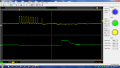
But the initial pulses are there to accelerate the valve's opening, isn't it? And, that would mean that I'd have to make a constant current circuit to drive the valve after those initial pulses, right?
 

ronv

Joined Nov 12, 2008
3,770
It's only my guess....
I think they PWM the 120 volts just to get about 60 volts average to open the valve quickly. When the current reaches say 8.5 amps they turn that circuit off and use PWM to control the 12 volt circuit at 3.5 amps or so. Or maybe they just switch the current on the 120 volts to 3.5 amps similar to the injection circuit.
 

RichardO

Joined May 4, 2013
2,270
It's only my guess....
I think they PWM the 120 volts just to get about 60 volts average to open the valve quickly. When the current reaches say 8.5 amps they turn that circuit off and use PWM to control the 12 volt circuit at 3.5 amps or so. Or maybe they just switch the current on the 120 volts to 3.5 amps similar to the injection circuit.
ronv:
Do you think that the 120 volts on the coil could just be the back EMF of the coil clamped to 120 volts? In other words ... is there a 12o volts power supply at all?

cartinez:
I think we may need more time resolution of the 28 kHz pulses to see what the voltage and current of the coil are really doing.
 

Thread Starter

cmartinez

Joined Jan 17, 2007
8,761
ronv:
Do you think that the 120 volts on the coil could just be the back EMF of the coil clamped to 120 volts? In other words ... is there a 12o volts power supply at all?

cartinez:
I think we may need more time resolution of the 28 kHz pulses to see what the voltage and current of the coil are really doing.
Ok, here's a higher resolution image of the voltage waveform.
In the previous posts, the images show the waveform with the scope's probe connected to one side of the coil (what I call the positive side), and the same probe's ground hooked to the other side. That's why the -75V pulse at the end of the waveform is shown in the same trace. I took the measurements using my USB hantek scope with my laptop.
In this image, I connected one probe to the positive side of the coil (shown in yellow) and the other one to the other side (shown in green) while both probe's grounds were connected to the machine's chassis. So instead of the yellow trace ending with a negative pulse, it ends in zero volts, while the green trace remains as zero volts, and delivers a 75V pulse in the end.
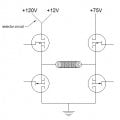
This is why I'm guessing that we have two power supplies connected to the coil, most probably using a mosfet H bridge.
Does this help?
 

Attachments

ronv

Joined Nov 12, 2008
3,770
ronv:
Do you think that the 120 volts on the coil could just be the back EMF of the coil clamped to 120 volts? In other words ... is there a 12o volts power supply at all?

cartinez:
I think we may need more time resolution of the 28 kHz pulses to see what the voltage and current of the coil are really doing.
No, The back emf goes negative, but the picture makes it more complicated because it looks like there is some kind of control over the 120 volt pulses as well. See how the time of them varies?
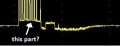
C, maybe one more picture blown up around 0 volts. It doesn't matter if the top of the pulses go off the screen just where ground (or 0 volts is). Maybe 5 volts per division. I'm trying to figure out why it doesn't get all the way to ground. Maybe it is clamped to 12 volts or something.
Do you know if there is some reason they used 120 volts? It looks like less would have given the same waveform.
 

ronv

Joined Nov 12, 2008
3,770
Yes, that part, but with the first part with no voltage right on the line, and maybe the bigger picture.
 

Thread Starter

cmartinez

Joined Jan 17, 2007
8,761
Yes, that part, but with the first part with no voltage right on the line, and maybe the bigger picture.
Alright, no problem. But it's gonna take a few days.... I'm not sure I understand your request "with the first part with no voltage right on the line"
Another question, what's the proper way to hook up the oscilloscope? With two probes, one on one terminal of the coil, and the other one on the other (both grounded to chasis)? Or only one probe connected to the positive side, and the probe's ground to the other side? Or it makes no difference?
 

ronv

Joined Nov 12, 2008
3,770
Let me see if I can't blow that one up.
If 0 was right on the center line it would make reading the voltage more easier. No biggie. :D
As long as the scope is floating just 1 probe usually is easiest.
 

Thread Starter

cmartinez

Joined Jan 17, 2007
8,761
Let me see if I can't blow that one up.
If 0 was right on the center line it would make reading the voltage more easier. No biggie. :D
As long as the scope is floating just 1 probe usually is easiest.
Well the scope wasn't floating on any measurement that I took... It was either grounded to the machine or the ground was referenced to the opposite pole of the coil. What I do know, is that neither one of the poles is connected to ground, at least when the machine is turned off. That's why I suspect the coil's connected to an H bridge, though I might be just plain wrong, of course.

Capture.JPG
 

ronv

Joined Nov 12, 2008
3,770
Here is what I think is happening. May be hard to follow.. :rolleyes:
As always it begins with in the beginning.
There are 2 supplies. A 120v and 12 volt.
The high current pulse is PWM with some maximum on time and an off time based on the current. This is why the period is longer as the current is building in the coil.
During the high current pulse the clamp or flyback diode is connected to the 12 volt supply so the inductive kick doesn't go below 12 volts.
The high current pulse may be terminated when the current reaches 8.5 amps or by time - maybe both. I'm not sure why now the voltage goes all the way to ground at the end of the high current pulse, but it is probably due to the way the supplies are switched.
At this time only the 12 volt supply is used and it is also PWM holding the current at 3.8 amps or so.
At the end when the 12 volts turns off all he clamps are off and the clamp voltage goes to -75 where is either clamped by a zener or avalanche breakdown of the 12 volt switching FET.
It seems more complicated than it needs to be, but maybe there is a reason like the valve can be a long ways from the control unit??
 

Thread Starter

cmartinez

Joined Jan 17, 2007
8,761
Here is what I think is happening. May be hard to follow.. :rolleyes:
As always it begins with in the beginning.
There are 2 supplies. A 120v and 12 volt.
The high current pulse is PWM with some maximum on time and an off time based on the current. This is why the period is longer as the current is building in the coil.
During the high current pulse the clamp or flyback diode is connected to the 12 volt supply so the inductive kick doesn't go below 12 volts.
The high current pulse may be terminated when the current reaches 8.5 amps or by time - maybe both. I'm not sure why now the voltage goes all the way to ground at the end of the high current pulse, but it is probably due to the way the supplies are switched.
At this time only the 12 volt supply is used and it is also PWM holding the current at 3.8 amps or so.
At the end when the 12 volts turns off all he clamps are off and the clamp voltage goes to -75 where is either clamped by a zener or avalanche breakdown of the 12 volt switching FET.
It seems more complicated than it needs to be, but maybe there is a reason like the valve can be a long ways from the control unit??
The valve is about 3m from the control unit, and it goes through changes in temperature, maybe up to 85°C
 

ronv

Joined Nov 12, 2008
3,770
Alright, no problem. But it's gonna take a few days.... I'm not sure I understand your request "with the first part with no voltage right on the line"
Another question, what's the proper way to hook up the oscilloscope? With two probes, one on one terminal of the coil, and the other one on the other (both grounded to chasis)? Or only one probe connected to the positive side, and the probe's ground to the other side? Or it makes no difference?
The valve is about 3m from the control unit, and it goes through changes in temperature, maybe up to 85°C
Do you want to duplicate it exactly or only functionally?
 

ronv

Joined Nov 12, 2008
3,770
More like a block diagram, but you can get an idea of the difference in timing.
I used 24 volts and a .6 ms pulse for the high current then pwm for the hold current.
I haven't figured out how not to clamp it at turn off yet. Do you think it needs to turn off fast or just on fast?
 

Attachments

Top