Electric Circuit with Diode and Capacitor

Thread Starter

Vihaan@123

Joined Oct 7, 2025
220
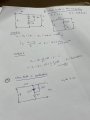
This is another circuit which i am trying to solve, i have few questions please help to clarify
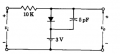
1761803024410.png

My work is as attached,
Q1. When the diode is non conducting which method do i need to use to calculate i(t)?
Q2. At exactly 3.7V of the input voltage, the diode will not start conducting, how to calculate the exact value at which point it will start conducting?
 

Attachments

WBahn

Joined Mar 31, 2012
32,702
The presence of the capacitor greatly complicates any analysis and you can't ignore the shape of the input waveform. A slowly ramped (effectively DC) waveform will yield a very different result than a sinusoidal waveform, which will be very frequency dependent, and that will be very different from a pulsed input waveform.
 

MrAl

Joined Jun 17, 2014
13,667
Ok the textbook problem was to check for pulsed input waveform but i considered it for sinusoidal and solving it.
Hello there,

It looks like you would use the step response for this and solve for the time 't' when the diode starts to conduct.
It is more interesting though with a sine wave or cosine wave but you still solve for 't' when the diode starts to conduct.

If you are having trouble with this, start by assuming that 3v source just 0v which means it's not there and the cap connects to ground. That would be a first step in learning how to do these. You still have the diode voltage of 0.7 volts though.
 

ericgibbs

Joined Jan 29, 2010
21,390
hi V123,
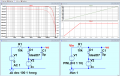
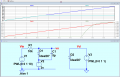
These two LTSpice simulations should help you understand the operation of the circuit.
1. the Frequency response plot
2. A 0V through 10Vdc ramp up input voltage.
[the diode has been configured to close to 0.7Vfwd drop]

E
EG 1803.png
 

MrAl

Joined Jun 17, 2014
13,667
hi V123,
These two LTSpice simulations should help you understand the operation of the circuit.
1. the Frequency response plot
2. A 0V through 10Vdc ramp up input voltage.
[the diode has been configured to close to 0.7Vfwd drop]

E
View attachment 357983
Hi Eric,

He seems to be indicating that the diode is ideal, but it is ideal such that when it conducts it drops 0.7 volts. That's different than when it conducts and drops 0.0 volts. That would make a difference because if there was nothing dropped then the circuit would clip at 3.0v not at 3.7 volts.
That's what it looks like anyway :)
 

MrAl

Joined Jun 17, 2014
13,667
This is another circuit which i am trying to solve, i have few questions please help to clarify
View attachment 357914

My work is as attached,
Q1. When the diode is non conducting which method do i need to use to calculate i(t)?
Q2. At exactly 3.7V of the input voltage, the diode will not start conducting, how to calculate the exact value at which point it will start conducting?
Hello again,

It seems that you might need more help with this.

There are a couple ways to handle this, maybe more than that.

1. If you know the voltage divider formula for impedances, you can calculate the voltage across the cap and go from there. The voltage would be due to the input Vi minus 3v and then later add that 3v back. If the input Vi is most general then you probably have to put this into a form like when using an integrating factor for solving differential equations. You end up with a simple equation with a sort of convolution integral in it. If it is a step input it's much easier.
2. If you use Laplace Transforms you can write the equation in the frequency domain with a general Vi(t) transforming to Vi(s), then later determine what you would like to try for Vi(s). Knowing the voltage divider formula helps here too.

Since the Laplace Transform method is pretty easy, we can look into that right now.
Starting with the impedance of the cap zc=1/(s*C). Then the voltage divider formula for the voltage across the cap is:
Vc=V*zc/(zc+R)
which comes out to
Vc=V/(s*R*C+1)
where V is the voltage that includes both the input source and the 3v source: V=Vi-3 and transformed it becomes Vi-3/s.
So we now have:
Vc=(Vi-3/s)/(s*R*C+1)
and because we want Vout and this is Vc we have to add that transformed 3v back:
Vout=Vc+3/s
which comes out to:
Vout=(Vi-3/s)/(s*R*C+1)+3/s
and simplified:
Vout=(3*C*R+Vi)/(s*C*R+1)
keeping in mind that Vi is really the frequency domain version of the input which would be written Vi(s) not Vi(t).
That is the result for the output voltage before the diode conducts.

Next we would substitute the actual input voltage form for Vi(s) and then use the inverse Laplace Transform to find the time domain solution like f(t). We would then set that equal to 3.7 volts plus an infinitesimally small voltage dv because that is what we consider the voltage to be when the diode just starts to conduct. Because dv is so small though, we just use 3.7 volts and that brings us to:
f(t)=3.7
We then go on to solve this for 't' the time when the diode just starts to conduct or is just ready to start conducting. In any case, it is when the diode starts to perform a clamping action which limits the output to 3.7 volts. That should answer your question about that as well.

It is also wise to take a brief look at how the circuit is bound to evolve based on the simple workings of the capacitor during some special times like t=0 and t going toward infinity.
At t=0 the cap is a short circuit (assuming no initial voltage Vc0). That means the output will always start at 3.0v (unless maybe the input Vi is an impulse, but we can look at that later). At t going toward infinity, the cap is an open circuit, so the output is defined by the other components and the input voltage if it changes. For a step input the cap would go open, for a sine input it may not, or may only be open for some time periods.

If we end up with a sinusoidal output then we could have several cycles of up and down for the output Vout. For example, if Vi(t)=3*sin(t) then we would see the voltage work it's way up, the diode starts to clamp the output to 3.7v, then the voltage will work its way down again. To find the wave when it starts to drop again we have to include the initial voltage of the capacitor.

The sinusoidal input is much more interesting as you can gather, but it is also harder to solve for because we can have many times when the output voltage goes up and goes down and keeps repeating. Therefore I would suggest you start with a step input like 3v, but you can also try other steps like 1v, 2v, 4v, etc., and see what you can glean from that.
Once you do that, then after getting the solution for a step like Vi=4 volts stepped, then using the initial voltage of the capacitor (which would be 0.7 volts at that time) change the input Vi to be 0 volts and see how the output changes then. This would prepare you for working with a sine wave much better than starting with a sine wave or cosine wave.

I know there is a little bit more to this than you might feel comfortable with at first, but it gets easier. If you have any more questions about all this feel free to ask here :)
 
Top