EHT power supply design and construction

@shortbus -- Many thanks for your reply!

Since the Faraday screen is 'flexible' wouldn't it deform when all of the parts are assembled to the case?
Quite possibly! -- At very least 'manually-assisted' 'de'-formation should be possible:cool:

Can you show a photo of the type of indicator your talking about?
Lemme 'mine' my NOS/UOS d'Arsonval 'cache' for an example!:)

Very best regards
HP
 
Kind friends --- please give this a look and let me know whatcha think!:)


Overview (Passive EHT Indicator)

Principal Design goals:

-To accurately measure 'floating' (i.e. non-ground referenced) DC EMFs to 100kV. (Zin=800MΩ).
-To accurately measure positive or negative ground referenced DC EMFs to 75kV. (Zin =400MΩ).

-To achieve stable readings via: Grounding of cabinet and contents (including the d'Arsonval movement) --in all operating modes-- and full electrostatic shielding of the d'Arsonval movement.

-To assure meaningful readings via presentation of the 'circuit-under-test' with a (Ca. 250%) 'heavier' load than provided by commonly available 'high voltage probes'.

-To provide greater EMF range and power handling than available from test equipment intended for servicing of CRT display systems.

-To enhance electrical 'ruggedness' in EHT environments via eschewal of semiconductor components (with the sole exception of the movement protection 'clipper').


Please note: that this 'installment' is an overview only! -- The primary functions of which being familiarization of the reader with the instrument's 'general anatomy' and sub-assembly designations! Please rest assured that minute details will be given in the (forthcoming) construction articles!


Schematic based upon the desirable dropping resistances / Typical d'Arsonval impedance.


Mode detail


Frontal view of assembled unit: (Note that improved d'Arsonval mounting will be presented in the construction articles).


Rotated view of assembled unit: Illustrative of the 'pole septum' assembly.


Front panel detail:
(Faraday shield dismounted).


'Mini-Fed' well and plug detail.


Interior view of 'Mini-Fed' Well.


Mini-Fed plug detail (Note the tape-wound PTFE 'alignment ribs').


Full view of test leads -- Test clips exposed.


Full view of test leads -- Test clips retracted.


Towers partially removed -- Note that same are attached to the cabinet assembly via threaded steel bolts.


Appearance of Cabinet assembly following removal of towers.


Tower port detail: Note top of PCV 'mast step' (to be shown presently) visible beneath grommet...


Appearance of uninstalled towers ('well-ends' bottom of image)


Appearance of uninstalled towers ('fastener-ends' bottom of image).


Interior cabinet view (perspective 1).


Interior cabinet view (perspective 2)


Interior cabinet view (perspective 3)


Mode selection/calibration subchassis detail.


Inasmuch as there seems to be some considerable confusion as regards the nature of the 'mast steps' - I have included the following draft by way of exposition...

Note that the 'receiving fasteners' are each fabricated of a steel hex nut soldered to the center of a 'fender washer' having an OD slightly less than the ID of the associated PVC end-cap (such that said washer is effectively 'pinched' between the end of the PVC tube segment and the 'breach' of said end-cap...

Installed positions of Tower components and chassis... Please note that ---for the purposes of this illustration--- cabinet and cabinet-cover are drawn as a single piece denoted 'chassis' below...


Best regards
HP
 

shortbus

Joined Sep 30, 2009
10,049
I have no comment on the presentation, but do have a question on what is happening overall. What kind of wire is the test leads made of? The reason for the question is that everything they are connected to is way larger and seems to be made to withstand the voltages involved, but the wires don't seem to have the same amount of insulation on them.

I guess what I'm saying is why do the 'mast and mast step' look to be so much larger and have much more insulation than the thin wires?
 
What kind of wire is the test leads made of?
We recommend UL3239-60kV (as per annotation of THIS IMAGE on post #1947) --- I apologize that what might quaintly be termed a "communication breakdown" between @Aleph(0) and myself has lead (Led?;)) to a rather 'non-linear' approach to this discussion -- To wit: please regard the project 'overview' (i.e. post #1962) as the 'official' initial post Re: this project!:cool: -- All construction details/design rationale to follow in subsequent construction articles:)

I guess what I'm saying is why do the 'mast and mast step' look to be so much larger and have much more insulation than the thin wires?
Hey @shortbus I promise to provide a direct response to your questions:) But first, I offer the following by way of clarification:

The 'masts' (said assemblies designated 'Towers' in the overview) each contain a single coaxially located 400MΩ, 15W 'EHT dropping resistor' potted in paraffin 'wax' -- Whereas the 'mast steps' merely anchor the 'towers' to the chassis/cabinet assembly and provide 'low end' electrical connection from the dropping resistors to the 'metric circuitry' (via lengths of 28 AWG solid Ag, kynar insulated leads each being connected to their respective "step's" metallic 'receiving hardware' thence emerging through said "mast step's" wall -- said leads being non-conspicuous in the overview photographs, but graphically depicted via the 'yellow line' in the step exposition diagram at the end of the overview and re-linked immediately below:


Note that EHT insulation is not necessary 'below' the dropping resistors! -- Please consider:

Given:
1) Rdrop =400MΩ each side.
2) Rmetrics (i.e. the effective resistance of Rd'Arsonval shunted by calibration resistance{s}) = 1kΩ (which being a rather high allowance).

Worst case 'low end' EMF (Balanced Mode) =
(Eapplied*Rmetrics)/(2*Rdrop+Rmetrics) = (100kV*1kΩ)/(2*400MΩ+1kΩ) ≈ 125mV

Worst case 'low end' EMF (Ground-referenced modes) =
(Eapplied*Rmetrics)/(Rdrop+Rmetrics) = (75kV*1kΩ)/(400MΩ+1kΩ) ≈ 188mV

Thus it may be seen that the contents of the cabinet (including the 'mast steps') needn't handle more than a scant two tenth's of a volt:) -- And... Oh yeah! To all fairly shouting 'how dare we use so poor a conductor as galvanized steel bolts on the (very low-EMF) 'low end'? I enjoin you to ponder the implications of a resistive connection in said circumstances;)

@shortbus as promised -- direct answers to your questions:


I guess what I'm saying is why do the 'mast and mast step' look to be so much larger and have much more insulation than the thin wires?
Our selection of 1" ID (SCH 40) PCV tubing for the Towers and Mast steps owes to several considerations:

1) Structural integrity -- Based upon our polls, it seems most readers are not possessed of quality AM (i.e. additive manufacturing) equipment and are not interested in purchase of same. Moreover, the small number of respondents indicating interest in fabrication via said technique tended to favor dubious consumer-grade equipment (of the class marketed as '3D printers', etc...) -- Hence our search for/choice of a ready-made product -- It should be noted that some PVC products contain metallic 'filings' and/or other conductive contamination! Although I have not encountered said issue with SCH 40 forms, I nonetheless, strongly advise subjecting prospective PVC materials to the 'MWO test' (to be outlined in the construction editions) prior to incorporation of same where electrical properties are important!

2) Facilitation of potting (Re: the 'towers') -- The physical dimensions and thermal properties of the selected tubing greatly eases potting of the dropping resistors...

3) Workability -- PVC tubing being, as it is, a non-brittle yet strong polymer material offers the ease of workability and strength of hardwood coupled with the highly favorable electrical properties of (most) dense polymers.

4) Versatility (i.e. accommodation of various resistor form factors) -- Come to that, there's nothing 'magic' about 1" ID -- Larger forms may be used where required... Recall that this article is a construction example -- it would be all of unrealistic (and intensely annoying) were we to assume all readers enjoyed ready access to resistor styles that, although yet widely available, have been 'out of production' for several decades... Indeed! Some readers may wish to merely string 'focus resistors' in series, or employ modern 'printed planar' EHT resistors (examples of which will be photographically illustrated in the construction edition) -- Further to the above, PVC tubing offers the versatility and convenience of standardized dimensions and chemical properties accommodative of wet or dry potting...

The reason for the question is that everything they are connected to is way larger and seems to be made to withstand the voltages involved, but the wires don't seem to have the same amount of insulation on them.
---Emphasis Added---

1)
Off-label design mandates over-design!:D --- Then too our design criteria provides for 'painless' range-extension of floating EMF measurement to 200kV (25W dissipation per resistor) and ground-referenced EMF measurement to 100kV (25W dissipation the applicable resistor) for those wise in the ways of brevity of connection and disciplined in observation of instrument duty cycle!...

As a possible point of interest, our tests show that minimum external flashover EMF (per tower) ≈ Ca. 270kV (Arc path: 'Breakout' at the Mini-Fed well ⇒ along the tower/over the ribs ⇒ to the mounting stud -- note that the tests were performed with the tower vertically mounted to a 'test jig' simulative of the cabinet -- Please bear in mind that, although no single tower would drop > 100kV during the above proposed 'extended-range operation', we are uncertain that 270% represents a sufficient 'margin of safety' - then too the resistors are rated only to 80kV (each) - hence our present 100kV (balanced {two resistor})/75kV (Unbalanced {Single-resistor}) arrangement/recommendation...

2) Re: the 'scantily clad' lead in question (i.e. UL3239-60kV) while it will indeed 'hold-off' 60kV sans immediate 'breakout', it vigorously 'sprays' corona and rapidly degrades in the presence 'gradient inducing' conductors/surfaces. As an example, charged with ground-referenced 50kV, its 'life expectancy' at 2cm from a grounded conductor is less than 10 minutes! Thus it seems UL's 'name game' strikes again!:rolleyes: For all that, its DC electrical properties are far superior to those of the best metallic-core 'spark plug wire' available! -- Indeed, carefully dressed, it is quite adequate to 100kV...

Do I hear you ask why we don't merely use/recommend better lead and, hence, save our readers the hassle? -- Good question!:) For the answer please consider the alternatives:

1) Federal Standard Cable --- I doubt our readers would appreciate the Ca. $100 per foot 'price tag' nor incessant 'wrestling bouts' with large (OD ≈ 0.80"), obdurately torpid cable. Moreover, were we to 'go that route' a proper arrangement via Federal Standard wells and plugs would be in order --- All said and done DIYing 'Federal style' would very likely come higher than purchase of a 'good used condition' industrially manufactured radiography certified 'voltage divider' (Ca. $3500) -- such being less than appealing to many hobbits/students...

2) Electrical enhancement of the UL3239-60kV (for true 150kV insulation) via sheeting same within 5/16" 'pex'/'poly' tubing -- Although I am told (by reliable sources) that some have had success with this, my experience in said regard has been as the familiar Synoptic Re: the admissibility of 'camels' to 'eyes of needles', etc:( --- That said, my mind is wide open should anyone have a suggestion!:)

OBTW @shortbus --- Below are the promised images of a 'bug-eyed' d'Arsonval unit...

DomeDar1.jpg DomeDar2.Jpg

Very best regards
HP:)
 
Last edited:

shortbus

Joined Sep 30, 2009
10,049
Below are the promised images of a 'bug-eyed' d'Arsonval unit..
If still using the earlier suggested (by you) anodized aluminum screen mesh I see no problem with using a unit like that. But if there was, a simple spacer could be added between the screen and the meter face, to stand it off and allow the screen to stay flat against the wall of the enclosure.
 

shortbus

Joined Sep 30, 2009
10,049
But first, I offer the following by way of clarification:
I understood that the towers contained the resistors and the need for the 'mast steps' to be the same size for support. I didn't think that a wire that thin would be able to take the EHT voltage and live though. Since there is a dropping resistor in the tower anyhow, is there a reason for not using automotive "resistance spark plug" wire for the leads? Having worked for the last 8 or so years of my employment where they made both the wire and complete plug leads, the wire as it was being made was continually tested to ~100KV. This was a 'wet' test, as it came out of the continuous autoclave that cured the final layer of silicon rubber. So it should hold up even higher voltages when it is final cured and dry. I say final cured because it wasn't cut into individual plug leads for 7 or more days after being made. The wire I'm talking about is ~8mm diameter and very flexible.

.
 

Thread Starter

Aleph(0)

Joined Mar 14, 2015
597
@shortbus Main problem with ignition wire is it can't take steady DC:(! So just guessing, since output of ignition coil is basically AC, it prolly has something 2 do with electrolysis or like that? Also insulation on ignition wire is just pulse rated at max voltage spec. So as example 50kV ignition wire only needs 2 handle maximum of like 100μs-1ms pulses of 50kV to initiate spark then rest of energy (which is like 99% of energy) is in long duration way lower voltage ringoff damped by arc in plug gap. So anyhow average voltage in ignition system is usually just 10% peak. So IDK if continuous application of max pulse-rated voltage is problem but DC definitely is:(.

Now abt resistor wires, problem we have with all we tested is resistive material opens up after ttl time of abt 2 hrs even with just moderate DC HV (like 40kV). So how we know it _opens_ instead of just increases value is it totally stops conducting at voltages < abt 15 kV and above that it gets _hotspots_ from internal arcing with heat basically turning silicone insulation into sand b4 just crumbling . Also that's totally internal problem cuz _dressing_ wire away from anything doesn't help. So anyhow I don't know exactly why it happens at like _molecular level_ (but @Hypatia's Protege might anyhow she says she'll have time on here this weekend:)) anyhow based on our tests and inquires to NKG (sp?) tech, ignition wire's definitely _verboten_ for DC HV which I say is vry sad cuz it could've been easy solution to problem if it worked:(! So I say it only goes 2 show that everything's getting more and more specialized to just intended application which basically makes _art_ of repurposing way harder than it needs 2b:mad:!


If still using the earlier suggested (by you) anodized aluminum screen mesh I see no problem with using a unit like that. But if there was, a simple spacer could be added between the screen and the meter face, to stand it off and allow the screen to stay flat against the wall of the enclosure.
Shortbus HP saw ur posts but didn't have time 2 reply so she wanted me 2 let u know she totally agrees abt meter:)! Also she said they're way rarer than she thought cuz only ones she has are from ts-510a/u which is antique army signal generator (which in her collection she classifies as _Sgt. Saunders era_:confused:). So don't bother 2 ask who Sgt. Saunders is cuz IDK:oops: except 2 say maybe he's _The Colonial_ b4 he made like _his mark_:D

Anyhow she wanted me to extend her apologies for wasting ur time cuz _dome lens_ meters are too rare to worry abt ppl having and like u said screen can just be formed to lens anyhow!

Now I'm gonna tell u something! HP missed point abt possibility of screen being stretched over lens cuz she didn't get that _locator_ in diagram is just spacer:rolleyes:! Which even I could totally have told her!:p

So being 100% serious HUGE thanks to you (@shortbus) and @cmartinez for your help and feedback and also for being only ppl (that we know of) involved on thread who are highly skilled at drafting:)!
 
Also she said they're way rarer than she thought cuz only ones she has are from ts-510a/u which is antique army signal generator (which in her collection she classifies as _Sgt. Saunders era_:confused:). So don't bother 2 ask who Sgt. Saunders is cuz IDK:oops:
---Emphasis added---

Bang go my curatorial ambitions:oops::( --- Perhaps I meant Lt. Hanley era?:confused::D:p

Come to that, in consideration of its 'reliability' under fire:rolleyes: -- Perhaps said instrument might better be dubbed: "The Pvt. Slovik SG"?:mad::D

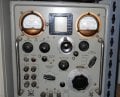
In the (admittedly unlikely) event anyone is interested -- Here's a 'bug eyed' TS-510A/U from my stock:
SigGen.jpg


So being 100% serious HUGE thanks to you (@shortbus) and @cmartinez for your help and feedback and also for being only ppl (that we know of) involved on thread who are highly skilled at drafting:)!
DOUBLE DITTO!:)

Very best regards
HP
 

shortbus

Joined Sep 30, 2009
10,049
@Aleph(0) , yes the tester used on the wire production line was AC @100KV. The tester consisted of a "brush" made of short pieces of bead chain that was powered by the voltage, and the wire being produced went through the "brush", before being wrapped on a big metal cable drum. When a new drum was put in the machine the wire was stripped to it's core and the core attached to the drum, which being metal on a metal machine that was at ground potential formed the rest of the circuit. If a bad spot was found in the wire a marking wheel would engage and print a stripe of white ink on the bad section of wire, signalling to an operator in later production that the wire was bad.
 

Thread Starter

Aleph(0)

Joined Mar 14, 2015
597
Perhaps I meant Lt. Hanley era?:confused::D:p
HP ok now from ddg I get that Sgt. Saunders and Lt Hanley are characters from SAME old time TV program!

Come to that, in consideration of its 'reliability' under fire:rolleyes: -- Perhaps said instrument might better be dubbed: "The Pvt. Slovik SG"?:mad::D
So it looks like Private Slovik was real life army soldier sentenced to chair for desertion? So ru saying signal generator totally quits when u need it most or just that it gives u electric shocks:confused:?

HP Anyhow I say ur2 funny:rolleyes:!
 

Jazz2C

Joined May 27, 2016
52
@Hypatia's Protege Just got your IM! Plz don't draw the wrong conclusions Re: my lack of participation! I swear it's all due to bad connections through my VPN! In fact Germany is now the only working freebie route and it's overloaded! Personally I think they should block data intensive traffic on the free channel! You know, games and media streaming, etc. So the small timers have a chance! If you look back you'll see I suggested bypassing Zen but @Aleph(0) was totally averse! So it's come down to a choice between nothing or next to nothing stability wise!:( Sure a paid subscription could easily be the best way forward but I don't trust Zen anymore!

Anywho I just reviewed your intro on post 1962! Hp you know I'd never lie to you! It's totally awesome!:cool: Just a heads up though! You dropped a "t" from "bottom" in "bottom of dropping resistor" in the diagram at the end of the intro. Personally I couldn't care less but I knew you'd want to know!

So it looks like Private Slovik was real life army soldier sentenced to chair for desertion?
ROFLMAO! A0 I highly doubt the military fools around with electric chairs! I mean REALLY! They have plenty of guns! Oh! Yeah! According to the wiki article, Slovik died of "lead poisoning" "lethally injected" at supersonic velocity!;)

I'm sorry if this sounds off! Everyone who's ever met me knows I'm not a callous guy! But the idea of the army using electrocution as a method of execution strikes me as totally hilarious!:D
 
Just a heads up though! You dropped a "t" from "bottom" in "bottom of dropping resistor" in the diagram at the end of the intro.
Ouch! --- Inasmuch as correction is complicated by the fact that it's part of an image (as opposed to text) such must await issuance of the next addition:oops: --- Many, many thanks for your attentive proofing!:)

But the idea of the army using electrocution as a method of execution strikes me as totally hilarious!:D
Ditto!:confused::D

So ru saying signal generator totally quits when u need it most or just that it gives u electric shocks:confused:
Based upon context -- Spec:
Come to that, in consideration of its 'reliability' under fire:rolleyes: -- Perhaps said instrument might better be dubbed: "The Pvt. Slovik SG"?:mad::D
What do you think (means of execution not withstanding)?:rolleyes::rolleyes::rolleyes:

SMH - gotta run!
HP:cool:
 

shortbus

Joined Sep 30, 2009
10,049
Just a heads up though! You dropped a "t" from "bottom" in "bottom of dropping resistor" in the diagram at the end of the intro. Personally I couldn't care less but I knew you'd want to know!
Those of us that have been with her from the start just assumed it was an obscure way of spelling/describing it. :)
 

shortbus

Joined Sep 30, 2009
10,049
Now abt resistor wires, problem we have with all we tested is resistive material opens up after ttl time of abt 2 hrs even with just moderate DC HV (like 40kV)
After thinking on this, aren't you trying some "double speak" here? Earlier in the thread when talking about TV flybacks that can and can't be suitable, we had an discussion on DC flybacks, the ones with internal diodes. Those were deemed unusable, because they aren't AC. Now you say resistance plug wire isn't usable because it breaks down over time with DC. But now comes the double speak, if the required EHT is AC, how does this make resistance plug wire unusable since the EHT is AC?

Or am I missing something yet again? That could very well be the case.
 

Thread Starter

Aleph(0)

Joined Mar 14, 2015
597
DC flybacks, the ones with internal diodes. Those were deemed unusable, because they aren't AC.
Shortbus output of flyback needs 2b AC cuz it needs 2b multiplied by Vabar cascade:)! All passive voltage multiplier topologies need AC input and are best with symmetrical sinewave!

Now you say resistance plug wire isn't usable because it breaks down over time with DC
Shortbus that's totally correct! Even when it isn't near wires at different potential! So I say resistance material gets electrolysed just by _corona current_ but that's just guess:confused:!

if the required EHT is AC, how does this make resistance plug wire unusable since the EHT is AC?
Shortbus THE REQUIRED EHT IS TOTALLY DC:)! But we need 2 start with sinusoidal AC from xfmr so we can _multiply_ it to higher (like 3X) voltage DC:)

So Shortbus I say plz remember these two things that we maybe aren't making clear enough:oops::

Diode-capacitor cascades (like Cockroft-Walton, Delon and Vabar) are also RECTIFIERS:cool:!

Even though we call transformer _LOPT_ and _flyback_ (cuz that's what it was in original application) we're definitely NOT applying it in flyback topology:eek:! It's driven by resonant-Royer so strictly fwd transformation:cool:! Voltage on xfmr secondary is symmetrical sinewave that automatically changes freq to match load (which I say is perfect thing abt using pwr oscillator for pwr conversion):)!

aren't you trying some "double speak" here?
But now comes the double speak
Shortbus I totally promise u we don't have like _hidden agenda_ of making things harder and more expensive than necessary:confused:! Is like @Hypatia's Protege's always saying _if functional inelegance is what readers want, FUNCTIONAL inelegance is what we must provide_ (she always puts stress on 2'nd _functional_ which o/c includes NOT compromising safety)!

So anyhow being clear plz think on this as like _block diagram_ of just one channel of PSU::)

Resonant Driver Xfmr Pri Xfmr Sec (40kHz-60kHz 27kVp sinusoidal AC) Vabar cascade 75kV *flat* (by which I mean <3% ripple) DC output under max load:)
 
Last edited:

shortbus

Joined Sep 30, 2009
10,049
@Aleph(0), this is the reason a long time ago in a world far away, wait that's some thing else. That's why way back I asked for a "block diagram" of what was happening in this project. You and Hp and maybe your imaginary group(the shirkers that are to timid to join this forum, and you know who you are, no one here does) have the knowledge of the total when finished project, but us outsiders, who are trying to help don't.

That was the reason for my question. And thank you for the answer.
 

Thread Starter

Aleph(0)

Joined Mar 14, 2015
597
You and Hp and maybe your imaginary group(the shirkers that are to timid to join this forum, and you know who you are, no one here does)
Shortbus sometimes I totally WISH some of them were just imaginary:rolleyes::p! Now being totally serious we got @theodoravain 2 come out of _woodwork_ and it turns out @Slo_Moe is personal friend of HP's that I accidentally chased away w/ curt reply (back in _bad old days_) suspecting maybe he was troll:oops:

But here's plan that I say can demonstrate serious intent of thread and so get a lot more of team 2 register and also get registered non-participants to join in (cuz even though they take projects and tutorials seriously they shy from thread cuz it's more _social_ than _educational_ culture so they're afraid of looking clueless asking questions and like that! Anyhow that's our consensus based on what they're saying and also _between the lines_ of what they're saying:rolleyes:

Anyhow plan is to have thread moved to on-topic forum! But we decided that B4 asking mods 2 do that we should prove to them (and also ourselves) that thread can work in strict format by first conducting it as on-topic thread for like 6 months right here in off-topic forum:)! Anyhow don't worry! We'll give advanced notice of when we're ready to start that! We're definitely not there yet:eek::oops: So it's basically like vry old telegraphy exam! We want 6 months _solid copy_ (by which I mean thread working like on-topic thread) instead of _multiple guess_ (by which I mean finding a few on-topic posts among pages of _chicken scratchings_:oops:):D!

...have the knowledge of the total when finished project, but us outsiders, who are trying to help don't.
Shortbus being totally honest neither of us (by who I mean HP and me) like block diagrams and flowcharts! Cuz basically it's just easier to go ahead and design actual circuits or, in case of software, develop code than trying to figure scale of _blocks_o_O!

So I'll make deal with you and everyone:cool:! Plz read intro to EHT PSU project (which is located on top of LOPT tutorial) right here. Now if after reading intro u still think _block diagram_ would be helpful plz tell us and I promise we'll definitely do it:)!

thank you for the answer.
Shortbus ur totally welcome:cool:!
 

shortbus

Joined Sep 30, 2009
10,049
But here's plan that I say can demonstrate serious intent of thread and so get a lot more of team 2 register and also get registered non-participants to join in (cuz even though they take projects and tutorials seriously they shy from thread cuz it's more _social_ than _educational_ culture so they're afraid of looking clueless asking questions and like that! Anyhow that's our consensus based on what they're saying and also _between the lines_ of what they're saying
That, looking clueless is one of my strong suits. They don't want to look clueless but are, from whats been said here, all on Twitter, Facebook and other worthless sites. Just tell them it's off topic and they can post their meal pictures here.
 

Thread Starter

Aleph(0)

Joined Mar 14, 2015
597
That, looking clueless is one of my strong suits.
Shortbus I say you underestimate yourself! Cuz imo you look like student in areas that are new 2 you and like teacher in areas new 2 us:)!

They don't want to look clueless but are, from whats been said here, all on Twitter, Facebook and other worthless sites.
Shortbus that's totally crazy thing abt it! They don't care abt being REALLY dumb on dumb sites (by which I mean social media sites) but are totally afraid of accidentally looking just _non-expert_ on educational site:confused::rolleyes:!

Just tell them it's off topic and they can post their meal pictures here.
OMG! Shortbus I know ur just joking but thought of giving them _open fourm_ gives me major heebie-jeebies! Cuz I totally guarantee it wouldn't be limited to just _meal pics_! More like pix of their sexual encounters, surgical operations, giving birth, using restroom, drunken rowdiness and just every other gross TMI thing u can imagine:eek:! So thread would be scrubbed and locked or just deleted (which would be vry sad cuz there's a lot of good info out here hidden in the _weeds_) now I don't mean 2 say they're a bunch of _degenerates_! Just undergrad students w/ a few drinkers and dopers with like _numbed_ inhibitions making them all look bad:rolleyes:! So we just insist that their posts are within _bounds_ which they resent cuz we set bounds narrower than site bounds! So it will be a lot easier for us _legislating morality_ when we can honestly say _limits are out of our hands_;) Now @shortbus if ur wondering why we don't just find more mature behaved ppl for teams all I can say is they are cross-section of target demographic! Plz just look around web on subject of HV, x-rays and related topics and see how almost all non-academic sites are totally loaded with like 3'rd hand misinformation! Even the few good amateur sites don't give theory just instructions:( So maybe we're just _charging windmills_ I can't deny that possibility at all! But somebody needs to try for sake of ppl who want comprehension w/o spending a lot of money or years on formal education that maybe isn't available to them! So it's not that we're such _saints_ or philanthropistso_O! It's just that we have like _passion_ for subject that we want to share and see treated with respect:cool:!
 

shortbus

Joined Sep 30, 2009
10,049
@Aleph(0) this conversation, should be continued in PM, to get my complete take on it. And not just meaning the non joiners.

now I don't mean 2 say they're a bunch of _degenerates_! Just undergrad students w/ a few drinkers and dopers with like _numbed_ inhibitions making them all look bad
While never an undergraduate I sure miss the good old(?) days. :p:eek:o_O
 
Top