EHT power supply design and construction

I say u need 2 show more detail of what ur calling _mast steps_
Will do! -- thanks!

Also plz show underside of chassis so ppl can see mast steps are bolted down
Howz about this?:cool: --- uploaded (and 'buried' on [blog] page 3) -- lo these two years:oops::)


Maritime analogy of _mast steps_ is totally apt cuz I can't think of anything they're more analogous to! But maybe u should keep analogy consistent by calling resistor housings _masts_ instead of towers:)?
Analogies can be taken too far --- 'Tower' is the 'preferred' term for insulated, high-EMF input/output terminals (whereas 'bushing' [in this context] properly refers to feed-through' insulator sleeves)... My use of 'mast step' in this context owes entirely to, as you point out, the dearth of formal designation - taken with the general cognizance of the term (Spec: Just as, despite appearances, a ship's main mast is supported below decks by the hull via a mast step -- The instrument's 'towers' are supported below the cover by the base of the chassis via the 'mast steps' -- inasmuch as 'tower' is properly applied to this context, extension of the analogy thereto would be all of unnecessary and inappropriate...

Now here's just possible problem: If I wasn't already acquainted with project I say transition from external view to internal view might be confusing. So I say u should also post image of cover by itself after removal from chassis! For better perspective u could show it with barrier attached so ppl will know septum is attached just to cover:)!
Well spotted! -- Will do:)

HP u are prolly planing to but just in case plz disclaim that _Mini Fed connector_ is just name u use to describe plug and well connectors u designed for project! Cuz otherwise ppl could get wrong idea thinking it's related to proper _Federal Standard Connector_ meeting IEC standards and like that:eek:!
Correct and correct! --- As planed 'Mini-Fed' will be vigorously 'disclaimed':) And safe technique expounded upon at withering length:cool:!

HP all I can add 2 that is to tell ppl that meter protector is actually single component with function of bilateral OVP and parallel-equivalent capacitance!

So for ppl who want to build it with zeners and cap u need vry low leakage in operating range! Cuz diode leakage isn't linear (which means u can't just include it as part of shunt resistance)! Anyhow _protector_ is optional part but it can definitely prevent damaging meter movement during overvoltage event! Also shunt cap filters out noise and ripple which can cause _blurry needle syndrome_:) Just so u know 100uA-FS D'arsonval meters are vry fragile:eek: But still totally _bullet proof_ compared to electronic meters near EHT equipment:cool:!
While I wholly concur with your advice, observations and monitions Re: this topic -- I remind you that such discussion is appropriately 'taken up' in the corresponding construction installment -- as opposed to the overview...

For the nonce -- if you have not done so -- please carefully proof the 'Mode Specific Equivalent Circuits' (on post 1919)

Many sincere thanks and very best regards
HP:)
 
Last edited:
@Aleph(0)

Very well then -- I've uploaded fourteen new images (inclusive of and pursuant to your suggestions). You will find them among previously uploaded new 'EHT-indicator themed images' HERE, HERE and HERE.

Please review these then post your comments to this thread (As a rule I disable comments to blog entries by way of averting the unsightly 'dog's dinner' such tend to make of the headers)...

Specifically -- Are there any further images/'image angles' you feel would be helpful to the reader all the while appropriate to an overview (note that construction details will be discussed in their turn)?

To the ends of efficiency and convenience; In the event of absence of an image/scene you deem advisable, please browse page #3 of my blog (where you will find many views of the EHT-indicator imaged in the course of its construction [Ca. Apr 2017]) for an acceptable view prior to requesting a new image!

Please note that flash-photography tends to interfere with colour rendering (e.g. causes CPVC to resemble PVC) wheres ambient illumination (despite spectra) tends to compromise focus/resolution and produces a rather dismal 'amber filter effect' -- hence the occasional necessity of duplicate images (i.e. one via flash illumination & one via ambient illumination) of the selfsame object/scene...

Very best regards
HP:)

PS
@theodoravain and @Jazz2C --- Thanks for absolutely nothing!:rolleyes:
 
Last edited:

Ya’akov

Joined Jan 27, 2019
10,259
If your available light photography is rendering things yellow, it may mean you have to adjust your white balance. The best way is with a grey card, but even a piece of white paper will work.

You may find investing in some inexpensive continuous lighting, preferably a couple of soft boxes, is worthwhile.

Two medium soft boxes is enough to greatly improve product photography, three is even better but the third would have to be on a boom to work properly and that becomes bothersome.

Alternatively, though not nearly as effective, a diffuser on your flash will help reduce specular highlights, and you can possibly use bounce flash if the walls/ceiling are a neutral color.

Please let me know if you’d like any help with this, I am happy to assist.
 

Thread Starter

Aleph(0)

Joined Mar 14, 2015
597
So HP is temporarily delayed by _work_ and MOSTLY _sorting out_ stupid prank @Jazz2C pulled at school:rolleyes::mad:!

Anyhow in her own words she guarantees to _have Overview done before Thursday morning come hell or high water_ so that's verbatim:)!

So @cmartinez @shortbus @JoeJester @JohnInTX since you've been long-term active on here, HP insists on logging in for a few minutes during wee hours of Monday morning to add u to viewer's list of new images in her blog so u can see we're really doing work and not just larking around making excuses:eek::)! So all we ask is plz don't draw conclusions from pix b4 HP presents them in overview:)!

Also anyone else who wants to see pics in advance just ask here! But if you want 2b added to viewer's list b4 tomorrow plz ask before like 3AM CDT (which is 08:00 UTC) Monday to make sure HP sees your request in time! To be clear any AAC member who asks will be added but like I said above it's not for proofing! Just to show we really are hard at work:)! So feedback, corrections and like that will be TOTALLY welcome after publication! (which HP guarantees by Thursday morning):)!

Please review these then post your comments to this thread (As a rule I disable comments to blog entries by way of averting the unsightly 'dog's dinner' such tend to make of the headers)...

Specifically -- Are there any further images/'image angles' you feel would be helpful to the reader all the while appropriate to an overview
HP I say it's as good as it's going to get for now so I say go with it! So if u want argument against _perfectionism_ all I can say is:
its construction [Ca. Apr 2017]
says it all:rolleyes::rolleyes::rolleyes:!

So anyhow between new pix, old pix and SB's sketches u have all the images u need for ENTIRE HV meter project (including for construction details) so plz just compose text, publish overview, move on to construction detail article and be happy:)!


If your available light photography is rendering things yellow, it may mean you have to adjust your white balance. The best way is with a grey card, but even a piece of white paper will work.

You may find investing in some inexpensive continuous lighting, preferably a couple of soft boxes, is worthwhile.

Two medium soft boxes is enough to greatly improve product photography, three is even better but the third would have to be on a boom to work properly and that becomes bothersome.

Alternatively, though not nearly as effective, a diffuser on your flash will help reduce specular highlights, and you can possibly use bounce flash if the walls/ceiling are a neutral color.

Please let me know if you’d like any help with this, I am happy to assist.
@Yaakov HUGE tnx cuz we definitely need help of someone knowledgeable with _visible spectrum_ photography:)!

So just 2 explain and describe her setup, cuz she's had bad experiences ruining expensive digital electronics even from just like passive _charge accumulation_ in Garret Lab (which is HP's hobby HV and radiology _play room_:p that she's basically made into big lead-lined, Faraday shielded ≈2,500 ft^2 suite to contain high and low PE {so ionizing and Hertizian} EMR + HVDC ion effects) she basically declared it a _non-essential sensitive electronics free zone_ with exception of vry cheap (like ≤$1k) bricks&mortar stocked consumer grade (IMO JUNK) electronics.

Anyhow here's stats I hope can help u help us:):

Imagining device is Nikon Coolpix (which as far as I can see is just el-cheapo-deluxe camera:rolleyes:) But for HP, refusing to causally _mix_ even just inexpensive (but still quality) semiconductor based gear and HV environment is total matter of principle after high voltage fatally bit her high 6-figure test equipment TWICE which cost her more than a week downtime cuz of manufacture lead-time:rolleyes:! So anyhow since she now keeps spares I say it's just a case of _twice bitten_ and like that:p! Now I'm just _smartphone photographer_ :oops: so I don't know 4 sure but it definitely looks 2 me like there are vry good cameras available at extremely low price (like $5k?) that could be immediately replaced w/o back-order issues! So I say HP is only hurting herself _boycotting_ quality in her high voltage lab:p!

Main room-level lighting is from 4-400W and 6-175W clear (by which I mean no-phosphor) Hg HID lamps with shades made from white diffuser panels salvaged from 60" flat panel TVs).

Table where she does most photography is lit by 60" LED TV panel with LCD removed hanging abt 4' above table so it's just LEDs+light guide panel + diffuser panel so it's VRY bright white (basically like LED-backlit TV displaying totally white screen on brightest setting only a little brighter cuz LCD _sandwich_ is totally removed).

Anyhow HP authorized my publishing these pix showing difference between no flash and flash lighting! (So o/c by _flash_ I mean light from camera's built in xenon flash tube! NOT Flash player!;))

So see how flash makes CPVC wells and septum guides look exactly same color as PVC end-caps and PTFE ribs & septum? Also it washes out fine details even though focus is way better than w/o flash:confused:!

Here's w/ flash


So pix w/o flash is more faithful to colors except for adding green/yellow _patina_ to everything also focus is vry poor!

So here's w/o flash
 

Ya’akov

Joined Jan 27, 2019
10,259
@Aleph(0) that’s a very “interesting” lighting setup, to say the least. But, least approach this systematically.

Looking at the two example photos, there are several improvements possible. Some without additional photographic kit, others would improve a great deal with something more capable.

The CoolPix camera isn’t terrible, it can produce decent if not great photos. So let’s deal with the lighting first.

The very first thing is to set the color temperature of the camera. On the CoolPix camera I have available (S9900) it is in the first menu (press the menu button), under White Balance. The option of interest is “PRE”, “Preset manual”. This brings up a framing box, and allows you to set the camera’s white balance using a neutral grey object, The right way to do this is with an 18% grey card but in a pinch, a piece of white paper will work.

The camera will then set the white balance to match the dominant light color temperature. This may not eliminate the green cast, however. The next step, if necessary, is to use a photo processing photo to shift the tint of the photo from green.

With the properly calibrated color temperature and the post processing, the photos will look right, color wise.

Except you have a problem: the photos are actually greenish. The non-flash photo is practically monochromatic, a “green and white” photo. You can desaturate it, and it looks “right” but as a black and white photo. Since you care about color rendition, you’ll need added lighting, but the on camera flash will never please you.

The reason the color rendition is unacceptable with the flash is the exposure. The highlights of that photo are “blown out”. The limitations of the on camera flash are quite severe and it is entirely unsuitable for this purpose.

The options are to get some off camera speedlites (flashes) triggered by the camera, or some continuous lighting. Continuous lighting is somewhat more cumbersome (really not bad at all, though) but much easier to use if you haven’t experience with strobe photography. Lights like these are inexpensive and will make a world of difference. It is a standard configuration of three softboxes, one on a boom. You might not always need all three but for times when the shadows can’t be properly managed with two, it will help a lot.

I selected CFL-based lighting because the cost-benefit is very high. If you wanted to spend more on LED lighting, that would be good in various ways, but it’s considerably more costly for approximately the same outcome.

Lighting for product photography seeks to eliminate hard shadows and preserve the shadows that reveal the contours and textures of the item. The diffusers of the softboxes provide a smooth and effective light source. I believe that you will find the photos so improved you will be happy with the extra effort.

NOTE: there is nothing in those fixtures that would care about the high voltage fields.

Once you have good lighting that permits wide color rendition, we can focus on... well... focus. Part of the problem of using a point and shoot camera is the lens, particularly depth of field. There are ways to compensate to some extent, but physical limitations of the optics will limit results.

First, shoot in A (aperture priority) mode and select f/8. The reason for this is two-fold. The smaller aperture will increase the depth of field and, while it is not a natural law, the general case is that practical lenses are sharpest about about that aperture. Since you will be shooting with a stopped down lens, your camera will adjust the exposure with the shutter speed. Do not allow this to get below about 1/60s or you will have blurry photos due to hand shake.

The camera will also use ISO (sensitivity of the sensor) to adjust exposure, if the ISO exceeds about 400, noise will begin to be a problem and the photos will look grainy. You can set the ISO so it isn’t automatic. I would suggest trying to shoot at ISO100 which is generally the native sensitivity of the sensor.

However, this might lead to a shutter speed too slow to handhold. There are two ways to deal with that, one is to add light. If you can’t do that you can use a tripod. If you choose the latter, be sure to use the camera’s 2-second self timer to avoid introducing camera shake when operating the shutter release (or use a remote release). If you don’t have a tripod, I would recommend getting one. I am happy to help select something that will be flexible enough for your use. You don’t want something cheap, but used is a good value.

In the end, a removable lens camera would be a very nice addition to your kit. You can use a DSLR or a mirrorless camera, the latter a nice idea to the extent it is generally more compact. If you are willing to consider upgrading the camera itself, I’d be happy to help you specify something.

I hope this is helpful, please let me know if I can help further.
 
@cmartinez, @JoeJester, @JohnInTX, @shortbus, @Yaakov

So @cmartinez @shortbus @JoeJester @JohnInTX since you've been long-term active on here, HP insists on logging in for a few minutes during wee hours of Monday morning to add u to viewer's list
Done! + @Yaakov too!:cool:


The new images may be found:
HERE
HERE
HERE
HERE

The old images (captured during construction two years ago) may be found:
HERE
HERE
HERE
HERE
HERE
HERE

Note that the 'old images' should be in public view...


So HP is temporarily delayed by _work_ and MOSTLY _sorting out_ stupid prank @Jazz2C pulled at school:rolleyes::mad:!
Umm... In consideration of the 'timing' of your l'ill over-share -- I'm bound to disclaim that JC's current 'foible' bears no connection whatever with the 'quid pro quo admissions scandal':eek:!


@Aleph(0) that’s a very “interesting” lighting setup, to say the least. But, least approach this systematically.

Looking at the two example photos, there are several improvements possible. Some without additional photographic kit, others would improve a great deal with something more capable.

The CoolPix camera isn’t terrible, it can produce decent if not great photos. So let’s deal with the lighting first.

The very first thing is to set the color temperature of the camera. On the CoolPix camera I have available (S9900) it is in the first menu (press the menu button), under White Balance. The option of interest is “PRE”, “Preset manual”. This brings up a framing box, and allows you to set the camera’s white balance using a neutral grey object, The right way to do this is with an 18% grey card but in a pinch, a piece of white paper will work.

The camera will then set the white balance to match the dominant light color temperature. This may not eliminate the green cast, however. The next step, if necessary, is to use a photo processing photo to shift the tint of the photo from green.

With the properly calibrated color temperature and the post processing, the photos will look right, color wise.

Except you have a problem: the photos are actually greenish. The non-flash photo is practically monochromatic, a “green and white” photo. You can desaturate it, and it looks “right” but as a black and white photo. Since you care about color rendition, you’ll need added lighting, but the on camera flash will never please you.

The reason the color rendition is unacceptable with the flash is the exposure. The highlights of that photo are “blown out”. The limitations of the on camera flash are quite severe and it is entirely unsuitable for this purpose.

The options are to get some off camera speedlites (flashes) triggered by the camera, or some continuous lighting. Continuous lighting is somewhat more cumbersome (really not bad at all, though) but much easier to use if you haven’t experience with strobe photography. Lights like these are inexpensive and will make a world of difference. It is a standard configuration of three softboxes, one on a boom. You might not always need all three but for times when the shadows can’t be properly managed with two, it will help a lot.

I selected CFL-based lighting because the cost-benefit is very high. If you wanted to spend more on LED lighting, that would be good in various ways, but it’s considerably more costly for approximately the same outcome.

Lighting for product photography seeks to eliminate hard shadows and preserve the shadows that reveal the contours and textures of the item. The diffusers of the softboxes provide a smooth and effective light source. I believe that you will find the photos so improved you will be happy with the extra effort.

NOTE: there is nothing in those fixtures that would care about the high voltage fields.

Once you have good lighting that permits wide color rendition, we can focus on... well... focus. Part of the problem of using a point and shoot camera is the lens, particularly depth of field. There are ways to compensate to some extent, but physical limitations of the optics will limit results.

First, shoot in A (aperture priority) mode and select f/8. The reason for this is two-fold. The smaller aperture will increase the depth of field and, while it is not a natural law, the general case is that practical lenses are sharpest about about that aperture. Since you will be shooting with a stopped down lens, your camera will adjust the exposure with the shutter speed. Do not allow this to get below about 1/60s or you will have blurry photos due to hand shake.

The camera will also use ISO (sensitivity of the sensor) to adjust exposure, if the ISO exceeds about 400, noise will begin to be a problem and the photos will look grainy. You can set the ISO so it isn’t automatic. I would suggest trying to shoot at ISO100 which is generally the native sensitivity of the sensor.

However, this might lead to a shutter speed too slow to handhold. There are two ways to deal with that, one is to add light. If you can’t do that you can use a tripod. If you choose the latter, be sure to use the camera’s 2-second self timer to avoid introducing camera shake when operating the shutter release (or use a remote release). If you don’t have a tripod, I would recommend getting one. I am happy to help select something that will be flexible enough for your use. You don’t want something cheap, but used is a good value.

In the end, a removable lens camera would be a very nice addition to your kit. You can use a DSLR or a mirrorless camera, the latter a nice idea to the extent it is generally more compact. If you are willing to consider upgrading the camera itself, I’d be happy to help you specify something.

I hope this is helpful, please let me know if I can help further.
@Yaakov -- Many thanks! I apologize that, owing to time constraints/divided attention I've had opportunity to merely 'skim' your reply:oops: -- I am looking forward to giving it the through read it deserves and, indeed, heartened by your familiarity with the camera!:cool: -- Fair warning - I am the epitome of an 'idiot photographer' -- I'll likely have many questions:oops::cool: -- One point (at least) that @Aleph(0) missed --- the 'amber/green artifact' doesn't always appear - even under the selfsame conditions:confused: --- In point of fact it can often be seen to 'fade' in and out (at a ≈ 1.5 Hz rate) on the view screen, as if the unit is 'hunting' for the correct 'gamma' level:confused: - said behaviour being more pronounced under arc-illumation (e.g. HIDs and linear florescents) than incandescents, LEDs or sunlight --- Perhaps subtle 60Hz 'flicker' 'confuses' the illumination-level firmware? -- Again many sincere thanks!

Very best regards
HP:)
 

Ya’akov

Joined Jan 27, 2019
10,259
@Yaakov -- Many thanks! I apologize that, owing to time constraints/divided attention I've had opportunity to merely 'skim' your reply:oops: -- I am looking forward to giving it the through read it deserves and, indeed, heartened by your familiarity with the camera!:cool: -- Fair warning - I am the epitome of an 'idiot photographer' -- I'll likely have many questions:oops::cool: -- One point (at least) that @Aleph(0) missed --- the 'amber/green artifact' doesn't always appear - even under the selfsame conditions:confused: --- In point of fact it can often be seen to 'fade' in and out (at a ≈ 1.5 Hz rate) on the view screen, as if the unit is 'hunting' for the correct 'gamma' level:confused: - said behaviour being more pronounced under arc-illumation (e.g. HIDs and linear florescents) than incandescents, LEDs or sunlight --- Perhaps subtle 60Hz 'flicker' 'confuses' the illumination-level firmware? -- Again many sincere thanks!

Very best regards
HP:)
That’s explainable by the difference in the flicker of the two light sources and the shutter speed of the camera. At some points, the camera probably sees monochromatic illumination. A longer shutter speed could, potentially, reduce that.

I am happy to answer any and all questions you have. I am certain we can get you to the point of taking photos you will be happy with and that exceed the current results substantially. I didn’t mention, though I intended to, the geometric distortion of the lens which can also be corrected to some extent though using a better lens is a better way.

Please do ask, I’ll help however I can.
 

Jazz2C

Joined May 27, 2016
52
@Jazz2C --- Thanks for absolutely nothing!:rolleyes:
@Hypatia's Protege I'm truly sry but Zen's gratis service is de facto restricted to their German server only! Needless to say routing all the deadhead traffic through one location is murder on throughput!

OK I did the research into C/PVC tubing dimensions, plz let me know if this helps.

All PVC tubing is specified by "schedule", SCH 40 and SCH 80 are most common. SCH 40 is regular white drain piping.

CPVC is available in dimensions specified in both the "Schedule" and "CTS" standards. Based on the actual dimensions you gave me for the nominal 1/2" and 3/4" I.D. tubes used in your Mini Feds, I'm going to say you're talking CTS, SDR-11. That's to say thin walled CTS.

Oh, yeah, as you guessed, PVC-U and PVC-C are synonymous with PVC and CPVC, respectively.


in her own words she guarantees to _have Overview done before Thursday morning come hell or high water_ so that's verbatim:)!
HP plz forget it! The weekend is fine! @Aleph(0) be nice! Everyone knows the delay is my fault this time! HP's alleged perfectionism has nothing to do with it! And since when is striving for excellence a vice?

@Jazz2C! --- That will be quite enough of that! -- Sentimental codswallop is all of unappreciated and always off-topic despite this thread's location!:rolleyes:
It's sentimental but not "codswallop"! But I'm sry it irritated you!:(
 
OK I did the research into C/PVC tubing dimensions, plz let me know if this helps.

All PVC tubing is specified by "schedule", SCH 40 and SCH 80 are most common. SCH 40 is regular white drain piping.

CPVC is available in dimensions specified in both the "Schedule" and "CTS" standards. Based on the actual dimensions you gave me for the nominal 1/2" and 3/4" I.D. tubes used in your Mini Feds, I'm going to say you're talking CTS, SDR-11. That's to say thin walled CTS.

Oh, yeah, as you guessed, PVC-U and PVC-C are synonymous with PVC and CPVC, respectively.
Many, many thanks! - Indeed! Having only just checked, the CTS/SDR standards jibe perfectly with my 'CPVC' samples! -- My faith in ASTM is restored!:D

HP plz forget it! The weekend is fine!
While, embarrassingly, it'll likely be a couple more days:rolleyes::oops: - The fault is not yours - but, rather, mine! - For setting 'hard' deadlines on a 'fuzzy' schedule:oops: -- The point I would make to our readers/teams is that these projects and tutorials now have my top leisure-time priority, that my leisure hours are in greater 'supply' for the foreseeable future and that I am 'forging ahead' to full advantage with said efforts!:cool:

And since when is striving for excellence a vice?
And I assert that @Aleph(0) has a point!:oops: --- Was perfection a prerequisite of action our species would yet be 'huddling in caves', 'swinging from trees' (or however anthropology has it this week);):cool:

It's sentimental but not "codswallop"! But I'm sry it irritated you!:(
I daresay your penchant for recidivism belies your credibility in this matter:rolleyes: --- That said - thank you for this (i.e. #1928) genuinely helpful, on-topic and wonderfully 'mush free' post! :cool:

Very best regards
HP
 
@Yaakov By way of maintaining the focus (pun not necessarily not intended;):oops:) your kind and much appreciated advice and assistance deserves -- I have taken the liberty of moving said discussion to HERE.

Many sincere thanks and very best regards
HP:)
 

shortbus

Joined Sep 30, 2009
10,049
OK I did the research into C/PVC tubing dimensions, plz let me know if this helps.

All PVC tubing is specified by "schedule", SCH 40 and SCH 80 are most common. SCH 40 is regular white drain piping
Just to make this clear, the 'schedule' of this and any piping means the thickness of the wall of the pipe. All pipe of a consistent material, say iron, copper or plastic, keeps the same outside diameter(OD) no matter what its schedule. In other words schedule 40 and 80 measure the same outside, but are different inside, with the 80 being smaller inside.
 
To @Aleph(0), @Jazz2C, @theodoravain, @cmartinez, @shortbus, @Yaakov, my old head teacher - and anyone who cares:D


Re: our forthcoming EHT Indicator 'TIHIDI':


In response to copious complaints, I have Re-imaged the exterior views - and, I believe --by the grace of a plastic 'teachest' lid background and, especially, @Yaakov's excellent advice (Thanks @Yaakov!:))-- with significant improvement!:cool:

Please note that this post is not the promised overview! -- But merely submission of three re-imaged views for comment prior to incorporation of same into said resource! --- Note also that while 'press of time' and 'missed opportunity' preclude re-imaging all (existing) 'problem photos' - It seems said remaining images are 'acceptable' --- Please note that my photographic skill has improved and will continue to improve going forward...:)

@Aleph(0) and @Jazz2C --- Please be advised that the EHT Indicator overview/ 'TIHIDI' will be presented following your input (including --while not limited to-- the 'consensus' of the Alpha team):rolleyes: --- That said input from all interested parties is welcome, encouraged and heeded!:)


Re-Imaged/Annotated views:

Annotated frontal view:


Rotated perspective (to allow perception of the PTFE pole septum)


Control detail


Gotta run! -- Please know that I plan response to your posts and PMs ASAP (early this week):)

Best regards
HP
 

Thread Starter

Aleph(0)

Joined Mar 14, 2015
597
In response to copious complaints, I have Re-imaged the exterior views - and, I believe --by the grace of a plastic 'teachest' lid background and, especially, @Yaakov's excellent advice (Thanks @Yaakov!:))-- with significant improvement!:cool:
HP Tnx! They're SO much better:)! @Yaakov HUGE tnx 2 you too for advice which totally made better pix possible:cool:!

HP so anyhow I have just two more suggestions b4 publication of _TIHIDI_ (which for benefit of ppl not familiar with abbreviation just means _This Is How I Did It_:)! Also it's strictly abbreviation NOT acronym! So plz don't try 2 pronounce it around puritanical ppl:eek::D!

HP Since ur using made-up analogous name _Mini-Fed_ for EHT meter connectors, I say u should introduce readers to real Federal Standard Connectors (including pix) so they have whole concept of analogy which imo is vry important for safety disclaimer and also to explain basis of analogy! Now I'm going to say something right here cuz it's basically a _given_ some ppl will try to build meter b4 full article is published (which they shouldn't do for safety reasons:mad:)! Anyhow one huge safety difference between real Federal Standard Connector and what HP's calling _Mini-Fed_ is on real Federal Standard Connector, cable is sheathed by grounded braid! So if insulation fails, HV just shorts to braid so is not hazard to personnel! So there're other _functional_ differences which HP can describe but shielded cable is main safety difference!

Note also that while 'press of time' and 'missed opportunity' preclude re-imaging all (existing) 'problem photos' - It seems said remaining images are 'acceptable' --- Please note that my photographic skill has improved and will continue to improve going forward...:)
HP I totally agree that most old pix are good enough 2 convey concept and that some can't be redone w/o unpotting, ungluing or unsoldering permanent assemblies!

But this pic definitely concerns me cuz u didn't explain how banana plug is centered in CPVC plug shuttle!
So I say u need 2 explain that! Also I say u should tell them that those wide white _ribs_ on plug shuttle are built up from turns of just PTFE pipe thread tape to like u say make plugs _reach sides_ of wells for ionized-air tight fit:cool:!

Here's old (but according to HP _acceptable_) Pic of complete _Mini-Fed_ plug that I'm commenting abt.


@Aleph(0) and @Jazz2C --- Please be advised that the EHT Indicator overview/ 'TIHIDI' will be presented following your input (including --while not limited to-- the 'consensus' of the Alpha team):rolleyes:
HP I'm sry cuz I know you totally wanted to have OV done by last Thursday:( But I say better a day week late than a dollar short! So now when u post overview and rest of article, quality will totally take precedence over expediency:)
 
Last edited:

Jazz2C

Joined May 27, 2016
52
@Aleph(0) Get this! Zenmate has been f'ked for months and getting worse! I'm sick of disconnects and freezes while I'm being tossed around servers! I'd also like uploads (on all my haunts) to work more than 5% of the time! YOU want me to anonymize! Fine! YOU find me a WORKING VPN! Otherwise I'm going barefoot! That's not a threat! It's an ultimatum!:mad:

Just to make this clear, the 'schedule' of this and any piping means the thickness of the wall of the pipe. All pipe of a consistent material, say iron, copper or plastic, keeps the same outside diameter(OD) no matter what its schedule. In other words schedule 40 and 80 measure the same outside, but are different inside, with the 80 being smaller inside.
o/c you're, right, @shortbus. But the damndest thing is they sell the $#!t by ID:confused: Dig this:
1" SCH 40 OD is 1.315", ID is 1.09"
1" SCH 80 OD is still 1.315" but ID drops to 0.957" to accommodate the heavier wall.
As if that's not sufficiently over complicated, CPVC is also available in "copper tubing schedule" (CTS) sizes with a similar "near miss" ID but wall and exact ID dimensions are based on the size dimension ratio (SDR) number! Sweet!:rolleyes:

As you said, OD for a given size stays the same despite schedule so why not sell it by OD? FWIW the same games are played with lumber! Ex. a 2X4 stick is really 1.5"X3.5"! Go figure!

That would be a good idea. When you Google it, it shows a company selling other manufacturers products, like Amphenol connectors.
FWIW I think "Federal" is a standard, not a manufacturer? It's basically a 1.5" Dia coax with multiple independent central wires. IIRC pin assignments for 3 lead Federal connector-cables (CW starting at 12 o'clock on the plug in the linked pic): large filament, filament common, small filament. Surrounded by like 100kV insulation. o/c anode sockets tie the leads together. But plz wait for @Hypatia's Protege's reply! She knows for sure! She can also upload piccys!:cool:


Please be advised that the EHT Indicator overview/ 'TIHIDI' will be presented following your input (including --while not limited to-- the 'consensus' of the Alpha team):rolleyes:
HP we're doing the GTM tonight! As far as I'm concerned it's a go!:cool:

@Hypatia's Protege and/or @Aleph(0) How do I start an AAC blog? I have more than 50 COUNTED messages do I need more? I saw where @Aleph(0) said she "initialized" her blog? How? Once I have a blog page, how do I set viewability attributes on individual blog posts? (I notice @Hypatia's Protege sets some images for full size display to everyone including guests and restricts some posts to view only by a "specified" list) how is that done?
 

shortbus

Joined Sep 30, 2009
10,049
o/c you're, right, @shortbus. But the damndest thing is they sell the $#!t by ID:confused: Dig this:
1" SCH 40 OD is 1.315", ID is 1.09"
1" SCH 80 OD is still 1.315" but ID drops to 0.957" to accommodate the heavier wall.
As if that's not sufficiently over complicated, CPVC is also available in "copper tubing schedule" (CTS) sizes with a similar "near miss" ID but wall and exact ID dimensions are based on the size dimension ratio (SDR) number! Sweet!:rolleyes:

As you said, OD for a given size stays the same despite schedule so why not sell it by OD?
It is really sold by OD, it's just the OD doesn't match or come close to the size it's called. No matter what the schedule is the OD needs to be the same or you would need a different tap and die to cut threads for all the different schedules. I used to know the reason that they settled on the OD for each pipe size but can't remember it now. Back in the early days all things were different sizes depending on who was making it, sheet metal, pipe and most importantly railroad track gauges. To go from one place to another they had to change the wheel spacing!

The 2X wood I do know that originally, back in the early days, when there where more trees to cut down the finish size was 2x what ever the width. But then as trees got used up they rough cut them 2X W, when I was young a 2x4 was 1 7/8 x 3 7/8 and it has shrunk ever since. I just bought a 2x10 and it is really only 1 1/2 x 9 1/4. Amazing my only hope is they keep the engineering formulas up with the shrinking size. If not there may be some failures in the future.
 
@Hypatia's Protege and/or @Aleph(0) How do I start an AAC blog? I have more than 50 COUNTED messages do I need more? I saw where @Aleph(0) said she "initialized" her blog? How?
To 'initialize' your blog you must:

1) Visit the AAC home page.
2) 'Hover' over the circular representation of your avatar (upper right-hand area of said page).
3) Click on 'Blog' (which being the third item from the top of the resultant 'drop-down' menu).

You will then be prompted to create your initial blog entry - following submission of which your blog will be active and linked from your personal menu...

how do I set viewability attributes on individual blog posts? (I notice @Hypatia's Protege sets some images for full size display to everyone including guests and restricts some posts to view only by a "specified" list) how is that done?
Said options are accessed via a 'scroll menu' near the bottom of entry creation/edit forms under 'More options' → 'View your entry'...

Well hey! I'm pleased to be the first to say your increased interest in participation here is greatly appreciated!:) Perhaps you could endeavor to bring @theodoravain and BB 'on board'?

FWIW I think "Federal" is a standard, not a manufacturer?
Correct.

IIRC pin assignments for 3 lead Federal connector-cables (CW starting at 12 o'clock on the plug in the linked pic): large filament, filament common, small filament. Surrounded by like 100kV insulation. o/c anode sockets tie the leads together.
You recall correctly!:) --- 'Tho I must confess -- as one more 'attuned' to reckoning from the 'well POV' (i.e. tubes, 'voltage' dividers, PSUs, etc...) the 'enantiomorphics' had me goin' even if only for a moment:oops:o_O

As an aside, Federal standard cables intended for supply/operation of 'grid controlled' tubes contain four internal conductors...

HP we're doing the GTM tonight! As far as I'm concerned it's a go!:cool:
I can but hope the balance of the CDT share your enthusiasm:rolleyes:

Many sincere thanks!

Best regards
HP:)
 
Last edited:
HP Since ur using made-up analogous name _Mini-Fed_ for EHT meter connectors, I say u should introduce readers to real Federal Standard Connectors (including pix) so they have whole concept of analogy which imo is vry important for safety disclaimer and also to explain basis of analogy!

Very well!
:rolleyes: --- Shall we call it:
'Everything you wanted to know about Federal Standard Connectors but weren't bored enough to ask'?:rolleyes:

Oooo-kay! -- Enough of that --- Here 'tis:cool:

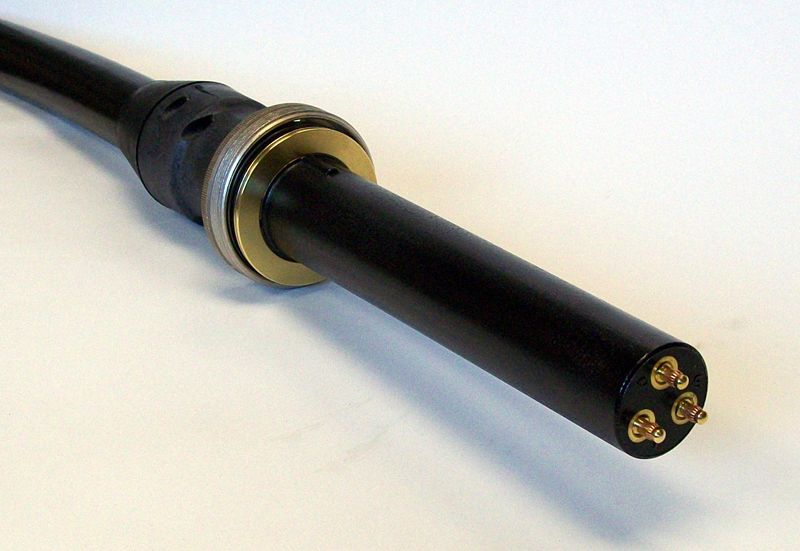
Firstly, a visual comparison ('Real Fed' vs. 'Mini-Fed'):


And now a minute 'exploration' of bona fide Federal Standard Connectors...

Beginning with 3 external views of an 'unadorned' well:


And an interior view -- Note the keyway (annotated):


Well-flange hardware:


Hardware fully installed on (upright) well:


/////////

Now for a look at an uninstalled Federal Standard PLUG: Note 'key' (lower facing)


Juxtaposition of plug (foreground) and well (background) --
Again note 'key' near top (to wit: left end as pictured) of plug:


Plug partially inserted into well:


Plug fully inserted into well:


//////

Plug installed on cable:


Cable-lock cap detail
-- Note threaded 'inner-ring' (annotated):


View of Well (lower left), Plug (lower center), Near-end of cable & lock cap (lower right). --- Note 'counterparts' at 'opposite' end of cable...


Plug assembly partially inserted into well.


Plug assembly fully inserted into well.
Note location of the retainer/lock-cap threads (annotated)
.


Lock-cap fully tightened -- plug/cable locked to well:


Note that although the cable shown in these images is partially armored -- Cu braid (immediately beneath the polymer jacket) covers the entire cable! -- The armor is merely by way of 'mechanical' damage preclusion with negligible electrical function...

Here's hoping y'all didn't find this as boring as I did!o_O:rolleyes:

Very best regards
HP:)

PS @Aleph(0), @Jazz2C --- Please be advised that this (IMO ill-timed) presentation came at the cost of time and effort that might have been better invested on the Indicator 'TIHIDI'!:rolleyes: --- Granting that a primer on standard EHT connectors/cables will be warranted at some future juncture...
 
Last edited:

Thread Starter

Aleph(0)

Joined Mar 14, 2015
597
@Aleph(0) Get this! Zenmate has been f'ked for months and getting worse! I'm sick of disconnects and freezes while I'm being tossed around servers! I'd also like uploads (on all my haunts) to work more than 5% of the time!
@Jazz2C I say u need to stop acting like a baby:rolleyes:! German server still works and upload success rate is more like 40% for small files! So since I'm living with it I say u can too!

Otherwise I'm going barefoot!
JC that's totally your call! Just don't come whining 2 me when u find out internet is paved with like razor blades:rolleyes:!

PS @Aleph(0), @Jazz2C --- Please be advised that this (IMO ill-timed) presentation came at the cost of time and effort that might have been better invested on the Indicator 'TIHIDI'!:rolleyes:
HP I say using name _Mini-Fed_ to describe your DIY HV connector totally obligated u to describe the industry standard connector who's name it was borrowed from! Anyhow like u say:

Granting that a primer on standard EHT connectors/cables will be warranted at some future juncture
So now it's work already done! So definitely copy post to blog for future use in tutorials:)!
 
Top