Facebook
 Google
 GitHub
 Linkedin

They are going to vacuum the oil in place? Not what I got from post #1776. And if that is what they are doing, I know of no "one way" seal that would allow a vacuum to be pulled then be kept for any length of time. The only way I know it is done is like in light bulbs where the glass is melted and pulled to make a seal.Wouldn't that depend on the design of the device's seal?
EHT power supply design and construction
- Thread starter Aleph(0)
- Start date
Scroll to continue with content

But wouldn't a "vacuum treatment" be better than no treatment at all? I mean, air and moisture will probably get back in, of course. But maybe it won't be as bad and it will have a tendency to purge itself as it warms up with use...They are going to vacuum the oil in place? Not what I got from post #1776. And if that is what they are doing, I know of no "one way" seal that would allow a vacuum to be pulled then be kept for any length of time. The only way I know it is done is like in light bulbs where the glass is melted and pulled to make a seal.
Am holding back any more until they chime in. I just know that "Hermetic seals" are pretty hard to do. And if they are just deaereating oil any of the type of things suggested so far even my bags will work. And don't even think it will take out the volatile chemicals from the oil.

Cmartinez sry but I don't have any mechanical drafting skill at allCan you post a sketch with the general geometry and dimensions of the part you need to vacuum-treat?
 . So anyhow here's info I hope will be just as useful!
So looking on phenolic housing tank in pic of parts for single Vabar output channel on post 1769:
So how that works is both tanks (1 for each channel) are mounted lid 2 lid with standoffs giving like 7cm gap for electrical leads plus abt 3 cm _annex_ on sides for expansion diaphragm housings. So like HP said it's basically a cube 22cm on a side (so volume of 10648 cubic cm). But I say @Hypatia's Protege forgot to make allowance for metering valve from aspirator reservoir (which supplies oil to tanks replacing volume lost cuz of light fractions and contaminants boiled off by vacuum). So perfect cylindrical VC size would be abt 50cm in height and 30 in diameterApproximate dimensions (each vessel) = 22cm*19cm*7.5cm -- Note that it it highly desirable (even imperative) that the cascade for each channel be potted simultaneously! Hence, as a practical matter, granting 'allowance' for positioning forms/fasteners, the VC must accommodate a ≈ 22cm cube...
! Cuz that way metering valve can be inside chamber which would totally make process easier!Shortbus I'm sry we didn't explain it vry wellOK, but that to me makes no sense. Unless the oil is kept under vacuum while this unit is in use and storage and never moved, air and moisture will go back into it. Even pouring the oil from a vacuum system into it's final part of the unit will add air back into it.
So it's totally sealed system after vacuum processing! So during processing inside VC, spring loaded check valves on housings open letting light fractions + contaminants boil off (but tanks stay totally full of oil it cuz of unidirectional feed from reservoir! Now when VC is brought back to atmosphere, valves close and we immediately seal them permanently cuz even though liquids are basically inelastic, their volume still changes with temp which could push oil out through valves instead of just expanding diaphragms.Shortbus just so u know, high-temp neoprene o-rings work perfectly for just airtight seals cuz atmospheric pressure at sea level is only abt 101kPa (so ≈ 15 PSI). So just as example, radiography _heads_ (by which I mean manufacturer supplied xray tube potting vessels) have used that for yearsAm holding back any more until they chime in. I just know that "Hermetic seals" are pretty hard to do.
So just FYI here's example of cut-away view of B150 style housing w tube installed
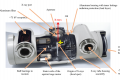
ETA Wow! I won't look on _gift horse's _ teeth but IDK how image upload worked on 1'st try
!Shortbus we definitely want to remove light fractionsAnd don't even think it will take out the volatile chemicals from the oil.
! So that's why we totally need vry low pressure! So if bags can hold vacuum of like 250μmHg (abs) that could work but we'd also need internal _cage_ to keep walls of bag from damaging phenolic tanks and interfering with metering valve and line! But it's like HP says, as courtesy 2 readers we don't absolutely insist on elegance at expense of economy within reason!Also FWIW we'd totally prefer dry potting with like super low sulfur room-temp (amorphous) solid hydrocarbons (so as example paraffin wax) but main problem we ran up against is temp needed for good viscosity (which is abt 200°C) damages potted components and also verges on breakdown (by which I mean pyrolysis) temp of potting wax.
We also tried _room temp_ potting by filling tank with solution of potting wax and naphtha (mixed for ideal viscosity) but problem is evaporation of naphtha is non-uniform so end result is totally unacceptable mess honeycombed with voids
! So we've also tried other solvents with same problemAlso! Acceptable dry potting compound has 2b easy to remove with just moderate heat or solvents that can't damage potted components (so definitely NOT epoxy or like that
!)So anyhow whole point is we definitely need proper VC or wrkable expedient that can handle deep vacuum cuz as far as I can tell dielectric oil is only way to go
!So huge tnx for help and ideas
! Cuz it's total balancing act between _good practice_ and what readers are willing to spend So we definitely need all the help we can get!
Last edited:
Again I might be wrong on this because I'm neither a chemist or a hydrocarbon engineer, but aren't your "light fractions" part of the chemical make up of the liquid? Something that is only removable or eliminated by the distillation process? I'm pretty sure that common transformer oil is based on mineral oil that can be bought in any drug store. They may add some other chemicals and colorants but the base is mineral oil. And since it is covered under FDA rules it doesn't have volatile light fractions.Shortbus we definitely want to remove light fractions
I still don't think it will work like you think it will/does. "O" rings will seal but they also need to be contained in a 'gland' type situation, to keep them expanded or compressed against the walls of the gland. Without the proper groove/gland an "O" ring has a problem sealing even at atmospheric levels, let alone keeping a high vacuum in a box. And don't get me started on phenolic plastics as far as them being impermeable.Shortbus just so u know, high-temp neoprene o-rings work perfectly for just airtight seals cuz atmospheric pressure at sea level is only abt 101kPa (so ≈ 15 PSI).
Like many things that we would think of as being solid they are, but not completely.Your, "atmospheric pressure at sea level is only abt 101kPa" sounds good, but belies the fact that "nature abhors a vacuum". That is why most things that need to keep a vacuum are made of glass, or metal that is mechanically sealed.
You got a point there ... practically all phenolics are porous and will easily allow gases through them, and most liquids will creep given enough time. But maybe perfect degassing is not a critical condition for what they want to do?And don't get me started on phenolic plastics as far as them being impermeable.
Last edited:
Shortbus that's right but we need to modify _distillate profile_ to fit application's thermal expansion criteriaaren't your "light fractions" part of the chemical make up of the liquid?
.Shortbus that's exactly how we do itSomething that is only removable or eliminated by the distillation process?
! Cold-distilling low boiling fractions off using vacuum instead of high temps. We only add enough heat to compensate for evaporative cooling, so whole process stays at abt 45°CShortbus that's basically correct except dielectric oils have lower sulfur content than pharma grade plus anti-oxidation additivesI'm pretty sure that common transformer oil is based on mineral oil that can be bought in any drug store.
Shortbus even pharma grade mineral oil is mixture of alkanesAnd since it is covered under FDA rules it doesn't have volatile light fractions.
! That's why they add tocopherols to prevent stratification of fractions. So just FYI it's vry uncommon for any hydrocarbon product to contain just one specific HC compound! Now I'm thinking maybe it's matter of words? Cuz when I'm saying _light fractions_ I just mean lowest boiling fractions in potting oil which aren't vry volatile at all compared to light fractions in evaporating oils (like gasoline and like that).Shortbus I totally agree! That's why lids and lands are grooved"O" rings will seal but they also need to be contained in a 'gland' type situation, to keep them expanded or compressed against the walls of the gland.
!Shortbus it's totally true that _high vacuum_ like needed in electron tubes (so like ≤ 10nmHg) is vry difficult to maintain but we're only pulling to so called _deep vacuum_ of like 250μmHgYour, "atmospheric pressure at sea level is only abt 101kPa" sounds good, but belies the fact that "nature abhors a vacuum". That is why most things that need to keep a vacuum are made of glass, or metal that is mechanically sealed.
But this is HUGE point! After potting process, contents of tanks are basically at atmospheric pressure cuz of flexible expansion diaphragms
! So only way to get negative pressure in tanks would be if they got cooled past diaphragms' range of motion (so for our setup < abt -50°C).So vacuum processing is used to clean and prep dielectric oil _in situ_ and sealed containers (by which I mean tanks) are just to contain and protect it from atmosphere
!And don't get me started on phenolic plastics as far as them being impermeable.
Shortbus and Cmartinez huge TNX for heads up! I didn't know that and based on her choosing those boxes for tanks I say @Hypatia's Protege didn't eitherpractically all phenolics are porous and will easily allow gases through them, and most liquids will creep given enough time.
! So even though surfaces look all glassy smooth that's not good enough if just scratch or chip can lead to contamination! So since Bakelite is electrically and thermally perfect material for our purpose, hopefully we can think of way 2 _seal coat_ them (cuz remember they don't have to stand pressure difference! They're just contamination barrier).that, you could do ... just make sure you do a meticulous and through job when applying lacquer or varnish, and try not to expose the edges to the liquid in question if you can avoid it ...opefully we can think of way 2 _seal coat_ them
I hate to say things now due to our past arguments. But will anyhow. Like much of this stuff I think your both coming from it at the "theoretical" level, not the "practical/real world" level. You're over thinking it in other words.But this is HUGE point! After potting process, contents of tanks are basically at atmospheric pressure cuz of flexible expansion diaphragms
So vacuum processing is used to clean and prep dielectric oil _in situ_ and sealed containers (by which I mean tanks) are just to contain and protect it from atmosphere
From the start of the 'vacuum potting' I was thinking you were trying to insulate with a melted (paraffin was mentioned somewhere in the deep past of this thread) or semi solid material that wouldn't flow into the deep recess's of the wiring and such, but now it seems not to be the case. The over thinking part now comes in. My mother-in-law lives across from an electrical sub station. They routinely change out the dielectric oil in the high voltage transformers, not the same voltage as your working with but it is a main station taking transmission voltages and dropping them down to the industrial level, because one of the main companies in that town get there power for a couple of arc furnaces for melting steel. They don't run a vacuum or hermetically seal those transformers. The oil is just pumped in and a plug is put back in the hole.
That said, you seem to think you need to vacuum distill the oil for your project, and again I'm assuming to make it so there is no chance of fire. But once the oil is contained, in a chamber with little to no oxygen/air, it is as safe as the gas tank in your car or the LPG in a grill tank. Things need air/oxygen to burn, transformer or even common mineral oil is neither very flammable or prone to evaporation, so where is the need to vacuum? I know I'm being kind of argumentative again but there is practical(the world I come from) and theoretical( the one both of you are from). Like the book, "men are from Mars and women are from Venus".
Shortbus plz relax cuz ur not saying anything objectionable at allI hate to say things now due to our past arguments.
!Shortbus actually it's just that we're coming at it from our real-world experience with potting low (mean) power mixed RF and DC HV equipment which have way more stringent requirements for dielectric properties and cleanliness than line freq apps mainly cuz dielectric heating and electrolysis are major issues but thermal transfer characteristics not so much (cuz remember we're just potting cascades not xfmrs or tube)I think your both coming from it at the "theoretical" level, not the "practical/real world" level. You're over thinking it in other words.
Shortbus I'm sry for confusionFrom the start of the 'vacuum potting' I was thinking you were trying to insulate with a melted (paraffin was mentioned somewhere in the deep past of this thread) or semi solid material that wouldn't flow into the deep recess's of the wiring and such, but now it seems not to be the case.
So being clear xfmrs are already dry potted from factory and we don't modify HV winding during rebuild so they just run in free (actually forced) air. Also since we're following them with Vabar cascades (which for our app are configured as voltage tripling rectifiers) we can run transformers at just 20kV RMS (which is less than original app in antique CTVs) for like 85kv DC unloaded output per ch o/c we're drawing way more current but forced air cooling of xfmrs totally solves that if we don't go overboard on loading duty cycle!Shortbus I totally agree pwr distribution xfmrs have totally different potting scheme (and so maintenance procedure) cuz in that app oil's role as a coolant is at least as important as a dielectric! Also dynamics are different at 60Hz AC compared to like 70/140 kHz PDCMy mother-in-law lives across from an electrical sub station. They routinely change out the dielectric oil in the high voltage transformers, not the same voltage as your working with but it is a main station taking transmission voltages and dropping them down to the industrial level, because one of the main companies in that town get there power for a couple of arc furnaces for melting steel. They don't run a vacuum or hermetically seal those transformers. The oil is just pumped in and a plug is put back in the hole.
! In our app idea is to pot it and forget it!Shortbus we're not trying 2 mitigate fire hazard with that (unfortunately idiotic ban on PCBs guaranteed all potting oil is combustible and so flammable at high temps but like u say no oxidizer = no fire/explosion riskThat said, you seem to think you need to vacuum distill the oil for your project, and again I'm assuming to make it so there is no chance of fire.
) Anyhow we extract lighter fractions to control (by which I mean minimize) thermal volume excursion so expansion diaphragm/bellows can have practical range w/o risk of rupturing Also plz remember just cascade (which is diodes and caps plus low power dropping resistors) doesn't produce much heat so ambient temp is definitely much bigger factor than for a potted transformer or tube! Also vacuum distillation cleans (by which I mean deaerates and dehydrates) oil which is 2x important for RF PDC application!Shortbus being totally sincere I don't see that at allI know I'm being kind of argumentative
? I say ur just asking why we're doing things the way we are and making sure we've considered easier alternatives, so nothing wrong with that! Also FWIW solid potting (using easily removed potting compound) would still be our first choice for cascades and anywhere thermal transfer isn't important.One thing though b4 anyone even suggests it! Re: SF6, been there tried that! Imo it's totally useless above 50kV unless maintained under pressure which is WAY bigger hassle than Vac potting
!Shortbus I know 'tis the season and that ur just joking but thinking back on history (of whole site not just this thread) even just silly politics scare the bejesus out of meLike the book, "men are from Mars and women are from Venus".
!Cmartinez So ur saying 2 keep sealant out of contact with oil? So since that means sealing just outside of tanks wouldn't there be problem with walls eventually saturating w oil maybe structurally weakening them (sry cuz I'm clueless abt chemistry of non-thermoplastic polymersjust make sure you do a meticulous and through job when applying lacquer or varnish, and try not to expose the edges to the liquid in question if you can avoid it ...
)? So if that's case maybe there's sealant totally impervious to oil so inside can be coated too?Yes use sealant inside too. But what I meant to say is that a phenolic plate's edges are much more porous than its faces. So make sure you use a much more generous amount of sealant on them, and even then try no to expose those edges to the oil in question, if you can avoid it.Shortbus plz relax cuz ur not saying anything objectionable at all
Shortbus actually it's just that we're coming at it from our real-world experience with potting low (mean) power mixed RF and DC HV equipment which have way more stringent requirements for dielectric properties and cleanliness than line freq apps mainly cuz dielectric heating and electrolysis are major issues but thermal transfer characteristics not so much (cuz remember we're just potting cascades not xfmrs or tube)
Shortbus I'm sry for confusion
Shortbus I totally agree pwr distribution xfmrs have totally different potting scheme (and so maintenance procedure) cuz in that app oil's role as a coolant is at least as important as a dielectric! Also dynamics are different at 60Hz AC compared to like 70/140 kHz PDC
Shortbus we're not trying 2 mitigate fire hazard with that (unfortunately idiotic ban on PCBs guaranteed all potting oil is combustible and so flammable at high temps but like u say no oxidizer = no fire/explosion risk
Shortbus being totally sincere I don't see that at all
One thing though b4 anyone even suggests it! Re: SF6, been there tried that! Imo it's totally useless above 50kV unless maintained under pressure which is WAY bigger hassle than Vac potting
Shortbus I know 'tis the season and that ur just joking but thinking back on history (of whole site not just this thread) even just silly politics scare the bejesus out of me
Cmartinez So ur saying 2 keep sealant out of contact with oil? So since that means sealing just outside of tanks wouldn't there be problem with walls eventually saturating w oil maybe structurally weakening them (sry cuz I'm clueless abt chemistry of non-thermoplastic polymers
Unless you machine the mold "skin" off of it. That's how I learned years ago about phenolic plastic and porosity. We did a job that kept getting rejected by the customer for porosity. Until an engineer in the customers group got involved and told them they picked the wrong type of material. Once the shiny 'skin' is removed cast phenolic becomes a sieve.Yes use sealant inside too. But what I meant to say is that a phenolic plate's edges are much more porous than its faces.
Aleph(0), I just am kind of "gun shy" lately I guess. Not from just this thread but a couple of them I've been in here lately. That I know a lot about and have been pretty much told I'm crazy for suggesting things.
Back to the potting, have you considered "dielectric grease"? While more money than the oils it is semi solid, and could be lightly vacuumed to distribute it well around the components. https://en.wikipedia.org/wiki/Silicone_grease#Dielectric_grease While kind of expensive in small amounts like for spark plug boots, like many things it is not as expensive in bulk. It also wouldn't need to be sealed quite as well in the container used because it is both inert and semi solid. Not trying to take up your time but to give other ideas that might work.
Back to the potting, have you considered "dielectric grease"? While more money than the oils it is semi solid, and could be lightly vacuumed to distribute it well around the components. https://en.wikipedia.org/wiki/Silicone_grease#Dielectric_grease While kind of expensive in small amounts like for spark plug boots, like many things it is not as expensive in bulk. It also wouldn't need to be sealed quite as well in the container used because it is both inert and semi solid. Not trying to take up your time but to give other ideas that might work.

Hypatia's Protege
- Joined Mar 1, 2015
- 3,228
Hey, shortbus -- don't let 'em get to you! -- Seems folks tend to become a bit 'edgy' 'round now every even yearI just am kind of "gun shy" lately I guess. Not from just this thread but a couple of them I've been in here lately. That I know a lot about and have been pretty much told I'm crazy for suggesting things.
-- I expect it'll 'clear up' in a couple weeks' timeIndeed! It is my experience that, properly applied, silicone dielectric gels typically achieve greater dielectric strength than available with common hydrocarbon potting oils (e.g. Shell Diala, etc) -- unfortunately, gel-dielectrics' 'Dippidy-Do' consistency significantly complicates degassing/de-aeration...Back to the potting, have you considered "dielectric grease"? While more money than the oils it is semi solid, and could be lightly vacuumed to distribute it well around the components.
FWIW I'm having another look at potting by flooding with fused paraffin 'wax' (i.e. solutions of very high boiling alkanes [principally eicosane through tetracontane] not to be confused with kerosene!) via vacuum processing of relatively cool (Ca. 100°C) liquefied 'wax' (thus obviating undue thermal stress/abuse of potted components)...
Note to all readers/interested parties: I apologize that I'll not likely be available for significant participation here prior to mid November -- thus I leave y'all in the capable hands of @Aleph(0) and @theodoravain
Very best regards and many thanks!
HP
Last edited:
Long barbecue season this year?I apologize that I'll not likely be available for significant participation here prior to mid November --
Hypatia's Protege
- Joined Mar 1, 2015
- 3,228
FWIW It seems over-assessment of the 'nutritional value' of lithium 'button cells' has emerged as the latest trend in the um... 'involuntary pica' sceneLong barbecue season this year?
- Go figure!For all that, my brief (if all too frequent) 'hiatuses' form the fora owe far more to sorting (offline) administrative bureaucracy (i.e. playing 'referee') than to anything like 'errands of mercy'...
Very best regards
HP
PS -- To all whom it may concern --- Immediately upon my 'full' return, I plan to present the EHT Indicator 'TIHIDI' (i.e. 'This Is How I did It -- IOW construction example) -- immediately followed by similar treatment of the LVPSU project... --- Said references to include links to members' 'alternative approaches', etc... quoted in my blog's 'reader feedback...' entry -- (which having now been moved into public view) -- Again! Please note that said entry is an ongoing compilation! - I shall endeavor to 'tag' readers with addition of their content to said entry! --Please note that while I strongly prefer affirmative permission for use of content, pressure of time demands my assumption of 'tacit permission' where such is not forthcoming in a timely fashion... -- In all cases, attribution is guaranteed via the nature of the 'quote' feature -- moreover, I promise prompt amendment or removal of content upon its provider's request!
Very best regards
HP
Oh, they have replaced the "tide Pods challenge" with button cells in MN?FWIW It seems over-assessment of the 'nutritional value' of lithium 'button cells' has emerged as the latest trend in the um... 'involuntary pica' scene
Shortbus I say totally bizarre part is there's a lot of cases of both among chronological adults and older teens (which aren't suicide attemptsOh, they have replaced the "tide Pods challenge" with button cells in MN?
!) So with detergent pods it's usually on a dare And with batteries it's usually just carelessness like holding them with teeth to free hands (and so accidentally swallowing or aspirating them cuz of coughing) or just carelessness like letting them fall in food unnoticed and like that!So anyhow just so everyone knows, Theo and I try 2 monitor thread on daily basis when HP is busy! But we can't always logon (cuz of iffy subscriber-side ISP security or VPN issues) so if u have problem (like with us using your contribs) or questions abt anything relating 2 this thread or tutorials plz just post here on thread! So if it's something u prefer to discuss privately ur welcome to PM any of us but since we don't always login on regular basis plz leave post here telling us to check PM
! HP Just for curiosity what's _Dippidy-Do_unfortunately, gel-dielectrics' 'Dippidy-Do' consistency significantly complicates degassing/de-aeration...
? SE hits don't help at all
Hypatia's Protege
- Joined Mar 1, 2015
- 3,228
Ummm... That'd be my fault - This timeYou two spell stuff funny.
---Emphasis Added---unfortunately, gel-dielectrics' 'Dippidy-Do' consistency significantly complicates degassing/de-aeration...
As an inveterate retro-TV aficionado, I'm bound to venture: The final nail in "The Wet Head's" coffin? -- A 'lube-job' too far, as it wereHP Just for curiosity what's _Dippidy-Do_
--- As regards its composition? You'll have to take that up with Procter & Gamble - assuming, that is, they'll own responsibility for said product's existenceTTFN
HP
Last edited: