EHT power supply design and construction

ATTN: @Aleph(0) and @Jazz2C

When you post and edit your copies with suggested changes -- Please place 'reference numbers' (in large font of the same hue as the corrected text) adjacent to, or immediately above, each suggested edit.

Many thanks!
HP:)
 

Thread Starter

Aleph(0)

Joined Mar 14, 2015
597
LOPT preparation tutorial development
Last action @ N/A

Ok, HP here's a start! All my comments and suggestions are in big blue font like this and suggestions are like {n}. I will post list of rationale for every suggestion right after this post:)!

Scope of series:

Central topics:
This tutorial is one in a (prospective) series with focus upon low ripple, relatively high current/power PSU solutions for radiography and other modest photon energy (≤ 2 MeV) particle accelerator applications - and, to a lesser extent, exploration of certain 'current intensive' electrostatic phenomena (e.g. electret photography, electret formation, electrokinesis, establishment of electrostatically 'cordoned' (atmospheric) pressure gradients {1} (“force fields”), high volume ion-flow systems, etc...

Peripheral and extraneous topics:
While everyone is welcome to view and post questions (within the confines of this site's TOS/UA) - Please be advised that those having interests confined to the following topics/applications will not likely find this series particularly useful (owing to the availability of significantly less 'labor-intensive' solutions to same):

--'Pedestrian' and 'Quasi'/'Peri'-EHT applications:
(e.g. CRTs, PMTs/Image tubes, Gas discharge devices, LASERs, 'negative ion air purifiers', TC primary drivers, GM tubes, etc...)
--Low current demonstration topics (e.g. 'Lifters', 'Jacob's Ladders', 'Plasma Spheres', 'Kirlian photography', 'Ion Motors', etc...)
--Capacitor discharge demonstration: (e.g. 'Quarter Shrinkers'/'Can Crushers', 'Rail/Coil Guns', 'EMP generators', electrical weapons, etc...)

Please be advised that site policy prohibits my response to most inquiries coming under the latter category...
=================================================

Scope of this tutorial
Provision of a minute, 'step by step' procedure for modification of 'heavy duty'
AC LOPTs for serious EHT application/research...

Said procedure having the following principal goals:
-- Improvement of insulation integrity via removal of auxiliary windings coaxial to the EHT winding.
-- Enhancement of versatility via electrical 'floating' of the EHT winding.
-- Appropriate adjustment of reluctance gaps.


The desirability of LOPTs:

Of the commonly available magnetic components applicable to low through medium power EHT{2} 'generation' production, the LOPT offers the advantages of relatively high power intermittent operation (several hundred Watts per transformer) and useful continuous power operation (to Ca. 150 Watts each transformer under forced air cooling). Moreover, LOPTs' amenability to resonant (and, hence, sinusoidal) drive permits development of systems productive of highly desirable{3}_ mean output EMFs (≈70% peak) as opposed to the rather low (1% to 5% 'spike' EMF) characteristic of flyback and similar pulse driven/energy storage topologies. Additionally, the inherent output symmetry attending resonant drive topologies facilitates implementation{4}_ of effective external EMF 'multiplication' schemes.

Prominent among the LOPT's disadvantages are the common expedient of integral rectification/EMF multiplication{5} circuity circuitry and 'end point' grounding schemes --- While the former objection is readily addressed via judicious transformer selection, the latter requires minor 'reconstruction', said procedure being the topic of this tutorial.

A few words regarding the unsuitability {6}of DSTs and their ilk:
Principally
1) Integral components electrically unsuited to general application.
2) Practical impossibility of modification for improved EHT winding to core insulation.

Re: point 1 (above) Although asymmetric drive may permit peak forward (and hence output) EMFs well in excess of the internal rectifiers' PIVs - such is, of course, inapplicable to 'filtered' or otherwise capacitively loaded schemes sans additional external rectifiers - moreover internal rectification greatly complicates cascading of multiple LOPTs for increased EMF and/or development of balanced output schemes...

Re: Point 2
(above)
'DC' LOPTs are constructed as indivisible units sans {7}‘margin for modification -- moreover (in the case of DSTs) the rectifiers are 'distributed' throughout the winding...

LOPT Selection:
The most desirable transformers are those intended for direct{8} 'generation' production of (pre-rectified) accelerating potential for large CRTs -- Contrary to common belief such units are yet readily available from long-established electronics supply houses (whom, in my experience, are only too happy to wave 'minimum purchase' and 'wholesale only' policies at the prospect of disposal of what they regard as {9} dead stock') --- That said, one should expect to size their purchase so as to offset the supplier's 'invoicing costs'... Prices as low as $20 (USD) per transformer (in reasonable quantities) are not uncommon...

The following images are offered as an aid to recognition of the desired form factor:

Assorted LOPTs typical of the desired geometry: {10}
vvvvvvvvvvvvvvvvvvvvvvvvvvvvvvvvvvvvvvvvvvvvvvvvvvvv
http://forum.allaboutcircuits.com/attachments/lopts-jpg.101773/

Detail - Axial view
vvvvvvvvvvvvvvvvvvvvvvvvvvvvvvvvvvvvvvvvvvvvvvvvvvvvv
http://forum.allaboutcircuits.com/attachments/lopt2-jpg.101772/

Detail - Transverse view
vvvvvvvvvvvvvvvvvvvvvvvvvvvvvvvvvvvvvvvvvvvvvvvvvvvvvvvvvvvvv
http://forum.allaboutcircuits.com/attachments/nos_tyre_lopt-jpg.101774/


The modification procedure:
--Please do not commence disassembly of the transformer prior to reading and comprehension of the entire tutorial...

To Begin:
Disassembly of the LOPT unit


=======================

Step Prq_1) Identify construction style of LOPT to be optimized.


Task:
1)
Identify construction style via the description most closely matching the reader's device in the following...

Full EMF AC LOPTs feature one of two general construction styles as outlined below:

Style 1) Features a single piece frame ('clamp') -- the rails of which maintain compression on the core via a single linear ligature fashioned of a metallic strap or bolt extending from {11}frame rail to frame rail across the top of the upper form leg 'facet'.

Example of style 1
vvvvvvvvvvvvvvvvvvvvvvvvvvvvvvvvvvvv

http://forum.allaboutcircuits.com/attachments/lopt_desc-jpg.101778/

Style 2) Features two independent metallic frame pieces OR a metallic half-frame and a backing plate/PCB -- such assemblies are bound by a single "U- bolt"/"U-strap" or two linear bolts/straps extending along the outer aspects of each horizontal form leg...

Examples of style 2

View of LOPT from 'closed' side of "U bolt" ligature
vvvvvvvvvvvvvvvvvvvvvvvvvvvvvvvvvvvvvvvvvvvvvvvvvvvvvvv

http://forum.allaboutcircuits.com/attachments/ubolt1a-jpg.101781/

View of LOPT from 'open' side of "U bolt" Ligature
vvvvvvvvvvvvvvvvvvvvvvvvvvvvvvvvvvvvvvvvvvvvvvvvvvvvvvvvv

http://forum.allaboutcircuits.com/attachments/ubolt1c-jpg.101784/

View of LOPT from 'closed' side of "U strap" Ligature
vvvvvvvvvvvvvvvvvvvvvvvvvvvvvvvvvvvvvvvvvvvvvvvvvvvvvvvvv

http://forum.allaboutcircuits.com/attachments/ubolt2a-jpg.101785/

View of LOPT from 'open' side of "U strap" Ligature
vvvvvvvvvvvvvvvvvvvvvvvvvvvvvvvvvvvvvvvvvvvvvvvvvvvvvvvvv

http://forum.allaboutcircuits.com/attachments/ubolt2b-jpg.101786/

Step Preq_2) Removal of form frame ('clamp')


Tasks:
1)
Remove any tape, looped conductors, ground leads, etc. ensnaring/bonding the frame to the form/core.

2)
Free each end of the frame ligature{s}

3A)
In the case of cylindrical bolt{s} or a cylindrical shaft 'U Bolt':
Remove backing fasteners (i.e. nut{s}/burs{s},etc...) then carefully withdraw the bolt{s} from the assembly.

3B)
In the case of independent strap{s}, or a 'U Strap': Straighten and/or unsolder each fastening 'tab' then splay the frame rails such that the ligature 'ears' clear the ligature 'tabs' --Or-- if so constructed, remove the backing plate/PCB from the ligature ends ('tabs').

4)
Remove the transformer (i.e. core and winding assembly) from the framing/clamping/mounting components -- please retain the frame and all associated hardware!

Image of transformer following removal from a single strap-ligature frame:
vvvvvvvvvvvvvvvvvvvvvvvvvvvvvvvvvvvvvvvvvvvvvvvvvvvvvvvv

http://forum.allaboutcircuits.com/attachments/loptdesc2-jpg.101780/


Annotation of assembly features referenced in following steps:
vvvvvvvvvvvvvvvvvvvvvvvvvvvvvvvvvvvvvvvvvvvvvvvvvvvvvvv

http://forum.allaboutcircuits.com/attachments/annotated-jpg.101788/


Step Preq_3) Procedure for removal of strap ligature{s} from LOPT core/winding assembly:

1)
Meticulously straighten and deburr the exposed segments of the frame ligature{s}.

2)
Carefully 'work' the frame ligature{s} free of the adhesive, then withdraw it/them from the space intervening the form and winding assembly{s} (and, hence, off of the form) -- Under no circumstances apply counter-thrust or torque to the EHT winding!

Ligature partially withdrawn from assembly.
vvvvvvvvvvvvvvvvvvvvvvvvvvvvvvvvvvvvvvvvvvvvvvvvvvvvv

http://forum.allaboutcircuits.com/attachments/loptligwdr-jpg.101790/

Ligature (in foreground) fully withdrawn from assembly.
vvvvvvvvvvvvvvvvvvvvvvvvvvvvvvvvvvvvvvvvvvvvvvvvvvvvvvvvvvvvvv

http://forum.allaboutcircuits.com/attachments/loptligout-jpg.101789/

Note: Inasmuch as same will be removed and discarded in later steps, damage to the external auxiliary windings (i.e. those on the form leg opposite the EHT winding) or coaxial auxiliary windings immediately adjacent to the core/form leg is of no consequence -- Care must be exercised, however, to avoid damage to the brittle ferrite form/core via excessive force or mechanical shock... Also - avoid handling the assembly by the EHT winding!

Step Preq_4)
Removal of external auxiliary windings from 'lower leg':

Tasks:
1)
Using a utility knife or similar tool, linearly section the full length of the 'external' Aux winding assembly. --- Note, the winding in reference resides on the form leg opposite that carrying the EHT winding!!!

2)
Peel, crumble and/or break the 'external' Aux windings away from the lower form leg.

Step Preq_5)
Separation of form pieces

Caution: In performance of the following tasks, it is of paramount importance that no torques or linear forces are applied to the EHT tyre! -- Moderate forces may be applied to the auxiliary shell and moderate compressive forces may be applied to the ferrite form longitudinal to the EHT winding 'leg' only!

3)
Endeavor to remove (or loosen) any shims intervening the form and central aspect of the auxiliary sleeve -- While damage to the auxiliary sleeve or winding is of no consequence, care must, nonetheless, be exercised to avoid breakage of the form!

Image of wooden shims (indicated by pick)
vvvvvvvvvvvvvvvvvvvvvvvvvvvvvvvvvvvvvvvvvvvvvvvvvvv

http://forum.allaboutcircuits.com/attachments/loptshim-jpg.101791/

4)
Using a #3 sharp fenestrated uterine curette, or similar non-ferromagnetic stainless steel instrument, carefully 'clean' the lower form leg of superfluous epoxy -- Note: Use of razor blades or other ferromagnetic or 'soft' metallic instruments will likely 'foul' the ferrite via metallic transfer to same!

5)
Submerge the lower leg of the form (prepared as per task #4 above) in acetone for a period of ≈ 90 minutes at 16°C ↔ 33°C -- Note: the EHT winding assembly must not be submerged, splashed or otherwise wetted with acetone! -- nor should acetone be allowed to condense on same! Owing to the flammability of ketones, said procedure is best preformed in open air or in an open container under a fume hood -- a closed container is not recommended owing to liability to condensation...

6)
Immediately following removal from the acetone bath, drive the reluctance spacer out of the lower form joint using an appropriate feeler gauge leaf --- Note that during and following removal of the reluctance spacer/adhesive from the 'lower' joint, application of even moderate distensive or constrictive forces to the form will result in significant cantilevered forces at the 'upper' form joint with (almost certain) breakage of one or both form pieces!

Of special concern in this regard:

A) Do not attempt to expand the gap while removing the spacer! -- The leaf thickness must be less than the gap width! Maintenance of an absolutely parallel relationship between leaf and form piece ends (i.e. gap 'walls') is imperative!

B)
Following removal of the spacer, take care to avoid application of transverse pressure or piece-to-piece torsion to the form! -- The safest handling method is manipulation of the assembly from one 'side' (i.e. by one form piece) only!

7)
Following clearance of the lower form joint of its reluctance spacer and adhesive, continued half-to-half form tenure owes to the upper form joint adhesive (at the center of the EHT winding assembly) - and, to lesser extent, adhesion of each form piece to the form sleeve of said assembly.


....WORK IN PROGRESS.....


=======================


=================================================

For these purposes we will consider four (coaxial) features of the EHT winding assembly:

To Wit:

{12} (Distal to medial) (Peripheral to Central).
1) The EHT 'tyre' (comprised of the EHT winding proper, potting material and bunting).
2) The Auxiliary shell (a paperboard or polymer 'collar' intervening the {13} medial central aspect of the EHT winding and the distal aspect of the Aux winding...
3) The Aux Winding{s}.
4) The form sleeve (intervening the {14}medial central aspect of the Aux winding and the ferrite form).

Please note said features in the image below:

Image of intact EHT winding assembly.

vvvvvvvvvvvvvvvvvvvvvvvvvvvvvvvvvvvvvvvvvvvvvvvvvvv
http://forum.allaboutcircuits.com/attachments/i1_1-jpg.101749/


Step 1) Locate the lug carrying the EHT return:

The EHT return generally emerges with one or more AUX leads from the {15} distal peripheral circumference of the AUX winding whence they are tied to a shell lug...

End of proofreading on AM of 6/25/2016

In this instance, said lug occupies the 2-o'clock postilion -- The image below shows said leads emerging from the Aux winding immediately below the CCW edge of the lug (as indicated by the ball-point pen) -- of special significance is the extreme peripheral position of the break-out point.

Image of the bundle containing the EHT return.

vvvvvvvvvvvvvvvvvvvvvvvvvvvvvvvvvvvvvvvvvvvvvvvvvvvvvvvvv
http://forum.allaboutcircuits.com/attachments/i1_2-jpg.101750/

Step 2)
Separate and identify the EHT return:


Tasks:
1)
Carefully unsolder all leads from the lug identified in Step 1 (above).
2) 'Untwist' and otherwise separate said leads.
3) Using a resistance indicator, check each lead for continuity to the EHT output contact --- the return lead will show a resistance of between 400Ω and 1000Ω All other leads should show infinite resistance (i.e. no continuity).

In the case of the demonstration transformer, three leads were tied to the lug -- the continuity examination identified the 38 AWG lead as the EHT return (said lead indicated by the pen in the attached image).

Image of separated EHT return --- Note that the associated lug was broken out of the way.

vvvvvvvvvvvvvvvvvvvvvvvvvvvvvvvvvvvvvvvvvvvvvvvvvvvvvvvvv
http://forum.allaboutcircuits.com/attachments/i1_3-jpg.101751/

Step 3
) Remove the form sleeve:

Please note:
Far and away the most significant challenges attending this procedure owe to the 'gossamer' nature of #38 and #40 AWG conductors... From this point onward it will behoove the reader to remain alert to the location of the EHT return whenever handling the assembly - while a severed or broken return lead is not necessarily 'fatal to the cause' - such will greatly complicate matters via the requirement of 'teaseling out' the end of a #40 or even #42 (AWG) lead from the lacquered winding!

Tasks:
1)
Carefully dress the return lead out of 'harm's way'.
2) Twist, pry and/or break the form sleeve out from the center of the Aux winding.

Image of EHT winding following removal of the form sleeve. Note the EHT return at ~ "2 O'clock"

vvvvvvvvvvvvvvvvvvvvvvvvvvvvvvvvvvvvvv
http://forum.allaboutcircuits.com/attachments/i1_4-jpg.101752/

Step 4)
Remove the AUX winding:


Precautions:
A)
While 'unraveling' the Aux winding, apply counter-thrust only to the shell --
as opposed to the tyre!
B)
While debriding residue from the 'medial gap' following removal of the Aux Shell - great care must be exercised is damage to the medial layer{s} of the EHT winding to be avoided!

Tasks:
1) Cut all leads attached to all remaining lugs.
2) Using a surgical pick or similar instrument, pry a few 'layers' of the Aux winding into the center such that they may be grasped with forceps.
Image of Aux winding prepared for removal.
vvvvvvvvvvvvvvvvvvvvvvvvvvvvvvvvvvvvvvvvvvvvvv
http://forum.allaboutcircuits.com/attachments/i1_5-jpg.101753/

3)
Grasp the the loosened layers and begin withdrawing ('unraveling') the Aux winding -- Taking great care to avoid application of tension to the return lead as you progress toward the periphery.

Image of Aux winding in an intermediate stage of removal.

vvvvvvvvvvvvvvvvvvvvvvvvvvvvvvvvvvvvvvvvvvvvvvvvvvvvvvvvv
http://forum.allaboutcircuits.com/attachments/i1_6-jpg.101754/

Note: The EHT return will typically be 'laminated' between the penultimate and ultimate layers of the auxiliary winding bunting
4) Cautiously break (not tear!) the bunting material away from the return lead.

In the image below you may observe the end of the EHT return (as per the pen) and its emergence from the bunting in the gap intervening the shell and the deflected bunting medial to the remaining lug at 4 O'clock

Image of EHT return embedded in peripheral Aux winding bunting.
∨∨∨∨∨∨∨∨∨∨∨∨∨∨∨∨∨∨∨∨∨∨∨

http://forum.allaboutcircuits.com/attachments/i1_7-jpg.101755/


Image of EHT winding following complete removal of Aux winding

vvvvvvvvvvvvvvvvvvvvvvvvvvvvvvvvvvvvvvvvvvvvvvvvvvvvvvvvv
http://forum.allaboutcircuits.com/attachments/i1_7-jpg.101755/

Step 5) Remove the AUX Shell:

Tasks:
1)
Carefully break, crumble and/or fold the auxiliary shell into the 'medial gap' via symmetrical application of force to the distal labra of same at quadrature to the plane of the return.

Under no circumstances attempt to pry the shell from the interstices!!! Doing so will almost certainly damage the EHT winding beyond repair!

2)
having thus loosened the shell, carefully remove the fragments being ever mindful of the return...

Images of the EHT winding following removal of the auxiliary shell...
∨∨∨∨∨∨∨∨∨∨∨∨∨∨∨∨∨∨∨∨∨∨∨
http://forum.allaboutcircuits.com/attachments/i2_1-jpg.101757/

∨∨∨∨∨∨∨∨∨∨∨∨∨∨∨∨∨∨∨∨∨∨∨
http://forum.allaboutcircuits.com/attachments/i2_2-jpg.101758/

∨∨∨∨∨∨∨∨∨∨∨∨∨∨∨∨∨∨∨∨∨∨∨

http://forum.allaboutcircuits.com/attachments/i2_3-jpg.101759/


Image of EHT winding and debris following removal of Form sleeve, Aux winding, and Aux shell:

∨∨∨∨∨∨∨∨∨∨∨∨∨∨∨∨∨∨∨∨∨∨∨
http://forum.allaboutcircuits.com/attachments/i2_4-jpg.101760/


Note:
Should the reader's EHT winding be potted in silicone (as opposed to merely 'jacketed' as in the case of the demonstration transformer) it will be desirable to arrive at this juncture sans disruption of the potting material -- Should a breach occur, prompt repair via application of electronics grade RTV is advisable...

Step 6) Prepare The Dummy Shell:

Note: Owing to the 'brittleness' of 'Purell' grade polypropylene, use of a sharp instrument is recommended!


Tasks:
1)
Excise the the base of the pharmaceutical vial.
2) Section the (resulting) cylinder longitudinal to its axis.
3) Temporarily mount the dummy shell on the ferrite form -- Verify end-clearance ≥ 5mm (form pieces in firm apposition) If end-clearance < 5 mm, trim the dummy shell to 'compliance' but try to keep end-clearence < 1 cm

Image of prepared dummy shell:
∨∨∨∨∨∨∨∨∨∨∨∨∨∨∨∨∨∨∨∨∨∨∨
http://forum.allaboutcircuits.com/attachments/i2_5-jpg.101761/


Image of correctly 'trimmed' dummy shell on leg of LOPT ferrite form:
∨∨∨∨∨∨∨∨∨∨∨∨∨∨∨∨∨∨∨∨∨∨∨

http://forum.allaboutcircuits.com/attachments/i2_6-jpg.101762/

Step 7) Prepare Return Lug:
Tasks:

1) Form a #4 solder lug such that the 'tab' is at a right angle to the plane of the fastener surface.
2) Drill a #66 (~0.83mm) hole through the lug immediately above the bend.

Image of properly prepared lug -- Notice the small (#66) hole near the fastener angle.
∨∨∨∨∨∨∨∨∨∨∨∨∨∨∨∨∨∨∨∨∨∨∨

http://forum.allaboutcircuits.com/attachments/i2_7-jpg.101763/

Step 8)
Installation of the dummy shell:


Image of EHT winding at this juncture - note return lead:
∨∨∨∨∨∨∨∨∨∨∨∨∨∨∨∨∨∨∨∨∨∨∨

http://forum.allaboutcircuits.com/attachments/i2_8-jpg.101764/

Tasks:

1) Furl the dummy shell, then position it in the medial gap from the side of the winding opposite the return lead such that the 'cut' faces opposite the output 'tower'.
2) Using a stylus, etc, mark the dummy shell at the point axial to the emergence of the return and 5 mm back from the edge of the dummy shell.
3) Carefully remove the dummy shell.
4) Using a drill bit commensurate with a #4 bolt, bore through the dummy shell at the point marked in task #2.
5) Liberally coat the dummy shell and gap surfaces with electronics grade RTV. -- Avoid application of RTV to the return lead!
6) Reinstall the shell as described in task #1, taking care to position the cut opposite to the output 'tower', and the bolt hole axial to the emergence of the return lead.
7) Mount the EHT winding/Dummy Shell assembly on the ferrite form.
8) Adjust the (linear) position of the winding tyre on the shell such that the former is equidistant from the form piece angles while the end of the shell emerging from the 'return lead side' of the winding tyre extends as far as possible from the winding sans contact with the form piece.
9) Remove the form from the assembly taking care not to alter the relative position of the shell/winding.
10) Manually expand the shell as much as possible -- smooth and 'touch-up' the silicone... --- Again keep the return lead free of adhesive!
11) Allow RTV to cure for at least 72 hours at temps of 45°F through 60°F -OR- for at least 48 hours at temps > 60°F

Step 9) Installation of the Lug and connection of the return:
Tasks:

1) Carefully insert the #4 bolt from inside the shell.
2) Secure the lug to the top of the shell as shown in the images below.
3) Solder-tin the end of the return lead.
4) Insert ~ 2 mm of the return lead into the #66 hole near the base of the lug then secure it with solder.

Note: It is imperative that you neither trim nor glue the return lead at this point! - Please loop any slack as shown in the images.


Images of the assembly; Dummy shell & Lug installed, return connected:
∨∨∨∨∨∨∨∨∨∨∨∨∨∨∨∨∨∨∨∨∨∨∨
http://forum.allaboutcircuits.com/attachments/i2_9-jpg.101765/

∨∨∨∨∨∨∨∨∨∨∨∨∨∨∨∨∨∨∨∨∨∨∨

http://forum.allaboutcircuits.com/attachments/i2_10-jpg.101766/

5)
Verify that the DC resistance (lug to output tower connector) -- is that measured in step #2, task#3


Anticipated FAQs

Note: the following questions approximate the 'mean' of copious feedback received at this 'stage' during composition of the original draft...

Q) The lug screw head will short the EHT return to the form -- and anyway, who wants the winding rattling around on the form like that?
A) We're not done yet! --- Patience!:)

Q)
One centimetre is insufficient spacing of lug and winding for 50kV operation!?
A) That's why we're going to intervene lug and tyre with a thickness of PTFE in a subsequent step.:)

Q)
Why not trim the return lead to length or at least glue it to the shell?
A) Prior to complete curing of the shell-to-tyre adhesive, and robust securing of the lug, provision for 'immunity' to relative motion of the parts makes good sense.:)

Q) What do spools of solder and capacitors have to do with rebuilding an LOPT?
A)
The extraneous items in the images assist to achieve optimal focus -- especially as regards diminutive objects (IOW I'm using an inexpensive camera).:cool:

Step 10) Prepare the CPVC Form sleeve:

Tasks:
1) Cut a length of 3/4" (id) CPVC tubing equal to the total length of the form-leg on which it will be placed (In this case of this demonstration 8.5 cm) See the two images immediately below...

Image illustrating desired sleeve dimension
∨∨∨∨∨∨∨∨∨∨∨∨∨∨∨∨∨∨∨∨∨∨∨∨∨
http://forum.allaboutcircuits.com/attachments/i3_1-jpg.101767/

Image of form and adjacent CPVC section cut as per step #10
∨∨∨∨∨∨∨∨∨∨∨∨∨∨∨∨∨∨∨∨∨∨∨∨∨∨∨∨∨∨∨∨
http://forum.allaboutcircuits.com/attachments/i3_2-jpg.101768/

2)
Cut shoulder stirrups in CPVC Sleeve:
Note: the stirrups must be sufficiently deep as to allow a slight amount of end-clearance when mounted upon the form (such that form-piece apposition is assured).

Image of form pieces and 'prepared' CPVC sleeve
∨∨∨∨∨∨∨∨∨∨∨∨∨∨∨∨∨∨∨∨∨∨∨∨

http://forum.allaboutcircuits.com/attachments/i3_3-jpg.101769/

Image of form and CPVC sleeve in an intermediate state of assembly
∨∨∨∨∨∨∨∨∨∨∨∨∨∨∨∨∨∨∨∨∨∨∨∨∨∨∨∨
http://forum.allaboutcircuits.com/attachments/i3_4-jpg.101770/


Image of (temporary) fully assembled form and CPVC assembly

∨∨∨∨∨∨∨∨∨∨∨∨∨∨∨∨∨∨∨∨∨∨∨
http://forum.allaboutcircuits.com/attachments/i3_5-jpg.101771/

Step 11)
Install CPVC form sleeve in EHT winding assembly:


Image of components referenced in this step:
(L to R) CPVC sleeve, EHT winding assembly, Form [core] pieces
∨∨∨∨∨∨∨∨∨∨∨∨∨∨∨∨∨∨∨∨∨∨∨

http://forum.allaboutcircuits.com/attachments/1-jpg.101711/


Tasks:
1)
Assemble EHT winding, CPVC sleeve and form as shown (below).
2) Using PTFE shims, center EHT winding assembly about CPVC sleeve (both sides).
Note: While the adhesive does not bond PTFE it is, nonetheless, essential that the shims be so formed as to preclude (interlocked) captivity therein!

Images of mounted and centered EHT winding as seen from 'EHT return side':
∨∨∨∨∨∨∨∨∨∨∨∨∨∨∨∨∨∨∨∨∨∨∨

http://forum.allaboutcircuits.com/attachments/2-jpg.101712/

∨∨∨∨∨∨∨∨∨∨∨∨∨∨∨∨∨∨∨∨∨∨∨

http://forum.allaboutcircuits.com/attachments/3-jpg.101714/

∨∨∨∨∨∨∨∨∨∨∨∨∨∨∨∨∨∨∨∨∨∨∨

http://forum.allaboutcircuits.com/attachments/5-jpg.101717/

4)
Using acrylic-based 'hot-melt' adhesive, tack the CPVC sleeve to the polypropylene shell at several points each side.
5) Remove form pieces.
6) Fill the space intervening the CPVC sleeve and the PP shell with acrylic-based 'hot-melt' adhesive taking care not to disturb the relative positions of said structures!
7) Allow the adhesive at least 60 Minutes to cool/cure.
8) Withdraw the shims.

Image of assembly immediately following withdrawal of shims as seen from EHT return side.
∨∨∨∨∨∨∨∨∨∨∨∨∨∨∨∨∨∨∨∨∨∨∨
http://forum.allaboutcircuits.com/attachments/7-jpg.101719/

9)
Fill the 'shim gaps' with acrylic-based 'hot-melt' adhesive.

Image of EHT winding assembly following completed installation of CPVC sleeve.
∨∨∨∨∨∨∨∨∨∨∨∨∨∨∨∨∨∨∨∨∨∨∨
http://forum.allaboutcircuits.com/attachments/8-jpg.101721/


Identification of components referenced in steps #12 through #15 (inclusive):

1) PTFE insulator.
2) EHT Winding assembly.
3) Form pieces.
4) LOPT Frame.
5) Polyolefin (heat shrink) sleeves.
6) Elastic cushions.
7) Frame ligature.
8) Form standoffs.
9) Reluctance gap spacers (see text).
∨∨∨∨∨∨∨∨∨∨∨∨∨∨∨∨∨∨∨∨∨∨∨
http://forum.allaboutcircuits.com/attachments/lopt_partsnum-jpg.101730/

Step 12) Prepare form guides


Prior to proceeding, it is imperative that the form pieces are absolutely free of adhesive residue, etc...!

Tasks:
1)
Trim two pieces of polyolefin tubing such that they extend the full inside length of each 'winding leg' of the assembled frame (as shown below).
2) With the sleeves in place on the form, clamp or otherwise place form pieces in firm apposition with close attention to alignment of same.
3) 'Heat-shrink' the polyolefin tubing -- Note: expeditious completion of this step will significantly reduce liability to ferrite breakage (secondary to uneven application of heat) and/or permanent shift of magnetic properties (secondary to excessive temperature)...
4) Allow at least 20 Minute 'cool down' period then carefully disassemble the form such that the heat-processed polyolefin tubes remain installed on each 'half-leg of a single piece.
5) Trim another sleeve then repeat the above procedure such that one leg is bound by a double layer of polyolefin.

Image of assembled form 'sporting' the unprocessed polyolefin sleeves (Post task #1)
∨∨∨∨∨∨∨∨∨∨∨∨∨∨∨∨∨∨∨∨∨∨∨

http://forum.allaboutcircuits.com/attachments/preshrink-jpg.101742/

Image of form piece following processing of sleeves (Post task #4)
∨∨∨∨∨∨∨∨∨∨∨∨∨∨∨∨∨∨∨∨∨∨∨

http://forum.allaboutcircuits.com/attachments/separated1-jpg.101743/

Image of form piece following processing of second sleeve on (arbitrarily chosen) EHT winding 'leg' (Post task #5)
∨∨∨∨∨∨∨∨∨∨∨∨∨∨∨∨∨∨∨∨∨∨∨

http://forum.allaboutcircuits.com/attachments/separated2-jpg.101744/

Step 13) Fashion and place reluctance gap spacers

Note: Reluctance gaps will be incorporated to reduce liability to saturation (in all cases) and to leave the transformer compatable with 'flyback' drive topology should same be desired... --- That said, this series prefers forward transfer paradigms (as explained in the introduction to this tutorial).

Note: The (.95mm) reluctance gap spacers salvaged from the disassembly process are shown in the "component identification image" for completeness of presentation only --- Based upon core material properties and desired output current, optimal operation requires development of reluctance gaps consistent with the inequality: 0.25mm < Gap < .5mm -- To this end 0.4mm (nominal) PTFE sheet stock will be used.

Tasks:
1)
Cut two small disks of PTFE having maximum diameters (as a practical matter, major axises) slightly less than that of the form piece 'ends'...
2) Check actual spacer thickness with a caliper -- then verify with a mechanical micrometer.
3) Very lightly smear one side of each spacer with electronics grade RTV.
4) Place each spacer ('siliconed' side down) flat upon each form piece end (inside each polyolefin sleeve).
5) Via firm tamping with a pencil eraser or similar implement assure that the RTV film 'tacks' the spacers to the form piece ends...

Images showing representative spacer and measurement of thickness:
vvvvvvvvvvvvvvvvvvvvvvvvvvvvvvvvvvvvvvvvvvvvvvvv
http://forum.allaboutcircuits.com/attachments/airgapcal-jpg.101725/

http://forum.allaboutcircuits.com/attachments/airgapmic-jpg.101728/

Image showing correct pre-assembly placement of spacers:
∨∨∨∨∨∨∨∨∨∨∨∨∨∨∨∨∨∨∨∨∨∨∨
http://forum.allaboutcircuits.com/attachments/airgapinplace-jpg.101727/


Step 14) Assemble LOPT

Tasks:

1) Tack elastic cushions and form standoffs to frame then position as shown:
∨∨∨∨∨∨∨∨∨∨∨∨∨∨∨∨∨∨∨∨∨∨∨
http://forum.allaboutcircuits.com/attachments/loptframechoks-jpg.101732/


2)
Verify that the reluctance gap spacers are fast to the form piece.
3) Hold the frame ligature in lengthwise apposition with the utmost facet of the form's EHT winding leg. (i.e. the leg carrying a double thickness of polyolefin).
4) Carefully place the EHT winding assembly over the form piece leg and ligature such that the shoulder stirrup engages the the form piece as shown below:

Form ligature in pre-assembly position:
∨∨∨∨∨∨∨∨∨∨∨∨∨∨∨∨∨∨∨∨∨∨∨
http://forum.allaboutcircuits.com/attachments/asm1-jpg.101729/

Views of EHT winding, form piece and form ligature in intermediate state of assembly.
∨∨∨∨∨∨∨∨∨∨∨∨∨∨∨∨∨∨∨∨∨∨∨
http://forum.allaboutcircuits.com/attachments/lopt_preasmby-jpg.101731/

vvvvvvvvvvvvvvvvvvvvvvvvvvvvvvvvvvvvvvvvvvvvvvvvvvvvvvvvvvvvvvvvvvvv
http://forum.allaboutcircuits.com/attachments/loptpartialasmby-jpg.101735/

Slowly press opposite form piece into place allowing time for displacement of air from the polyolefin tubes.
∨∨∨∨∨∨∨∨∨∨∨∨∨∨∨∨∨∨∨∨∨∨∨
http://forum.allaboutcircuits.com/attachments/loptpreframe-jpg.101737/


5)
Install transformer assembly into frame such that the ligature strap ends extend through the 'ears' of the frame.
6) Very carefully but firmly clamp assembly preparatory to fastening...
∨∨∨∨∨∨∨∨∨∨∨∨∨∨∨∨∨∨∨∨∨∨∨
http://forum.allaboutcircuits.com/attachments/loptpresoldered-jpg.101739/


7)
Solder ligature ends to frame
∨∨∨∨∨∨∨∨∨∨∨∨∨∨∨∨∨∨∨∨∨∨∨
http://forum.allaboutcircuits.com/attachments/loptpostsoldered-jpg.101736/

Step 15) Install lateral insulator


Tasks:
1)
Form a carotid of 0.093" (AKA "93/1000'ths") PTFE sheet stock as per item #1 in the image (immediately below):
∨∨∨∨∨∨∨∨∨∨∨∨∨∨∨∨∨∨∨∨∨∨∨∨∨∨∨∨∨∨∨∨∨∨∨∨∨∨∨∨∨∨∨∨∨∨
http://forum.allaboutcircuits.com/attachments/lopt_partsnum-jpg.101730/

2)
Size, shape and fit the insulator to the EHT winding assembly in a manner consistent with the following images but do not apply adhesive at this time.
Note that the insulator must trimmed to closely fit the shell and extend beyond the distal aspect of the EHT winding by at least 1 cm.

νννννννννννννννννννννννννννν

http://forum.allaboutcircuits.com/attachments/final-jpg.101745/

vvvvvvvvvvvvvvvvvvvvvvvvvvvvvvvvvvvvvvvvvvvvvvvv
http://forum.allaboutcircuits.com/attachments/strikeshldside-jpg.101748/

3)
Having properly formed the insulator, 'de-gloss' one side of same using '00' grit emery cloth/paper.
4) Apply liberal quantities of electronics grade RTV silicone to the appropriate surfaces of the EHT winding assembly and the entirety of the 'sanded' side of the insulator.

5) Attach the insulator to the EHT winding assembly as shown in the above images
6) Apply an excess of electronics grade RTV to the exposed side of the insulator and adjacent areas of the EHT winding assembly...
7) Distribute the RTV over the insulator and EHT winding assembly surfaces such that an interlocking bond is established.
8) Position the LOPT 'insulator up' then allow at least 48 hours curing time.


To be continued/refined via edit...
 

Thread Starter

Aleph(0)

Joined Mar 14, 2015
597
HP here's list of rationale for suggestions! HP I hope you like how I'm doing it cuz it's way less fun than it looks:mad:!

1 Common terms so ppl know you mean inelastic force field.
2 Cuz _generation_ can be confused with action of electromechanical machine.
3 Extra space.
4 Extra space.
5 Spelling.
6 Omitted conjunction.
7 HP I understand why you said _margin_ instead of _provision_ cuz manufacturer intent would be implied by _provision_ but it needs scarequotes cuz is still nonstandard usage!

8 Same reason as suggestion 2.
9 Idiomatic expression needs scare quotes.
10 Punctuation.
11 To strengthen distinction from power supply terminology.
12 Cuz of YOUR idea for less ambigious terms of relative reference.
13 do. 12.
14 do. 12.
15 do. 12.
 
HP I hope you like how I'm doing it cuz it's way less fun than it looks
Aleph - please rest assured that you've done an outstanding job! -- Many, many thanks!:)

So... On to discussion:

1)
Common terms so ppl know you mean inelastic force field.
I dunno --- "force field" is all of ambiguous, informal and, frankly, smacks of 'fringe topics' --- While indeed the cited technique -- in enforcing a pressure gradient -- effectively maintains an abrupt, inelastic, well nigh invisible 'wall'
(said phenomenon being sparingly 'visually detectable' owing refractive boundaries secondary to abrupt pressure [and, hence, density] gradients) -- I, nonetheless, feel the nomenclature is best left to the reader -- hence my 'offer' of a description only...

To wit:
Hypatia's Protege said:
electrostatically 'cordoned' (atmospheric) pressure gradients
You were quite correct to bring your concerns to my attention! -- Please know that I remain open to further discussion of your suggestion!:)

For the benefit of interested parties: You may find an account of the (accidental) discovery and (somewhat) scientific treatment of the phenomenon in question HERE:)
At present, although such is a popular demonstration project with DC EHT enthusiasts (e.g. VDG builders, etc...), it has yet to 'find its way' to the TC community (presumably owing to the difficulties attending rectification of the requisite EMFs)

#2 and #8
Cuz _generation_ can be confused with action of electromechanical machine.
Agreed! -- Thank you!:)

3 Extra space.
4 Extra space.
5 Spelling.
6 Omitted conjunction.
10 Punctuation.
Well spotted!:)

7 HP I understand why you said _margin_ instead of _provision_ cuz manufacturer intent would be implied by _provision_ but it needs scarequotes cuz is still nonstandard usage!
Excellent!:)

9 Idiomatic expression needs scare quotes.
Indeed it does!:oops:
:)

11 To strengthen distinction from power supply terminology.
Good point!:) -- While I doubt the readers would confuse mechanical components of an LOPT with, for instance, an op-amp -- they might think we did!!!:eek::eek::eek::rolleyes:


12 Cuz of YOUR idea for less ambigious terms of relative reference.
13 do. 12.
14 do. 12.
15 do. 12.
Perfect! --- For future reference please know that you need 'flag' only the first occurrence of a recurrent 'change out' word/phrase:)

Again Many thanks! -- I plan to update the tutorial with suggestions 2-15 this weekend!

All the best
HP:)

PS please advise me when you continue!:)
 
Last edited:
@Aleph(0)

This is to advise you that suggested edits #2 - #15 have been submitted/saved to the tutorial (Post #480)

Please note the following points:


--You may merely 'flag' subsequent 'ambiguous relative reference' (no need to 'illustrate' required changes):)
--Please do not renumber your suggestions session to session (for example, your next suggestion should be numbered '16'):)
--Please do not remove or alter (your) suggestions from previous 'sessions' (Re: post #544)
--Suggestion numbers need not be ordered by their positions in the tutorial -- If, for instance, you should you notice a hitherto 'missed' issue - please flag it with the next number in the sequence...

Many sincere thanks!:):):)

All the best
HP:cool:

PS
@Jazz2C --- When you get a chance to proofread the Addendum - Please use the above guidelines as well as Posts #544 and #545 as examples of correct 'form' -- But again! Your participation here must not be to the detriment of your 'bona fide' academic work!!!:cool:
 
@Jazz2C

Aleph tells me that you're yet experiencing some embarrassment Re: the accident with the MDO? --- Well hey! By way of showing you that we all suffer 'setbacks' - have a look at THIS THREAD:eek::oops: -- Note that, in my case, it required four mishaps to convince me of the obvious!:oops::oops::oops:

At risk of 'driving the point into the ground' (NPI) you got all the important 'stuff' right!:):D

Best regards
HP:)
 
Last edited:

Jazz2C

Joined May 27, 2016
52
This post is off topic
/////

Aleph tells me that you're yet experiencing some embarrassment Re: the accident with the MDO?
Aleph talks too much!:rolleyes: I'm fine!:cool: Just sry that you ended up paying for my mistake:(

Well hey! By way of showing you that we all suffer 'setbacks' - have a look at THIS THREAD:eek::oops:
Oh Yeah! I remember the hubbub over that! A0 was talking in tongues and having conniptions! I didn't know you told the world about it though? I admire your candidness!:) Anywho my mistake was dumber b/c I just hooked everything up right out of the box!:oops: So you broke four tubes, so what? You had good reasons to think you'd figured out the trouble b4 each try! You only went wrong by thinking industry wouldn't stoop to separate structural supports. So yeah! Like you're always saying you're too optimistic! That's better than expecting something I bought from some schmo on ebay and transported by rough and tumble couriers to contain the right amount of oil in a tank that isn't even sealed!:oops:

A little less melodrama, please!:rolleyes:
Sry I'm always afraid that I'm like an albatross around your neck! As far as I'm concerned you've kept your promise to my folks a thousand times over! So even though I want to continue to be a part of your life more than anything in the world I wouldn't want you to feel obligated!:(

While your gratitude is much appreciated - Please don't allow these 'secondary studies' to interfere with your academic work! ...K?:)
Hp I keep telling you that since you write the checks for my formal education and put in the effort for the informal studies how they're prioritized IS TOTALLY YOUR CALL!:D So being college friendly means I can resume informal study including major participation to this thread by mid July!:) So let's make it when you're back on your normal routine?:)

As risk of 'driving the point into the ground' (NPI) you got all the important 'stuff' right!:):D
You're right that safety is the most important part but it's not everything:(

HP if it's not too much bother could you post a pic of one of your dividers? I want to compare it to mine b4 assuming anything!:eek:

PS In message 182 A0 refers to Jimmy Carlson by his initials. I just want everyone to know my initials are JC too but I"M NOT JIMMY CARLSON!
 
Last edited:
///////Off topic Post////////

Just sry that you ended up paying for my mistake:(
Don't be! -- As previously discussed, maintenance of study materials is my responsibility - Moreover you have amply demonstrated you sincerity as a student!:cool:

I didn't know you told the world about it though? I admire your candidness!
It's wasn't as noble as all that:rolleyes: -- I required advice as regards preservation of my two remaining tubes -- AAC seemed (and, in point of fact, proved to be) an excellent source of same:)

Sry I'm always afraid that I'm like an albatross around your neck!
Must you render Coleridge upon the veritable eve of my um... immersion?:eek:;) Between Aleph's promises of 'posthumous expectoration' and your 'poetic sensibilities' seems I'm well sorted on the 'cheering section' front?!:eek::eek::eek::D

I want to continue to be a part of your life more than anything in the world I wouldn't want you to feel obligated!:(
First off -- I continue to assist you because you have proven yourself to be a sincere student - period!:) -- Secondly - I ask that you endeavor to regard me merely as an instructor - or, if you must, as a 'parent figure' -- Any other perspective is a waste of your 'emotional energy' and can only detract from your studies...:(

Hp I keep telling you that since you write the checks for my formal education and put in the effort for the informal studies how they're prioritized IS TOTALLY YOUR CALL!:D
On the contrary! - Your life choices are yours alone! --- But to the case in point -- you need only ask which will be more important to you 20 years hence -- Get my point!;):cool::)

So being college friendly means I can resume informal study including major participation to this thread by mid July!:) So let's make it when you're back on your normal routine?:)
Good deal!:cool:

You're right that safety is the most important part but it's not everything:(
Hence the term student!:):):)

HP if it's not too much bother could you post a pic of one of your dividers? I want to compare it to mine b4 assuming anything!:eek:
Can do:) -- But please give me a couple days...

PS In message 182 A0 refers to Jimmy Carlson by his initials. I just want everyone to know my initials are JC too but I"M NOT JIMMY CARLSON!
I think everyone gets that!:) --- Still, I understand your concern!:eek::D

Sincerely, Poor Jimmy!:( -- Nothing he was legitimately charged with was felonious at the time of his arrest (and all of it victimless in any event!) - it seems US justice (at least) is hopelessly 'broken':mad::mad::mad::(


Very best regards
HP:)
 

Thread Starter

Aleph(0)

Joined Mar 14, 2015
597
Whole post is off topic
/////////////////////

HP sry about no proofreading cuz I just got back:rolleyes:! So I'll get on to it next week for sure:)!

So let's make it when you're back on your normal routine?:)
Ha ha! Better watch it HP! I say he's confusing you with evil teacher Mary Kay Letourneau:eek::p! Chill out JC! You know I'm just joking:D!

Aleph talks too much!:rolleyes:
You better be careful, JC! I haven't even gotten started:D!

A0 was talking in tongues and having conniptions!
JC as one who says you like the sound of breaking glass you just wouldn't understand:rolleyes::p!

I just want everyone to know my initials are JC too but I"M NOT JIMMY CARLSON!
JC doth protest too much, methinks:p!

Sincerely, Poor Jimmy!:( -- Nothing he was legitimately charged with was felonious at the time of his arrest (and all of it victimless in any event!) - it seems US justice (at least) is hopelessly 'broken':mad::mad::mad::(
HP you can sure say that again:mad:! I guess someone knew what they were talking about when they said the meek will inherit the earth:(!
 

Thread Starter

Aleph(0)

Joined Mar 14, 2015
597
Between Aleph's promises of 'posthumous expectoration' and your 'poetic sensibilities' seems I'm well sorted on the 'cheering section' front?!:eek::eek::eek::D
HP If you expect me to endorse stupidity you're in for a long wait:mad:! If you need more tubes you have the money to buy guaranteed good stock w/o risk to life and limb:rolleyes:! After the way you ragged on me about stupidity of ultralight aircraft I don't know why you think deep sea diving for JUNK is any safer:rolleyes:? So forgive me for caring!
 
HP sry about no proofreading cuz I just got back:rolleyes:! So I'll get on to it next week for sure:)!
No problems! -- Inasmuch as I don't expect to be 'back on track' here prior to the 18'th - we've plenty of 'margin':)

///// End of on-topic content /////
Ha ha! Better watch it HP! I say he's confusing you with evil teacher Mary Kay Letourneau:eek::p!
That your 'quest for material' has driven you 'out of context' tells me that JC's manners must be improving?!:):p:D

I haven't even gotten started:D!
Oh! But you have! -- Your challenge is (and has always been) stopping!:cool::D

JC as one who says you like the sound of breaking glass...
That surprised me! Somehow I didn't figure JC for a Nick Lowe fan?:confused:;)

If you need more tubes you have the money to buy guaranteed good stock w/o risk to life and limb:rolleyes:!
A) For the ten duotrigintillion'th time: Money and convenience are not the point!:rolleyes:
B) The hold may contain tubes unavailable elsewhere at any price!

After the way you ragged on me about stupidity of ultralight aircraft I don't know why you think deep sea diving for JUNK is any safer
@Aleph(0) ! -- You own and operate several proper aircraft! - Still you choose to risk your 'neck' larking about with motorized kites! -- As I recall, 'sport' figures prominently in your 'stream of rationalization'? Ok then! - You may enter that as my 'plea' as well!:rolleyes::D

All the best
HP:)
 
Last edited:
HP if it's not too much bother could you post a pic of one of your dividers? I want to compare it to mine b4 assuming anything!:eek:
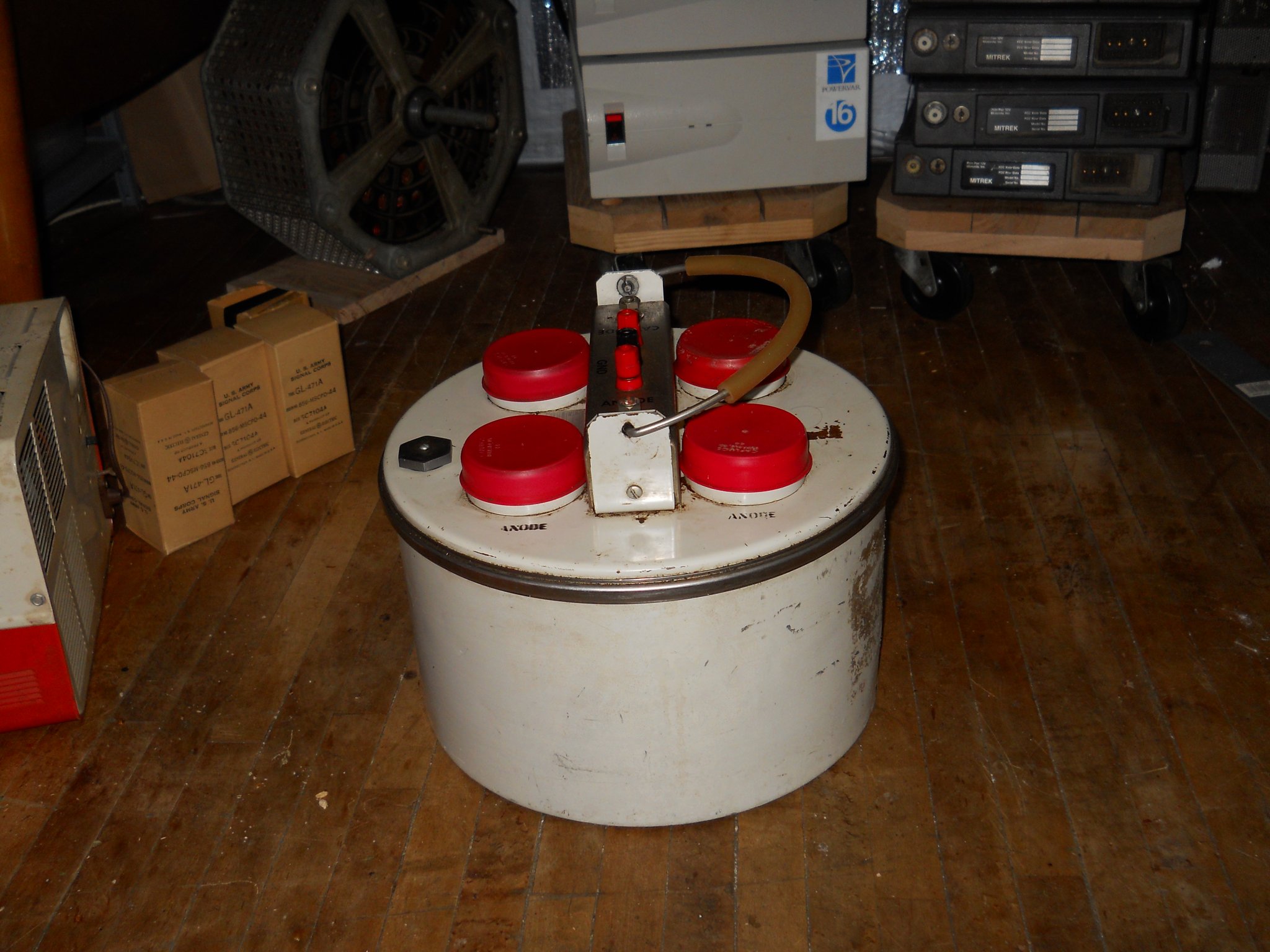
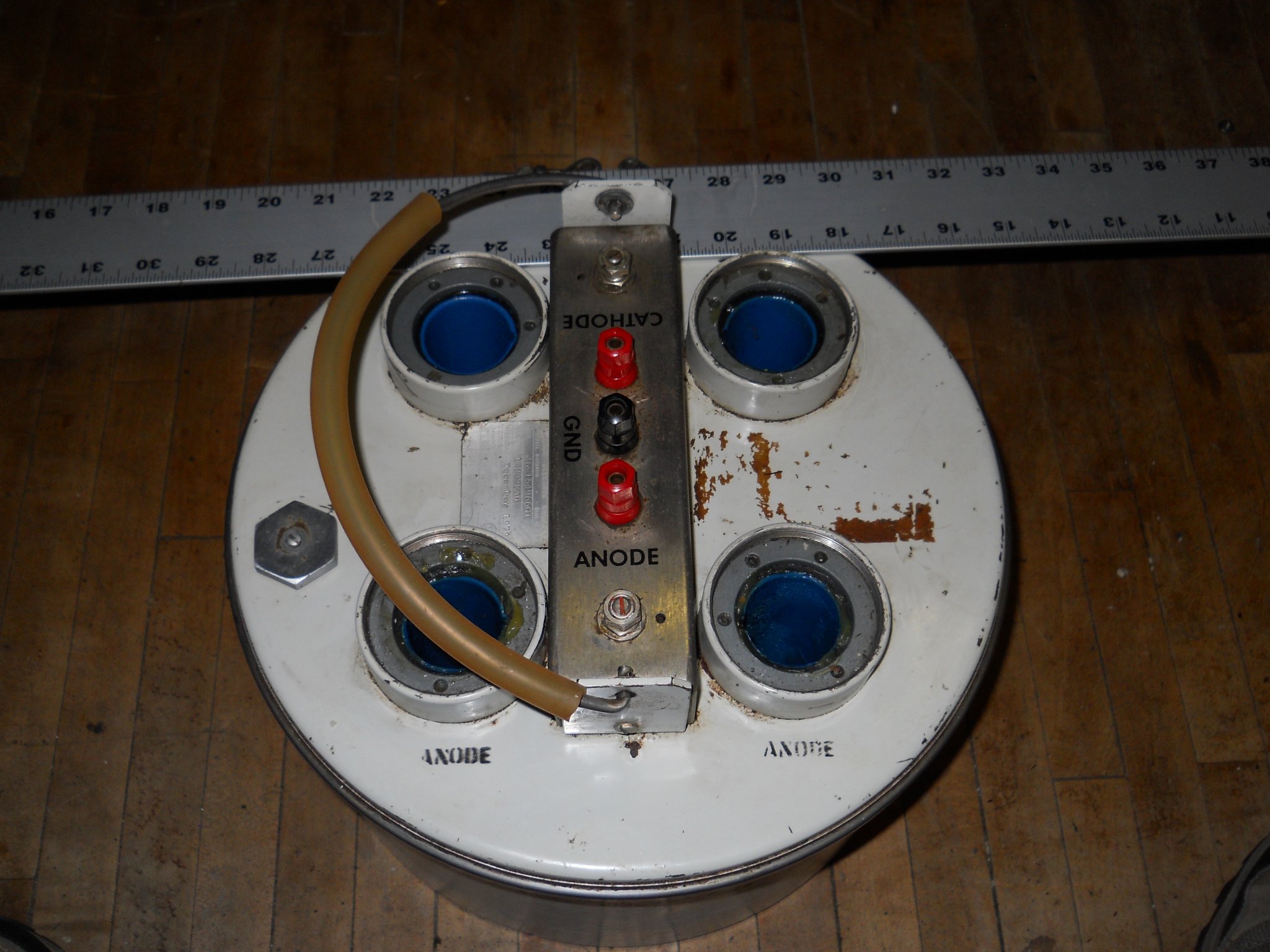
@Jazz2C -- Please forgive the dusty appearance of the imaged device -- Lemme tell ya!!! - That shed is maybe 2° cooler than the Solar photosphere and at least as humid as the depths of the Marianas Trench!:eek::eek::eek: -- So I 'snapped and ran', as it were!

Below are three images of a divider similar to the unit @Aleph(0) purchased for you (note that the Fed wells' dust covers were removed prior to imaging the penultimate and ultimate views)

FWIW the dimensions = 12" in diameter and 8" from base to top edge of the 'can'...

The 'low side' resistances (cathode or anode binding post to ground) should 'fall between' 150Ω and 250Ω depending upon the respective positions of the calibration pots...

Hope this is of assistance/reassurance!:D

Best regards
HP:)

Profile:


Top


Top detail:
 
Last edited:
@Aleph(0) & @Jazz2C

In the unlikely event either of you 'wingnuts' are yet possessed of your digits following this evening's festivities - please let me know (no later than Thursday morning) should you need 'script copies' of any of my tutorial-related posts. --- Come Friday I'll be, in the words of Aleph's "Fave" antediluvian band; "Heading out to somewhere, won't be back for a while..." -- Sans (gasp!) internet connectivity!:eek::eek::eek::D

All the best
HP:)
 

Thread Starter

Aleph(0)

Joined Mar 14, 2015
597
HP I tried routing through your provider like you said but I just keep getting thrown to some stupid survey screen after a few minutes:confused: So don't be angry cuz I took your advice but it doesn't work:(

In the unlikely event either of you 'wingnuts' are yet possessed of your digits following this evening's festivities
HP UR2 funny:rolleyes:!

please let me know (no later than Thursday morning) should you need 'script copies' of any of my tutorial-related posts.
HP I say we just let it be until you're back on here cuz it's too hard doing like you say _half duplex_:D!

in the words of Aleph's "Fave" antediluvian band
HP my favorite old time band is Zep so Heart is like Zep lite:D

"Heading out to somewhere, won't be back for a while..."
HP if Stan is right that boat has gotten on its beam-ends what's the point cuz hold is flooded for sure? So I say just stay home but I know you won't so just make sure you get back:(!
 
///// Off-Topic post /////

HP I tried routing through your provider like you said but I just keep getting thrown to some stupid survey screen after a few minutes:confused: So don't be angry cuz I took your advice but it doesn't work:(
Connection speed, etc... are only as good as the 'weakest link', as it were -- routing to my ISP via your VPN means data is yet 'filtering' through your VPN! Get it? --- The objective of the 'experiment' was to force your (apparent) public IP (or an 'in-route' DNS addy) to ≈ my IP (hence ruling out 'net neutrality throttling', etc, as the source of your 'connectivity woes') --- So... Did you experience better connectivity while it lasted?

I just keep getting thrown to some stupid survey screen after a few minutes:confused:
In my (admittedly limited) experience in this regard, it has been my observation that VPNs 'protect' their user's public IPs during unexpected 'outages' that way --- Thus it seems something triggered your VPN's 'bailout' feature -- Was the title of the 'survey page' something like 'Disable Feedback {your browser's name}'?

Please try this -- follow the link I sent via email, then, once connected, please visit THE SITE LINKED HERE where you should see the 'public IP' selected by your VPN and my IP (value of most significant byte = 67 decimal) in at least one of the "DNS Address Detection" fields... But puleeze! -- Don't make a habit of 'hooking' my ISP for other than debugging purposes! I have no desire to 'own' your browsing behaviour!!!:eek::eek::eek::p

@Aleph(0) --- While I'm happy to attempt to assist you with this - please be advised that I'm far from a networking expert!!!:oops::oops::oops:

HP UR2 funny:rolleyes:!
Ain't it Dulu... ahem... the truth!:D:rolleyes:

HP I say we just let it be until you're back on here cuz it's too hard doing like you say _half duplex_
:D
!
Considering 'full duplex' hasn't been going like the proverbial 'dose of salts' -- I see your point:rolleyes::rolleyes::rolleyes: - Ok then! On my return it is:) - So please prepare yourself to work! - I'd like to see the current tutorial transferred to projects prior to my B-Day!

HP if Stan is right that boat has gotten on its beam-ends
I'll take the evidence of my eyes over that of Stan's side scanner any day!:) -- The vessel is in the same (upright) position and orientation it occupied last autumn!:)

so just make sure you get back:(!
Just make certian you're ready to offer substantial assistance with the tutorial or you'll wish I had been 'lost at sea'!;):D

All the best
HP
 
Last edited:
@Aleph(0) ,@Jazz2C and anyone who cares?!:confused::(;)

I'm off!:cool: I expect to return to the fora by the weekend of the 23'rd -- Please note that I will have scant (if any) opportunity to 'look in' here in the interim -- Please direct any questions pertinent to this thread to @Aleph(0) (via a post here or to her PM)...

Best regards
HP:)
 

Jazz2C

Joined May 27, 2016
52
Yo HP! Sry I missed a chance wish you bon voyage:(

HP b/c you do media clips here I chose this as a farewell tune for you on expedition!:cool: You should know I chose carefully so it reflects my true feeling!:)


Jazz2C

Joined May 27, 2016
52
Was the title of the 'survey page' something like 'Disable Feedback {your browser's name}'?
Hey Aleph! That's a new bug with Leaseweb VPN services! It doesn't matter what browser you're using! The destination page is always "Disable Feedback Chrome" after abt 20 minutes. Story is the VPN randomly thinks you're unsubscribing so it wants an exit interview. What really sucks is it disables the VPN on the spot leaving you buck naked at the DNS level for sure! If I were you I'd talk to IT before continuing with that VPN when security counts!
 

Jazz2C

Joined May 27, 2016
52
@Jazz2C -- Please forgive the dusty appearance of the imaged device -- Lemme tell ya!!! - That shed is maybe 2° cooler than the Solar photosphere and at least as humid as the depths of the Marianas Trench!:eek::eek::eek: -- So I 'snapped and ran', as it were!

Below are three images of a divider similar to the unit @Aleph(0) purchased for you (note that the Fed wells' dust covers were removed prior to imaging the penultimate and ultimate views)

FWIW the dimensions = 12" in diameter and 8" from base to top edge of the 'can'...

The 'low side' resistances (cathode or anode binding post to ground) should 'fall between' 150Ω and 250Ω depending upon the respective positions of the calibration pots...

Hope this is of assistance/reassurance!:D

Best regards
HP:)

Profile:


Top


Top detail:
Tnx HP!:cool: Now I just need to know what the little screw in the oil filler plug is for? Mine has one too but it's seized and I'm afraid to use too much torque to loosen it b/c if it shears I'm sol again!:oops:

 
Top