Eagle Ground Plane

sparky 1

Joined Nov 3, 2018
1,218
Some of introduction section an example of what it is about and what the goals are in terms that a music artist
is trying to produce the voltage multipliers for example to push a tube high enough to get a certain affect.
The parts list and instructions sometimes come from a pile of notes. The revisions from the original pedal are
interesting when needing to make room for more circuit and ground planes are smaller.

The-Knight-Of-Tone-3v1-Building-Docs.pdf
 

Thread Starter

rpschultz

Joined Nov 23, 2022
812
I think I may have misunderstood my friends suggestion. He said we SHOULD have ground plane between caps, to reduce tolerance to create GP.
 

eetech00

Joined Jun 8, 2013
4,705
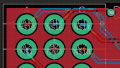
Someone suggested we shouldn't have GP between capacitor leads of power rails. OK, but how do you prevent Eagle from creating a GP in those situations? I increased the autorouter spacing to 0.5mm, here is what I have. On electrolytic caps it doesn't have a GP between leads (due to the spacing constraint), but on MLCC's and Film it does.

View attachment 341726
View attachment 341727

View attachment 341728
There are "gaps" in the plane because the clearance setting for your plane and traces are too big.
A good ground plane will have no gaps and will fill completely between pads. There are different philosophys on how wide clearances should be, and is only limited by the PCB fabricators capabilities. The board you are building is low voltage/current, I recommend between 10mil (0.254 mm) and 8mil (0.2032 mm) clearances. Larger than necessary pads can also cause gaps in the plane. Remember that the plane is an electrical connection, so it does no good to have isolated areas. The idea is to create a "noise filter" by using a contiguous plane (creates parasitics between the upper and lower planes, thus creating a "filtering" effect".
 

Thread Starter

rpschultz

Joined Nov 23, 2022
812
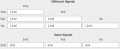
Thanks. Here are the default settings in Eagle - I think the Ground Plane falls within that 10mil pad-pad clearance. Seems fine for low voltage/current, although I could tweak them down some.

This project is intended to be sold as a kit to DIYers. Not rookies, but not pros either. If the GP gets too close to a solder pad, do you worry about sloppy solder joints arcing over?

1738584446718.png
 

eetech00

Joined Jun 8, 2013
4,705
Thanks. Here are the default settings in Eagle - I think the Ground Plane falls within that 10mil pad-pad clearance. Seems fine for low voltage/current, although I could tweak them down some.
Check with the PCB fabricator you will use. They have a set of rules for fabricating the board.
I make the clearances small enough, usually 8mil, so I can route 1 trace between pads, while still obtaining a complete ground plane "fill" between them. As an FYI, pads/trace sizes/widths "out of the box" are usually over-conservative and have a lot of room for adjustment.

This project is intended to be sold as a kit to DIYers. Not rookies, but not pros either. If the GP gets too close to a solder pad, do you worry about sloppy solder joints arcing over?
The solder mask will prevent unintentional solder shorts for manual or automated soldering. That is its purpose.
 

Thread Starter

rpschultz

Joined Nov 23, 2022
812
Different PCB, similar topic. I have a more complicated PCB that I've added a GP for. But the autorouter seems to be confused leaves airwires between ground connections; errors DRC.

1739151455842.png

1739151480363.png

I think it might have something to do with Net 0 vs Net GND. But I'm not sure how to correct it. The GP is on GND.
 

nsaspook

Joined Aug 27, 2009
16,328
Different PCB, similar topic. I have a more complicated PCB that I've added a GP for. But the autorouter seems to be confused leaves airwires between ground connections; errors DRC.

View attachment 342305

View attachment 342306

I think it might have something to do with Net 0 vs Net GND. But I'm not sure how to correct it. The GP is on GND.
You've made a autorouter death trap, where is does something early, then breaks it later for something else. Too many broken polygons from too little space to easily route traces. If you want to use that thing with dense two layer boards with a GP, you need to make it easy to do the right thing by giving it more open space.

Most of my current stuff is 4-layer to solve this and other problems.
 

Thread Starter

rpschultz

Joined Nov 23, 2022
812
Not sure why, but I deleted all my grounds and replaced them with a different ground: named GND on net 0. This worked.

This PCB had previously been fabricated without a GP, with the grounds individually routed. Adding a GP simplified the routering significantly as you would expect.
 

eetech00

Joined Jun 8, 2013
4,705
Different PCB, similar topic. I have a more complicated PCB that I've added a GP for. But the autorouter seems to be confused leaves airwires between ground connections; errors DRC.

View attachment 342305

View attachment 342306

I think it might have something to do with Net 0 vs Net GND. But I'm not sure how to correct it. The GP is on GND.
The airwire represents a electrical "disconnect" between the plane areas with the same net name.
Its unclear what you ended up with when you deleted the grounds and reapplied the plane.
You'll need to check your solution to be sure the resulting connections are what you expect.
 

Thread Starter

rpschultz

Joined Nov 23, 2022
812
The airwire represents a electrical "disconnect" between the plane areas with the same net name.
Its unclear what you ended up with when you deleted the grounds and reapplied the plane.
You'll need to check your solution to be sure the resulting connections are what you expect.
THIS. That was it, portions of the GP weren't connected to each other. I was able to move some stuff around. Thanks for the explanation.
 

Thread Starter

rpschultz

Joined Nov 23, 2022
812
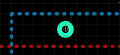
The grid is 1mm. It looks like it won't create a GP any closer than 1mm to the edge. Is this common? Or can it get closer to help connect GP areas?

1739209477333.png
 

eetech00

Joined Jun 8, 2013
4,705
The grid is 1mm. It looks like it won't create a GP any closer than 1mm to the edge. Is this common? Or can it get closer to help connect GP areas?

View attachment 342331
Yes. it common to have clearance between any copper and the board edge, usually 0.010-0.020 inch, so eagle should allow a smaller clearance than 1mm. There is a minimum clearance, but you 'll need to check with your board fabricator. Most fabricators will post their rules on there web site, or you can send them an email. Then set the tools rules accordingly.

Copper shouldn't be right at the edge of the board, or problems with the copper, or component mounting, can occur.
 

Hemi

Joined Mar 17, 2012
34
It looks like you might be using OSH Park to fabricate your designs, so I'd recommend downloading the design rule files from them:
OSH Park Docs ~ Eagle ~ Design Rules Files.

Some of their rules are pretty aggressive leaving very little clearance for tolerance issues so you might relax them a bit especially if you will be hand soldering your design, but it's a good start that will make it easier to design a board than using the defaults from Eagle.
 

Thread Starter

rpschultz

Joined Nov 23, 2022
812
I have 2 separate ground planes AGND and DGND. I have them overlapping top (red AGND) and bottom (blue DGND) and would like to connected with a via. But I can't get the vias to actually connect since they are different names:
1743624586120.png1743624599386.png

Is this possible?
 

nsaspook

Joined Aug 27, 2009
16,328
I have 2 separate ground planes AGND and DGND. I have them overlapping top (red AGND) and bottom (blue DGND) and would like to connected with a via. But I can't get the vias to actually connect since they are different names:
View attachment 345960View attachment 345961

Is this possible?
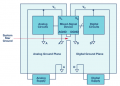
No, you really don't want to connect them with a via. I use a jumper (for a ferrite bead or choke) or a zero ohm resistor for a direct connection. I use a part of the board where I expect analog current paths and digital current paths are small to reduce AGND ground to DGND ground crosstalk. I also normally don't place them on directly top of each other in the PCB stack. There of course exceptions to every rule depending on signal speeds, power and mandatory device placement for other reasons.
It's usually a compromise with mixed signal devices like a ADC or DAC.

https://www.analog.com/en/resources/analog-dialogue/articles/staying-well-grounded.html
https://jlcpcb.com/blog/understanding-analog-and-digital-ground-in-pcb-design

1743625890788.png
 
Last edited:

nsaspook

Joined Aug 27, 2009
16,328
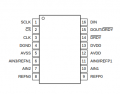
Not a PCB but it shows the partition of analog and digital signals.
https://www.ti.com/lit/ds/symlink/ads1220.pdf
1743626380011.png

The chip is well designed to split into a analog and digital halfs to make DGND (DVDD was from the computer collecting the data) and AVSS easy to partition with seperate grounds.

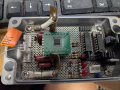
On this experimental board there is a shield between the two to keep the SPI digital signals from the analog filtered frontend and a separately filtered analog supply using batteries and zeners for low noise regulation.
1743626607424.png

1743626864801.png

Voltage levels using that system from a 100W solar panel looking at a full moon at night in a dark location. Those little sharp peak ticks you see are airplane lights in the sky flying over-head. I life in the glide-slope of the local airport. After mid-night they stop flying usually, so no more airplane ticks. I guess it could be used as a aircraft sensor in the right conditions but that's not what it was designed for.
1743627593505.png
https://forum.allaboutcircuits.com/threads/super-moon-shine.100322/post-904573

1743627729606.png
This was making 1.2 uW power from a 240W solar panel array.
 
Last edited:

nsaspook

Joined Aug 27, 2009
16,328

nsaspook

Joined Aug 27, 2009
16,328
So put ferrite bead to connect different ground planes? Or put it on the 9v rail? Or both?
What 9v rail? Normally, unless there is sensitive analog circuitry sharing power with digital, normal bypass caps are OK but if the analog needs, say. 50nV resolution on a 245-bit ADC or something like that, then DC rail isolation and filtering is a good idea. It won't hurt when you don't really need it but you need to have energy filter and bypass/decoupling caps on both sides of the bead (s) from the supply to each common on their respective sides.
 
Top