Dual power supply not balanced ?

Thread Starter

Circuitfreak101

Joined Apr 13, 2016
15
Hi all. I have built a dual 12v -0v 12v supply from a half wave rectifier running into the usual 7812 & 7912 etc and all is well except the output voltages aren't even and I think this is causing a DC offset on the output of my opamp based headphone amp .... here's the circuit, excuse the crude drawing I don't have any software for drawing circuits yet
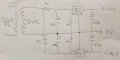
dual12v_Circuitfreak101_800x394.jpg
http://thesuperheroesonline.co.uk/dual12v.jpg

Can anyone help improve this design .... it basically has to power 2 mic preamps, a virtual ground mixer and a headphone amp all based around NE5532's

All help appreciated and thanks for looking


Mods Note:
Please upload you circuit to the forum and compress it to a clear image as 800x600 .jpg file.
 

LesJones

Joined Jan 8, 2017
4,511
If you look at the data sheets for the two regulators you will find that the voltages you are getting are well within the specification of the regulators. Do you really need the voltages to be closely matched for your application ?

Les.
 

Thread Starter

Circuitfreak101

Joined Apr 13, 2016
15
Thanks for the replies

I'm not bothered by the mismatch except there's around 160mV on the headphone output with respect to ground so I've had to use capacitors in series on the output to block the DC reaching the headphones. Here's the circuit it's a well known Cmoy

CMOY.jpg
 

OBW0549

Joined Mar 2, 2015
3,566
I have built a dual 12v -0v 12v supply from a half wave rectifier running into the usual 7812 & 7912 etc and all is well except the output voltages aren't even and I think this is causing a DC offset on the output of my opamp based headphone amp ....
There's absolutely no way that small mismatch in power supply voltages-- 12.22 volts vs. 11.84 volts-- could possibly cause the offset you're observing. Most op amps have extremely high CMRR, especially at DC, and the OPA2132 is no exception: its input offset voltage shifts only 30 μV per volt of power supply change, maximum, meaning that at most you'd see a few tens of microvolts offset on your output due to supply imbalance.

That said, I don't see anything obvious in your circuit that could be causing the offset you're seeing: the op amp's input offset voltage and its input bias current are both very low.

The only thing I can think of that might be causing it is RF oscillations; high-speed op amps have a VERY strong tendency to "break into song" when their supply pins are not properly decoupled or their circuits are not laid out carefully. (I notice your circuit diagram doesn't show any decoupling caps on the op amp supply pins.) Often, these oscillations are at very high frequencies (tens or even hundreds of MHz) and they can't be seen unless viewed with a very high bandwidth oscilloscope; so they're often missed. Unless you're equipped to see them directly, their main effect is usually to cause a mysterious offset in the op amp output. That offset is often dependent on output voltage, so it can also result in distortion of your output signal.

So I would suggest getting a good wideband scope and checking for signs of oscillation on the op amp outputs.

Also, the data sheet for the OPA2132 gives detailed circuit layout guidelines in section 10.1 on page 14; make sure you're following them.
 

Thread Starter

Circuitfreak101

Joined Apr 13, 2016
15
Yes although that circuit doesn't show any I have 100N ceramic capacitors across pins 8 and 4 on all 4 opamps on the board, which is veroboard. Also I'm using an NE5534 at the moment rather than the OPA

I think maybe the fact it's built on veroboard in a hap hazzard way could be the problem then, certainly being a prototype it's currently a rats nest of wires. I need to pay more attention to layout
 

LesJones

Joined Jan 8, 2017
4,511
The NE5534 has pins for balace adjustment. If you have not connected them and set it up as shown in the data sheet then this is the probable cause of you offset.

Les.
 

OBW0549

Joined Mar 2, 2015
3,566
Also I'm using an NE5534 at the moment rather than the OPA
There is an ENORMOUS difference between the OPA2132 and the NE5534.

Here's your problem: the input bias current of the NE5534 is 500 nA typical, 1500 nA maximum. That input bias current has to flow through 100 kΩ resistor R2, causing a 50 mV drop across R2 which gets amplified by the gain of your circuit.

This is why, when working with op amps having large input bias currents, it's always important to have equal resistances on the (+) and (-) inputs of the amp so as to balance the voltage drops; otherwise you can get large offsets, as in your circuit.
 

Thread Starter

Circuitfreak101

Joined Apr 13, 2016
15
Ah AK doh yeah I have drawn D2 the wrong way round but it is correct in the circuit

@OBWo549 Thanks for that explanation ... I will substitute the NE for the correct chip
 
Top