Dual Lambda Signal Modifier

SgtWookie

Joined Jul 17, 2007
22,230
I can put an underdrive pulley on it which would make it spin faster so it would require less power to get more out of it.
If you replaced the alternator's pulley with a smaller one, the alternator would spin faster at a given engine RPM. However, it would increase the load on the engine due to the reduced mechanical advantage.

If you installed a larger pulley, it would decrease the alternator's RPM for a given engine RPM, but it would decrease the load on the engine due to the increase in mechanical advantage.
 

cat3rn

Joined Jun 3, 2008
117
Improving mechanical efficiency will indeed lead to better mileage. So will a reduction in vehicle mass. Even good driving habits have a beneficial effect.
Short of having a roll bar encased in a fiberglass body, I would have to cut out every piece of non safety metal and holes in the floor and side panels you would not see an increase of more than 2% of gas mileage.
I think people are looking for more of a bolt on type of enhancement to improve it.
However, I do agree with the keeping the tires properly inflated and aligned and not stomping on the gas or doing hard braking etc you would see a pretty noticeable improvement.
Lets try to keep on subject of this topic.
 

SgtWookie

Joined Jul 17, 2007
22,230
I have attached a circuit using a 555 and transformer and I am curious as to the merits of it, does anybody have any suggestions?
It's very dubious at best. It's a bad idea. Narrowband O2 sensors just won't work outside of their very narrow range (right around stochiometric). If you really want to change the air/fuel ratio and keep the ECU running in closed-loop mode, you will need to get wideband O2 sensor(s).

Cat3rn found a wideband O2 sensor with a programmable interface that could be used to directly interface with an ECU designed for use with narrowband O2 sensors. Link to his post in another thread:
http://forum.allaboutcircuits.com/showpost.php?p=92976&postcount=21

However, you need a fallback mode in case the cell is not producing gas. Running with an extremely lean mix could cause severe engine damage.
 
Last edited:

Thread Starter

Capt-Killjoy

Joined Sep 29, 2008
58
Just so you know Damian....I have already built and tried that EFIE circuit and it does not work for our model year vehicles. It adds voltage on both ends of the switching voltage and will overdrive the upper end of the signal. Your ECU will see 1.0V plus whatever offset voltage you have applied. It will cause your Check Engine Light to come on and your ECU to go into a default stradegy, and ignore the O2 sensors all together. If you use the circuit provided by RonH in this thread, it will work for you to a point.
HOWEVER, as SgtWookie has stated many times through-out this thread, and I must concur.....installing wideband sensors on your truck would be the best. But if you are not in that position, then the circuit by RonH will allow you to do what you are trying to do, to a point.
 
Last edited:

cat3rn

Joined Jun 3, 2008
117
It's very dubious at best. It's a bad idea. Narrowband O2 sensors just won't work outside of their very narrow range (right around stochiometric). If you really want to change the air/fuel ratio and keep the ECU running in closed-loop mode, you will need to get wideband O2 sensor(s).

Cat3rn found a wideband O2 sensor with a programmable interface that could be used to directly interface with an ECU designed for use with narrowband O2 sensors. Link to his post in another thread:
http://forum.allaboutcircuits.com/showpost.php?p=92976&postcount=21

However, you need a fallback mode in case the cell is not producing gas. Running with an extremely lean mix could cause severe engine damage.
The link above is just a rear O2 simulator for 4 wire Gm vehicles. The link to the WB O2 sensor and programable interface is here.

http://www.innovatemotorsports.com/products/lc1.php
 
It's very dubious at best. It's a bad idea. Narrowband O2 sensors just won't work outside of their very narrow range
I am aware of the Narrowband issue - and will get wideband sensors for my car - the question is about the circuit as it has a different architecture to the other presented - hence I am curious as to the difference!
 

cat3rn

Joined Jun 3, 2008
117
I am aware of the Narrowband issue - and will get wideband sensors for my car - the question is about the circuit as it has a different architecture to the other presented - hence I am curious as to the difference!
Ok so now since we have the narrowband issue resolved and everyone knows to use a wideband O2 sensor can someone come up with a EFIE that will control the WB O2 sensor. The complete layout I can do, I just need the circuit. I know others have been posted, then corrections made but no real finished product. We all are looking for help here to complete this task. I will then make a layout and post it.
 
Last edited:

SgtWookie

Joined Jul 17, 2007
22,230
Ok so now since we have the narrowband issue resolved and everyone knows to use a wideband O2 sensor can someone come up with a EFIE that will control the WB O2 sensor. The complete layout I can do, I just need the circuit. I know others have been posted, then corrections made but no real finished product. We all are looking for help here to complete this task. I will then make a layout and post it.
The wideband O2 sensor already has a programmable EFIE that comes with it, with two ports (or output channels); by default one side is set up to emulate the output of a narrowband O2 sensor, the other side is set up to produce a linear ramp from 0v to 5v (if I remember correctly) according to the air/fuel ratio. It's in the installation instructions.

You could reprogram one of the channels for a fixed leaner lambda output for running with "hydroxy", and leave the fixed standard lambda for operation without; just switch between the two channels using a relay or semiconductor analog switch, such as a CMOS 4066 (Maxim/Dallas has much better analog switches). If you wanted to change the mix "on the fly", you'd need to have a laptop on board with the programmer installed.

Alternatively, you could build a comparator circuit with a pot to adjust the threshold. Something like a pair of LM3914 dot-bar LED drivers would be beneficial to view what your threshold setting is and the actual output from the wideband O2 sensor.

But, I don't know how involved you want to get with this.

Using the supplied EFIE with a switch/relay/analog switch would be the lowest-risk option.
 

cat3rn

Joined Jun 3, 2008
117
You could reprogram one of the channels for a fixed leaner lambda output for running with "hydroxy", and leave the fixed standard lambda for operation without; just switch between the two channels using a relay or semiconductor analog switch, such as a CMOS 4066 (Maxim/Dallas has much better analog switches). If you wanted to change the mix "on the fly", you'd need to have a laptop on board with the programmer installed.
I haven't looked through the instructions, but I'll take you word for it as I believe that is what it is used for anway.

Alternatively, you could build a comparator circuit with a pot to adjust the threshold. Something like a pair of LM3914 dot-bar LED drivers would be beneficial to view what your threshold setting is and the actual output from the wideband O2 sensor.
I could build it but I need someone to work out the circuit for me with everything labeled and I will do the layout andmake a PCB and post it. Could you do that. (in your spare time of course I wouldn't want this to be your only project.) lol


But, I don't know how involved you want to get with this.

I want to not just get my feet wet I want to get totally soaked if you know what I mean.

Using the supplied EFIE with a switch/relay/analog switch would be the lowest-risk option.
OK lets go with the low risk option. Thanks
 
Last edited:

cat3rn

Joined Jun 3, 2008
117
Or, you could simply use a capacitance meter to measure it. If you would like to build yourself a pretty good LC meter, click this link:
http://ironbark.bendigo.latrobe.edu.au/~rice/lc/
A marginally improved LC meter with calibration routines (version 2) is here:
http://ironbark.bendigo.latrobe.edu.au/~rice/lc/index2.html
This would be a worthwhile project that would give you a very handy tool for many future projects.
I am trying to put together a parts list but on this design but I have a few questions. Like what else is new. lol

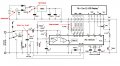
What is a Ccal? I assume it is a capactior but is it a special kind?

The schematic shows a 1N4004 but the layout does not.

what does the T stand for in 10uF T

Also look at the attached pics for other questions.
 

Attachments

SgtWookie

Joined Jul 17, 2007
22,230
I am trying to put together a parts list but on this design but I have a few questions. Like what else is new. lol
We're used to that ;)

What is a Ccal? I assume it is a capacitor but is it a special kind?
That's a capacitor used for calibration. The text spells out the types to use.

The schematic shows a 1N4004 but the layout does not.
They're off-board. The two diodes located close to each other have but one label, 1N4004. They are to prevent reverse polarity of you accidentally connect either external power or the battery backwards. They are also to prevent external power from trying to charge a 9v battery, or the 9v battery from powering anything external to the circuit (like, if a 9v wall wart should develop an internal short.)

what does the T stand for in 10uF T
That would be a 10uF Tantalum capacitor.

Also look at the attached pics for other questions.
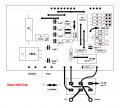
Starting from the upper left on the schematic:

"What is this?" That is a DC power jack. You chose the size. 2.1mm and 2.5mm are pretty popular.

"Not on layout" - the two 1N4004 diodes. Already explained.

Down from there - "What is CCal?" - already explained.

To the right - "What are these?" - they are dual headers, 2 rows x4 pins, like on the back of a PC disk drive.
 

cat3rn

Joined Jun 3, 2008
117
Got it thanks
a real gentleman and a scholar
Oh I forgot to thank you for your service to our country. My 2 older boys have each been in Iraq both about to become sgts. Oldest is in Ft Lewis and the other is 101st Airborne will be home from Iraq before Chrsitmas.
So again your service to our country is greatly appreciated.
 

cat3rn

Joined Jun 3, 2008
117
We're used to that ;)
They're off-board. The two diodes located close to each other have but one label, 1N4004. They are to prevent reverse polarity of you accidentally connect either external power or the battery backwards. They are also to prevent external power from trying to charge a 9v battery, or the 9v battery from powering anything external to the circuit (like, if a 9v wall wart should develop an internal short.)
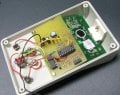
I don't see the diodes on his picture where should they be?
 

Attachments

SgtWookie

Joined Jul 17, 2007
22,230
I don't see the diodes on his picture where should they be?
If you compare the board layout with the photograph, you will notice that the red wire (from the board +supply) goes to the item in the upper left corner, which I can only assume is a 2.1mm or 2.5mm power jack, and the black wire next to it goes off the edge of the photo. There is no connector shown for a 9v battery.

I can't tell you why those diodes were omitted from this particular assembly photo, nor why the black wire was not shown connected to the 2.1mm or 2.5mm jack. This would be a question to pose to the person who did the writeup on it. You can find out how to contact them on the website.

Please be sure to read the FAQ.

Note that you should purchase the capacitors from an authorized distributor of new components, such as Digikey or Mouser - unless you have the capability of reconditioning capacitors that have been sitting around for an unknown period of time. Old tantalum and electrolytic caps can have a very high leakage rate. If the current into them isn't limited, they'll explode.

One way to recondition them is to use a variable voltage power supply in series with a large resistor (10k or more). Raise the voltage slowly over a period of time (hours to days) until the voltage is the same as the capacitor's rating. If the current through the resistor doesn't fall within specifications (see datasheet) after a period of time, the capacitor is scrapped.

It's easier to go with brand new components.
 
YOU COULD TRY AN O2 EXTENDER TO PLACE THE SENSOR OUT OF THE FLOW OF THE EXHAUST IN WHICH IT WILL READ LESS O2. MAKES SENCE TO ME. WHAT DO YOU THINK?
 
Top