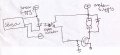
Driving transistor from current sinking device

BBee

Joined Dec 6, 2018
35
A point to be careful of is the maximum dissiapation of the IC, which is not stated. It may sink far higher current than stated for a short time, but could well overheat and fail. Another point is that if the IC runs hot it's calibration may be off. I notice that you are using a low voltage version. It may well be that my recommendation of transistor plus fet may be tricky, dependant on the switch on voltage of the fet if you run external circuitry at this voltage. It may be useful to work in easy stages and (initially) fit a pull up resistor on the output, check the logic, then proceed with external circuitry. I still prefer to use external inductive load switching (even if the IC will stand it, which with the datasheet given, it does not appear to).

Tracy
 

BBee

Joined Dec 6, 2018
35
Another point which occurs to me is that (as well as being an inductive load and so will require a reverse diode across it for transistor protection) if, for any reason, additional load is put on the motor it's current requirement may well exceed the 30mA by a large amount. This is one reason why motors burn out when stalled. As such, in my opinion, external driving circuity is needed.

Tracy
 

dendad

Joined Feb 20, 2016
4,637
I would vote for an opto coupled output.
SensorMotorDrive.jpg
Something like this.
And it prevents the load from damaging the sensor.
 
You missed the entire point.

I had a confusing email exchange with the manufacturers who pointed me towards the 100uA in the datasheet. I said: but this is listed as the minimum not the maximum. They replied: "the output is guaranteed to sink at least 100 μA so you can design around that."
So it appears they won't specify a maximum!
You are to design around this. If you sink <100 mA, the part works.

it't nothing more than we deliver a minimum of 80 PSI of water to the house.

Nominally 120/240 V from the grid. It doesn't count lightning strikes or blackouts.

I had one company when I looked at their schematics for a piece of $5000.00 scientific equipment. You don;t have a single item for power line conditioning. They promptly told me that we specify 120 V 60 cycles. A power disturbance is YOUR responsibility. it was going to cost us another $1000 for repair.
 

ebp

Joined Feb 8, 2018
2,332
Specs are often rather confusing because something described as a minimum is actually a maximum to meet some criterion. In this datasheet, it isn't very obvious, but what it is saying is that if the maximum current into the output is 100 µA or less, the output will be no more than 0.2 V above "ground" - they guarantee it will work that way up to at least 100 µA, but that is the maximum current at which the performance is assured.
 

dendad

Joined Feb 20, 2016
4,637
Ah. I just looked t the data sheet (should have done that first) so my circuit will not work directly as the supply voltage is too low. But a buffer transistor to drive the opto would work. Still use an opto I think. It is good protection noise wise too.
 

ebp

Joined Feb 8, 2018
2,332
You can cascade two common emitter NPN stages. Drive the base of the first with a pullup resistor suitable for about 100 µA with the supply voltage you are using. Assume you get a useful gain of about 20 from that transistor, so you can use a collector resistor of about 1/20 of that value. The second stage will also give you a gain of 20 or so, so from the 100 µA input to the first base you can have about 100 x 20 x 20 µA into the collector of the output transistor. If you supply voltage is very low (say 3 V or less, you might do very slightly better by assuming transistor gain of 10 to 15 instead of 20.
 

MisterBill2

Joined Jan 23, 2018
27,524
You can get the 2N3906 PNP transistors and build up the multi-stage darlington amplifier. And that 100 microamps is what they guarantee that their device can sink under some specified condition. So a two stage DC coupled amplifier will certainly drive your small motor. You are not going to need that snubber diode because the current is not changing that fast. Recall V=L dI/Dt, and if the dI.dT is not fast then the voltage is not much.
 

BBee

Joined Dec 6, 2018
35
Just to add another pennyworth. I have recently gone back to using Germanium transistors for low voltage circuits. I have a transistor inverter which works reliably at one and a quarter volts supply (with the transformer I am using, giving around 24V O/P at this voltage). I am roughly using ideas gleaned from Russian military radio equipment, as used with their rod pentodes. The leakage with Germanium is greater as is it is with temperature too, but turn on voltage is somewhat lower.

Tracy
 
Top