Driving transformer primary side with TRIAC

Thread Starter

hanskobber

Joined Oct 20, 2025
5
I am a bit new in power electronics, and I made this PCB to control a heating element using burst fire control mode.
I am using a burst window of 20 half periods and in the two scope screenshots I am sending a burst of 10/20 half periods.

Everything works great when driving a resistive load, but the issue is that the heating element is on the other side of a transformer.
The control has to be done on the primary side of the transformer, since the current will be way too big on the secondary side.

And when I connect the transformer, the resulting waveform is far from ideal and current can apparently only flow in one direction which I can not understand. I know that the TRIAC will turn off later than with the resistive load due to the lagging current caused by the inductive load, but I do not understand why the waveform looks like it does and why current only flows in one direction.

The triggering is done by an FPGA that also gets an input for the zero crossing (which works fine).

I have tried connecting the trigger directly to 24VDC to have the TRIAC constantly open, but the waveform is the same as in the attached just without the pause of course.

When I turn up the power, I quickly get a lot of current even with small load on the transformer, and I believe that this is due to the asymmetry in the waveform that causes a DC component in the signal.

Can anyone see any flaws in the circuit design or maybe the control method is not suitable for controlling transformer primary side?
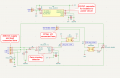
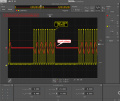
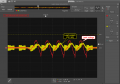
Circuit diagram.pngScope - Resistive load.pngScope - Inductive load.png
 

Thread Starter

hanskobber

Joined Oct 20, 2025
5
When you tested with the transformer, did it have some form of resistive load in the secondary?
Yes, I had an array of power resistors connected on the secondary side.
The transformer is specified to 400V 10A on the primary side, and 10V 400A on the secondary.
But I did not fully load it, since I already got too high current on the primary with 230VAC it immediately triggered the 13A fuse I had in front.
 

Sensacell

Joined Jun 19, 2012
3,780
If you turn on the primary circuit on the zero crossings, you will see the maximum inrush current: the transformer starts without any stored core flux to oppose the incoming voltage.
Turn the transformer on at the peaks.
 

Thread Starter

hanskobber

Joined Oct 20, 2025
5
If you turn on the primary circuit on the zero crossings, you will see the maximum inrush current: the transformer starts without any stored core flux to oppose the incoming voltage.
Turn the transformer on at the peaks.
So you mean like using phase chopping instead of burst fire mode?
But how does this explain why the waveform looks like it does when I connect the trigger signal to 24VDC directly?
 

Sensacell

Joined Jun 19, 2012
3,780
Use burst mode, but turn on the Triac on the Voltage peak.
Turn it off on zero current (the natural commutation point of a triac.)

This avoids (a) large inrush currents (b) large voltage spikes from energy stored in core inductance

1. Magnetizing Current (Im)

  • The magnetizing current is the small current that flows in the primary winding even when the secondary is open (no load).
  • It is required to establish the magnetic flux in the core.
  • This current lags the applied primary voltage by about 90°, because it is mainly inductive in nature.
  • It’s typically only 1–5% of the full-load current.

⚡ 2. Load Current (I₂)

  • The load current flows in the secondary winding when a load is connected.
  • It is in phase with the load voltage if the load is resistive, or lags/leads depending on whether the load is inductive or capacitive.
  • The primary current due to load (I₁′) is almost in antiphase (180° out of phase) with the secondary load current (I₂), because the transformer’s action maintains opposing ampere-turns to keep the core flux nearly constant.
 
Last edited:

schmitt trigger

Joined Jul 12, 2010
2,056
Small details;
I don’t see a snubber circuit neither on the main Triac nor the optocoupler.
Have you read the optocoupler datasheet? They clearly illustrate snubber usage.
 

schmitt trigger

Joined Jul 12, 2010
2,056
Another “small” detail: on the resistor that feeds the optocoupler, you mention 10 mA. With the 2k2 resistor, this means a Vpp of over 22 volts.
Is this correct? Vcc over 22 volts?

EDIT: I can see now it is 24 volts.
 
Last edited:

schmitt trigger

Joined Jul 12, 2010
2,056
Did I mention the Triac? No, I mentioned if you had read the optocoupler’s datasheet. It also requires a snubber.
This may not be the root cause of your problem, but you have to systematically eliminate any probable causes.
 

Ian0

Joined Aug 7, 2020
13,112
Firstly, you don't have an inductive load. The impedance seen at the transformer primary is the impedance of the load scaled by the turns ratio. Inductance is not your problem, transformer saturation IS. As others have said, if you want to switch a transformer with a triac, you must do so when the FLUX is naturally at zero, not when the VOLTAGE is, and that is when the voltage is at the peak.
Alternatively, get a transformer wound specially for the job, so that it can withstand the extra flux that is generated by triggering at zero crossing.
The current waveform shows your triac triggering half wave. That is because the gate resistor is far too small, and there isn't enough voltage across it to generate sufficient gate current to trigger. Use 100Ω.
For burst firing, there is no need to generate trigger pulses for each cycle. You will avoid mistriggering if you continuously gate the triac.
Always switch on for an even number of half cycles. And always start a pulse on the opposite polarity to the polarity of the last cycles when it was switched on. That allows the remanant flux to work to work to your advantage.
If you are only switching 5 times a second, it may not even be necessary to synchronise the gate pulses, especially if you have a transformer that will withstand a little extra flux.
It's a high-commutation triac, so it doesn't necessarily need a snubber, but adding a snubber never did any harm.

And, just out of interest, what is the voltage and current of the heating element? And why are you connecting it across two phases of a three-phase supply?
 

Thread Starter

hanskobber

Joined Oct 20, 2025
5
Firstly, you don't have an inductive load. The impedance seen at the transformer primary is the impedance of the load scaled by the turns ratio. Inductance is not your problem, transformer saturation IS. As others have said, if you want to switch a transformer with a triac, you must do so when the FLUX is naturally at zero, not when the VOLTAGE is, and that is when the voltage is at the peak.
Alternatively, get a transformer wound specially for the job, so that it can withstand the extra flux that is generated by triggering at zero crossing.
The current waveform shows your triac triggering half wave. That is because the gate resistor is far too small, and there isn't enough voltage across it to generate sufficient gate current to trigger. Use 100Ω.
For burst firing, there is no need to generate trigger pulses for each cycle. You will avoid mistriggering if you continuously gate the triac.
Always switch on for an even number of half cycles. And always start a pulse on the opposite polarity to the polarity of the last cycles when it was switched on. That allows the remanant flux to work to work to your advantage.
If you are only switching 5 times a second, it may not even be necessary to synchronise the gate pulses, especially if you have a transformer that will withstand a little extra flux.
It's a high-commutation triac, so it doesn't necessarily need a snubber, but adding a snubber never did any harm.

And, just out of interest, what is the voltage and current of the heating element? And why are you connecting it across two phases of a three-phase supply?
Thank you for your answer!
The voltage and current of the heating element is 10V 400A and it is connected like that because the heat element is actually a graphite encapsulation for a material test sample that we need to heat to >1000°C
Really appreciate the answer, and will try out the suggestions.
 
Top