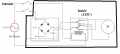
About the circuit, it would work as drawn but if this is a motor of any size it is likely to get upset if it is running at speed and you suddenly reverse the voltage.
AH is certainly correct, reversing a spinning motor produces a lot of stress, both mechanical and electrical. Even just short-circuiting the terminals will produce very high currents and mechanical stresses. So the solution is to use two separate relays, one for forward and the other for reverse, or else, use one to switch on/off, and the other to select the direction. Of course, the application of the motor does matter, since some applications are much more demanding. The size of the motor also matters greatly.
AH is certainly correct, reversing a spinning motor produces a lot of stress, both mechanical and electrical. Even just short-circuiting the terminals will produce very high currents and mechanical stresses. So the solution is to use two separate relays, one for forward and the other for reverse, or else, use one to switch on/off, and the other to select the direction. Of course, the application of the motor does matter, since some applications are much more demanding. The size of the motor also matters greatly.
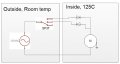
One more potential solution is to utilize a three position switch, with the center position being "off", and then using a simple diode from each of the "on" positions, with the 2 diodes having opposite polarities. This would supply the motor with half-wave rectified power in either direction, with the downside being that there would be some reduction in torque. The best part is that it would not require any components to be located in the hot area.
One more potential solution is to utilize a three position switch, with the center position being "off", and then using a simple diode from each of the "on" positions, with the 2 diodes having opposite polarities. This would supply the motor with half-wave rectified power in either direction, with the downside being that there would be some reduction in torque. The best part is that it would not require any components to be located in the hot area.
Please stop suggesting sensical solutions that don't involve operating sensitive components inside an oven. See post #15. Switching polarity from a more logical location is no longer viable. Apparently the power supply is also inside the oven as well as the motor. And this mystery device has presumably been relocated to the inside of a nuclear reactor, hence no running wires into it.
Apparently the power supply is also inside the oven as well as the motor. And this mystery device has presumably been relocated to the inside of a nuclear reactor, hence no running wires into it.
Did I forget to mention this mystery device needs to be able to withstand 234 cpm from a cesium-137 source? (JK)
I should clarify: The AC power source and switches (power and direction) are outside the device and away from the high temperature area, see attached. I actually could replace those switches with a 3Pole switch, what I cannot do is put the relay or rectifier outside the device.(convenient huh?)
One more potential solution is to utilize a three position switch, with the center position being "off", and then using a simple diode from each of the "on" positions, with the 2 diodes having opposite polarities. This would supply the motor with half-wave rectified power in either direction, with the downside being that there would be some reduction in torque. The best part is that it would not require any components to be located in the hot area.
If I understand you correctly, see attached schematic for confirmation; the suggestion might just work and would be simpler than what I was trying to pull off. I will have to run the torque numbers as that will be a drastic reduction, but I might be able to live with it.
The frustrating thing is that in your 2nd drawing above, if you just short out the diodes you now have both motor wires brought out of the oven where almost anything could be done with them, yet this is not allowed.
The frustrating thing is that in your 2nd drawing above, if you just short out the diodes you now have both motor wires brought out of the oven where almost anything could be done with them, yet this is not allowed.
Some more thoughts prompted by SB's post. (Post #32) The fact that the motor is running in this high temperature environment suggests it must be a specially designed motor. Is this the case ? If it is a series wound (universal motor.) reversing the polarity to the motor will not reverse it's direction. But it would give you the option of bringing the armature and field connections out separately which would allow you to reverse it externaly while still only having AC going into the oven. As you say that you can only take AC into the oven it does not seem to make sense to be allowed to convert the AC to DC inside the oven. Can you explain the reasoning for this restriction ?
What's frustrating about it from this side of the aisle is that you're treating us like mushrooms (keeping us in the dark and feeding us crap). Threads like this come up all the time. OP comes in, gives some absurd criteria, won't explain why, makes us all do detective work and resolve through 5 pages of nonsense, the perfect questions to ask to get the needed info out of OP. All so we can put together a solution that meets all the criteria but OP still doesn't like it because of some top secret reason he can't divulge. I could tell what direction this thread was going from the first time you deflected my question.
We don't sit around here waiting for good ideas to gobble up. If you think that what you're working on is going to revolutionize ovens, just know that you're wrong. There's no sense in not giving us all the details and answering plain & straight questions with vague answers like "it's no longer viable." Tell us what's going on so we can better help you. All we want to do is help you, and I for one don't have time for all this cloak & dagger crap.
The motor is an off the self, high-temperature (class H windings), 110 VDC brushed motor. It’s what I have to work with at the moment. A universal motor may have been better option for simplicity sake.
Good news though!
MisterBills2’s simplified half bridge solution did the trick, at least in the short term. The motor pulsates a little bit but nothing significant and it still produces a generous amount of torque. I am hoping that life span is not effected to bad, I will keep you updated.

 Facebook
 Google
 GitHub
 Linkedin