DPDT Relay or alterative

Thread Starter

JamesStew

Joined Feb 9, 2018
12
Hi all,

I am looking for help from the fine people at AAC.

I am in search of a DPDT relay, 115 AC coil, Rated for a temperature of 225F, 3-6 Amp draw, PCB mount, relatively small package < 1 cubic inch.

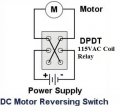
…or an alternative, with the aforementioned specifications? All I am doing is using the relay to reverse polarity to a motor, see attached image.


Best Regards,

Thank you in advanced!
 

Attachments

AlbertHall

Joined Jun 4, 2014
12,625
I can't help finding a 225°F relay - that's hot!

About the circuit, it would work as drawn but if this is a motor of any size it is likely to get upset if it is running at speed and you suddenly reverse the voltage.
 

Thread Starter

JamesStew

Joined Feb 9, 2018
12
Dodgydave: I had the same initial thought, Omron was one of the first places I looked.

AlbertHall, MaxHeadRoom: I wouldn’t call it cold! …This obviouslydoesn’t help when electronics tend not to like the heat. There is VDC power ON/OFF before the relay shown. The motor is not suddenly reversed while running.
 

strantor

Joined Oct 3, 2010
6,875
Why on earth do you need this rated for such a high temperature? Is it not possible to mount the relay in a cooler location and run wires into the hot location?
There are a few problems I encountered while searching:
  • High temp relays are uncommon
  • PCB mount relays with 110V coil are uncommon - most PCBs are low voltage DC.
  • High-temp, pcb-mount, 110V coil relays are apparently unicorns.
Try to do this a different way.
 

Thread Starter

JamesStew

Joined Feb 9, 2018
12
  • The 225F (or at least 205F) is a requirement. It is being used very close to an oven and its modular so unfortunately I can’t run wires away.
  • 110-120 AC switching signal is required.
  • PCB mount is a requirement.
If there is a way to do this without a relay, I am more than open to suggestions. My background is mechanical so I have a limited arsenal when it comes to work arounds. This is the main reason I took to the forums for help and suggestions.

In the end, I am trying to do is reverse polarity of a DC source with an AC signal at High temperature. There could be a solid workaround, I just have no knowledge of a way at this time.
 

Thread Starter

JamesStew

Joined Feb 9, 2018
12
Phone round relay manufacturers/distributors, Do you have a link? it's not coming up with a google search.

I will have to get back to with the PCB material used, it has been tested and worked for long enough that it is not raised a concern but you have me curious. The relay (or whatever I can figure out to make this work) is a retro fit to an already working/tested device.
 

Thread Starter

JamesStew

Joined Feb 9, 2018
12
Sorry, my bad! This part was a new phrase for me: https://www.macmillandictionary.com/us/dictionary/american/phone-round

I just tried actually googling "Phone round relay manufacturers"

I have been looking around at all the big manufacutures over the past few days: Omron, TE, Panasonic, Crouzet, LittleFuse, Honeywell etc. with little luck. Again, why I turned to the forums looking for some hope of either a product or an alternative methoed.
 

AnalogKid

Joined Aug 1, 2013
12,128
108 DegC is well within the operating temperature range of many power MOSFETs. Four of them arranged in a circuit called an H-bridge can supply reversible DC to a motor. Have you told us the motor voltage yet? This circuit will not fit inside 1 cu. in., but then neither will a DPDT relay with 10 A contacts.

If this is a retrofit, what is the relay in there now? Data? Photos?

ak
 

Thread Starter

JamesStew

Joined Feb 9, 2018
12
The motor voltage is 110 VDC, rectified from 110 VAC.

I have some room to play with, the 1 cu in. was more of a reference. I just don't have unlimited space, i.e. a 5cu. in. relay will not work.

There is not a relay in there now. Reversing the motor or polarity currently is done outside the device, which is no longer viable. Hence I need to retrofit the control (the reversing polarity part) into the device.This would be simple if it weren’t for the temperature aspect .

I had not looked into H-bridges for this. I have used them in the past for some other motor control/position projects. When I last used one I had programed a microchip to give power, break, and PWM signal to the H-bridge which drove a motor with some position control.

I think I did not consider using a H bridge for this project because the last time I used one it took some (relatively) significant programming,
control logic, and signals to drive the motor. whereas this current project needs to be real simple:
  • With a 110VAC input signal: takes the 110VDC input and outputs one polarity of 110VDC.
  • With No input signal: takes the 110VDC input and outputs the opposite 110VDC polarity.
This may be possible to do with an H-bridge, I will have to do my research here. (again, mechanical background..)
 

AnalogKid

Joined Aug 1, 2013
12,128
Note that full-wave rectified 110 Vac produces a pulsating unipolar voltage, not clean DC. Peak value is 160 V -ish, half-sine pulses. The RMS value of the waveform is 110 V. Will your motor be happy with pulsating DC?

You are correct, no uC or other complexities needed for your application. What are the ground and neutral relationships among the AC and DC sources?

ak
 

Thread Starter

JamesStew

Joined Feb 9, 2018
12
Max current at stall of the motor is 1.5A, something went wrong if we hit stall. Typical operating conditions are around 0.2A.

I am aware the DC voltage out will not be clean, I need to read up a little more on the specifics for my knowledge. I do not foresee a problem with a pulsating VDC other than a reduced motor life. The power is only going to a motor for an industrial type device where precision position control is not required. I do need to do my research to confirm this.

There is only one source, VAC. The neutral should be at a 0 volt potential. The motor case is grounded for safety.

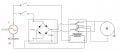
I attached a simplified schematic for reference. It is missing some more switches and controls but it gives you a basic idea of the purpose and the relay in question that I am trying to find or replace.
 

Attachments

MaxHeadRoom

Joined Jul 18, 2013
30,658
I am aware the DC voltage out will not be clean, I need to read up a little more on the specifics for my knowledge. I do not foresee a problem with a pulsating VDC other than a reduced motor life. The power is only going to a motor for an industrial type device where precision position control is not required. I do need to do my research to confirm this.

.
Full wave bridge (SCR) controlled drives have been used for decades in treadmill etc, also, KB, one of the largest manufacturers of small DC drives use this method in their low end drives.
The current wave form in the motor is quite different from the supply voltage, it is a mean level saw tooth in nature and does not go to a zero point as the voltage.
Max.
 
Top