Not necessarily. The black is clearly the original colour and the brown may be the varnish which is often used to secure and protect the windings.
Does it get unduly hot in use?
The sterilizer is not working anymore. It goes to random symbols and error codes at start up. It may work eventually after 50-100 attempted starts. Here's a video:
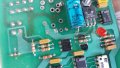
Picture of board:
Any thoughts on where to start troubleshooting based on the components on the board? It's 30yo and circuit board is no longer sold. Individual components are still available except the information on the eprom.
It looks OK to me. The yellow-brown stuff, as Albert said, is just transformer "varnish" and it is that color when fresh. Unless there is some sort of intermittent connection it is extremely unlikely there is anything wrong with the transformer. Sometimes a "shorted turn" will develop, but that generally leads to the fuse blowing.
Somewhere on (or off) that board there must be electrolytic capacitors that filter the rectified output of the transformer. They would be my number one suspect. They do "wear out" and at the time that was made there were very few electrolytic capacitors specified for long life (typically they were rated for 1000 hours at 70°C or 85°C).
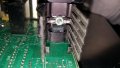
Another thing work checking is the thermal compound, if any, used between the voltage regulator(s) and the heatsink(s). The most common type of that time used silicone oil to suspend the thermally-conductive "filler" and the oil will evaporate over the years. The regulators are almost certainly types that are internally thermally protected, but it is still good to keep them cool to prevent failure. I greatly doubt there is a problem with a regulator, but it is not impossible.I looked again at the photo with the relay and can't make sense of how the regulator (or transistor or ??) is mounted to the adjacent heatsink. It looks like there was a flat piece of "something" under the nut and whatever it was has broken in two. I can't see any evidence of what looks like thermal goop.
[EDIT and yet another look] It appears the regulator is just mounted flat on the board. The blue capacitor may be the only filter cap. It looks like ones Philips made in auld lang syne. I can sort of imagine I see part of a Motorola MACxxx part number on the device on the heatsink, which would make it an SCR or triac, almost certainly with line voltage on it, so care is warranted. If it is an SCR or triac, it may be driven by an optocoupler, such as the 6-pin part near the blue cap. Optocouplers do slowly degrade with use (the output of the infrared emitting diode drops). If the processor is monitoring things, it may be finding a firing failure and putting up an error code. ... But I still suspect the capacitor.
Those blue philips capacitors are prone to fail. Measure the voltage on the capacitor.
I would expect something between 10 and 12 Volts.
When it is below 8 Volts, the regulator can not function correctly and the system will give failures.
I'd start with replacing the capacitor. If you have some capacitors on hand you could try just bridging another one across as a quick test. I can't quit read the value on the original but it looks like 470 µF. Anything rated for 25 V or higher and probably in the range of 330 to 1000 µF would be OK.
The optocoupler probably is OK, but if you want to "shotgun" it just in case, the base part number is MOC3010. The R in R8733 probably designates the manufacturing plant and 8733 means it was made in the 33rd week of 1987.
The part to which you linked is a surface mount version. You want the MOC3010M which is the through-hole type with standard lead spacing. At the time the original was made neither of the other variants would have existed.
Some transformers are vacuum impregnated with laquer and then baked to cure it. They often look a bit over done - what it smells like might be more informative.
It's working!!! I replaced the Philips blue cap with an NTE one. Also, I noticed a small hairline crack where the bolt mounts the board. It appears this is also the thick ground trace which the bolt was overtightened. I soldered a bridge over the crack.
Thanks so very much for all the help. This is a great board with awesome members.

 Facebook
 Google
 GitHub
 Linkedin