Facebook
 Google
 GitHub
 Linkedin

Not only Prof. Sam Ben-Yaakov,Professor Sam's data seems to disagree with that observation, if I understand correctly.
but TDK, manufacturer of ceramic capacitors,
talked the same:
https://www.tdk.com/en/tech-mag/electronics_primer/6
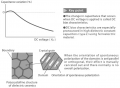

"●DC bias characteristics (DC voltage characteristics)
The capacitance of a ceramic capacitor also changes according to the applied voltage. With a DC voltage, this property is referred as the DC bias characteristics. With low dielectric constant capacitors (type 1), capacitance hardly changes, but in high dielectric constant capacitors (type 2) with "B" characteristics and especially ceramic capacitors with “F” characteristics, the change is significant. This is due to the fact that high dielectric constant capacitors use a ferroelectric substance (such as BaTiO3) which generates spontaneous polarization.
Ceramics material is a polycrystalline substance that consists of a large number of crystal grains. In ferroelectric material, the so-called domains of these grains are arranged alternately in the opposite direction, thereby canceling each other out, so that no spontaneous polarization occurs. As the strength of the applied direct electric field increases, the dielectric constant initially also rises because the orientation of spontaneous polarization is aligned with the orientation of the electric field. However, when the electric field is made stronger, alignment ceases and saturation is reached, causing the dielectric constant to drop. When applying DC bias, it is therefore necessary to select the correct parameters taking the characteristics of the dielectric as well as the usage voltage and withstand voltage into consideration. Also, the capacitance drop caused by DC bias will tend to be more pronounced in smaller capacitors."