Do diodes always connect ground?

MisterBill2

Joined Jan 23, 2018
27,540
The educational part will be to examine the CMOS IC specifications as far as the logic threshold levels are given. Then look at the diode specifications relative to reverse leakage and voltage drop at very low currents.
 

Thread Starter

ElectroEnthusiast

Joined Jun 22, 2024
11
OK, now I pose that same question to the "Electro Enthusiast: Was this an effort to learn something about diodes? Or about logic gates??. Or something else that we all missed.
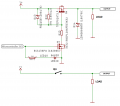
Yes, what I am actually trying to understand is this circuit.
1733743495826.png
It's supposed to convert the 3.3V output of the microcontroller to a 12V (V+) output. I understand how a 1 from the microcontroller would connect the output to V+ but when the microcontroller outputs a zero, how is the output a zero?
It can't get the ground from the flyback diode, right? I tried to simulate what happens when you connect a diode like that to a gate to be sure but the gate always detects a zero no matter the direction of the diode. Then I am confused and I cannot tell where in the circuit ground is connected to output.
 

sarahMCML

Joined May 11, 2019
697
When the micro outputs a zero, Q7 turns off, and so Q4 is turned off by R22. Therefore its output is pulled, by the load on the drain, to the same ground as that of Q7.
In this case, if the VGS of Q4 is greater than +&- 12V, there is no need for D13 or R23, although it's good to have a small resistor of 10 or 20 Ohms connected right at the gate to stop parasitic oscillations. R22 could better be smaller to speed up switching as well.
 

Thread Starter

ElectroEnthusiast

Joined Jun 22, 2024
11
When the micro outputs a zero, Q7 turns off, and so Q4 is turned off by R22. Therefore its output is pulled, by the load on the drain, to the same ground as that of Q7.
In this case, if the VGS of Q4 is greater than +&- 12V, there is no need for D13 or R23, although it's good to have a small resistor of 10 or 20 Ohms connected right at the gate to stop parasitic oscillations. R22 could better be smaller to speed up switching as well.
Thank you very much for your reply and I think there is some gap in my knowledge here. If there is a zero on Q7's gate, that means there is no connection between its drain and source, right? How come ground would be connected to the circuit's output then? I know it's a basic question, I just don't know the answer.
 

MrChips

Joined Oct 2, 2009
34,817
You are thinking that ground is a requirement for zero volts.

There are other ways of reaching zero volts. All you need is a way to drain charge away from a node. Any load on the output will do that when there is no source.
 

MisterBill2

Joined Jan 23, 2018
27,540
The confusion about "ground" and the off state of the circuit is why I often object to the use of that "ground" symbol in place of showing an actual "common" conductor.
Actually showing the rest of the circuit is not that much additional effort and avoids information gaps for those less experienced folks wanting to understand and learn.
 

panic mode

Joined Oct 10, 2011
4,991
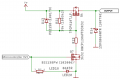
This diagram really helped me understand this and it makes sense now.
part of interpreting circuits and schematics in general is to come up with simplified/reduced representations. this way one can focus one specific part of the circuit. one can draw it out... and with a bit of practice this can be purely in mind... by tuning out the "noise" one can focus on specific things that are analysed. so one can look at schematics, and rather as a set of images... an entire slide show... and it changes depending on what one is looking at.
 
Top