DIY power transformer help

Thread Starter

quitenoob

Joined Mar 27, 2022
262
How do you filter 34,000 options based on the volts that they would drop, if you were only using them at 15% their rated current? Only way I know is, filter them all 500A+ and then consult the datasheets of each. That sucks. I'm not going to do that
hahahha I'm with you brother. So lets just get this show on the road and pick something that is not objected to by experienced readers of this thread.
 

strantor

Joined Oct 3, 2010
6,875
When looking at that link I see
Rectifiers 280 Amp 200 Volt
My fingers are twitching. Trigger happy when near the order button. Do I give in and get those?
As I said, I would if it were my project. but I'm impulsive. I'm sure there are better devices but I wouldn't have the patience to sniff them out. If you're a more patient person than I am, you can go to the rectifiers section, remove all the filters I enabled, and create your own. I would filter out everything below 500A and everything that is out of stock, and then sort by price. Go down the list looking at the datasheets, at the charts of VF Vs. Amps, and pick the device with the lowest VF @ 150A that is in your price range.
 

strantor

Joined Oct 3, 2010
6,875
I did not. what I did was put probes of my mmeter in the powder while the mmeter was in continuity mode. It made no beeb regardless of the distance between the probes
I am having a hard time believing that iron powder is nonconductive. Iron is conductive. I can't fathom why in powder form it suddenly wouldn't be. I suspect eddy currents are the main source of inefficiency in your transformer. Can you measure the actual value of resistance rather than just listen for the beep?
 

Thread Starter

quitenoob

Joined Mar 27, 2022
262
I think I do not even have to order extra powder.

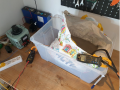
A better container also does the trick

1651320489445.png

look how low the VAC in is and how high the amps out.
amps in prim. are even lower than earlier tests
 

Thread Starter

quitenoob

Joined Mar 27, 2022
262
I am having a hard time believing that iron powder is nonconductive. Iron is conductive. I can't fathom why in powder form it suddenly wouldn't be. I suspect eddy currents are the main source of inefficiency in your transformer. Can you measure the actual value of resistance rather than just listen for the beep?
if you tell me how to measure I will tell you the values I get
 

strantor

Joined Oct 3, 2010
6,875
if you tell me how to measure I will tell you the values I get
Just put your meter on Ohms and jab your probes into the powder like you did before, but read the value on the meter instead of listening for the beep. Try taking measurements at 0.5", 1", 2", 4", etc.

What country are you in? I don't know whether to be be talking in inches or mm, or what suppliers to recommend.
 

Thread Starter

quitenoob

Joined Mar 27, 2022
262
Just put your meter on Ohms and jab your probes into the powder like you did before, but read the value on the meter instead of listening for the beep. Try taking measurements at 0.5", 1", 2", 4", etc.

What country are you in? I don't know whether to be be talking in inches or mm, or what suppliers to recommend.


My humble apologies but I am going to post actual resolution images. I am sorry if an antiquated internet connections can't keep up but the fact of the matter is that only a few people actually contribute anyway.

1651323804439.png

1651323825413.png

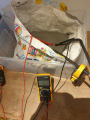
Really I tried also different resolutions. There seems to be no conductivity.

I am of course all ears to how to better assess whether this is correct or not.
 
Last edited by a moderator:

Thread Starter

quitenoob

Joined Mar 27, 2022
262
My humble apologies but I am going to post actual resolution images. I am sorry if an antiquated internet connections can't keep up but the fact of the matter is that only a few people actually contribute anyway.
Also, As an IT guy my self. May I suggest to server side process incoming images and create several scaled versions of them? And then serve one that is connections wise most suitable
 

strantor

Joined Oct 3, 2010
6,875
Yes sir, I'll get on it.

I am from the wrong side of the pond so I do not do elbows, pinkies, thumbs and what not ;)
I am from the Netherlands. -5m below sea level. My brain works best in internationally accepted scientific notations ;)
Got it. I will try to cross references cubits, furlongs and stones to SI deci-units from now on. Sorry I don't know of any Dutch electronics outlets though.

I have been to your country, it is a beautiful place!
 

strantor

Joined Oct 3, 2010
6,875
I am sad to announce it is no longer ;(
Since when?! I went in 2014 and thought it was nice. Has it descended into ruin since then? I stayed in Rotterdam for a couple of weeks, working at Seatools facility. I enjoyed driving the countryside between there and Amsterdam. Didn't get much time for tourism but what I saw, I was impressed with. The building construction referred to as "new" is older than most structures in America.
 

MrSalts

Joined Apr 2, 2020
2,767
The Permiability of iron drops more catastrophically as density of elemental iron decreases in a given volume. Pure iron has permeability but has huge eddy current losses. Powder with insulated particles is good but air gaps between particles is a tragic decline.

The exact decline highly depends on whether the iron is hydrogen annealed (99.8%) vs as atomized (97-99%).
Natural repose vs compacted vs compacted with lubricant vs compacted with epoxy. soft, annealed iron can become much more dense but passivated oxidized layer can be broken by compression and cause eddy current increase. When I say "compressed", a typical iron powder inductor core is generally formed by pressing iron powder into a die with tons of pressure in a hydraulic press.

Iron is conductive so something happened to the surface of the powder you are using. There are three general methods to create iron powder.

Gas atomized - at the top of an inert-gas filled chamber, nitrogen or argon gas jets blast molten iron dripping from a nozzle. It falls down and solidifies. The iron is dropped into drums with the lids askew to allow the surface to slowly passivate in the next few days. Then sealed for packaging.

Water atomized - same as above except, a water jet hits the bead of iron dripping from a nozzle. This can be more oxidized -thicker and chemically different than gas atomized

Carbony process - a chemical, iron Pentacarbonyl, is vaporized into a large vessel and then super heated to decompose the chemical into elemental iron plus carbon monoxide. The inside the vessel, the iron falls down as 1-5 um diameter spheres.

Some irons accept very thin (nanometer) passivation technologies and some will only oxidize in thick (5-10 micron) depth. Once you oxidize a 60 um diameter particle to 5um, and get the corresponding volume increase of the counter ion used in oxidation, your concentration of elemental iron is significantly diluted which is added to the air space between particles and numerator decrease as you have even less elemental (un-oxidized) iron.

The highest quality (lowest loss, lowest eddy current cores are made from "carbonyl iron" but it is also 5x to 10x the price of other iron powders which are, in turn, multiples of the price of any other structural iron shape you may buy.

I have never made a core of loosely poured iron powder but I could imagine the permiability is quite low. Your idea to pour powder over the core is good, just not great. Your energy losses (1- ("watts into primary"/"watts into secondary")) are going somewhere, usually the losses go into heating the iron core. Are you measuring the temp rise of your iron powder? Can you feel the heat or are you only running this thing for a few minutes at a time? You should be able to smell the hot PVC pipe as the first warning sign (assuming you don't have Covid smell losses)

you should find a way to pound your iron into a core shape or even connect your pipes to an air compressor to compact what you have. Or, use a vibration table to compact the powder. Keep adding powder to your pipes until you cannot add more.
 

Thread Starter

quitenoob

Joined Mar 27, 2022
262
The Permiability of iron drops more catastrophically as density of elemental iron decreases in a given volume. Pure iron has permeability but has huge eddy current losses. Powder with insulated particles is good but air gaps between particles is a tragic decline.

The exact decline highly depends on whether the iron is hydrogen annealed (99.8%) vs as atomized (97-99%).
Natural repose vs compacted vs compacted with lubricant vs compacted with epoxy. soft, annealed iron can become much more dense but passivated oxidized layer can be broken by compression and cause eddy current increase. When I say "compressed", a typical iron powder inductor core is generally formed by pressing iron powder into a die with tons of pressure in a hydraulic press.

Iron is conductive so something happened to the surface of the powder you are using. There are three general methods to create iron powder.

Gas atomized - at the top of an inert-gas filled chamber, nitrogen or argon gas jets blast molten iron dripping from a nozzle. It falls down and solidifies. The iron is dropped into drums with the lids askew to allow the surface to slowly passivate in the next few days. Then sealed for packaging.

Water atomized - same as above except, a water jet hits the bead of iron dripping from a nozzle. This can be more oxidized -thicker and chemically different than gas atomized

Carbony process - a chemical, iron Pentacarbonyl, is vaporized into a large vessel and then super heated to decompose the chemical into elemental iron plus carbon monoxide. The inside the vessel, the iron falls down as 1-5 um diameter spheres.

Some irons accept very thin (nanometer) passivation technologies and some will only oxidize in thick (5-10 micron) depth. Once you oxidize a 60 um diameter particle to 5um, and get the corresponding volume increase of the counter ion used in oxidation, your concentration of elemental iron is significantly diluted which is added to the air space between particles and numerator decrease as you have even less elemental (un-oxidized) iron.

The highest quality (lowest loss, lowest eddy current cores are made from "carbonyl iron" but it is also 5x to 10x the price of other iron powders which are, in turn, multiples of the price of any other structural iron shape you may buy.

I have never made a core of loosely poured iron powder but I could imagine the permiability is quite low. Your idea to pour powder over the core is good, just not great. Your energy losses (1- ("watts into primary"/"watts into secondary")) are going somewhere, usually the losses go into heating the iron core. Are you measuring the temp rise of your iron powder? Can you feel the heat or are you only running this thing for a few minutes at a time? You should be able to smell the hot PVC pipe as the first warning sign (assuming you don't have Covid smell losses)

you should find a way to pound your iron into a core shape or even connect your pipes to an air compressor to compact what you have. Or, use a vibration table to compact the powder. Keep adding powder to your pipes until you cannot add more.
I posted the powder details in comment #137. it seems to be air atomized
 

Thread Starter

quitenoob

Joined Mar 27, 2022
262
you should find a way to pound your iron into a core shape or even connect your pipes to an air compressor to compact what you have. Or, use a vibration table to compact the powder. Keep adding powder to your pipes until you cannot add more.
the powder inside the pipe is compacted using manual vibration by banging on it. That method only gets us so far and I am pretty sure that way I can't get any more in it.
 

Hymie

Joined Mar 30, 2018
1,347
I know you’ve spent a lot of time/money on this project, and have probably learnt a lot along the way – but I have a feeling that you should read my post (#39), and accept defeat.

Even with a 5V, 70A supply, there is still work to do to control the battery charge current; if you can get it to work with a 5Vdc supply, you could revisit your home-spun transformer design at some later date.
 
Top