DIY power transformer help

strantor

Joined Oct 3, 2010
6,875
If you are looking at the voltage drop at the rated current, then I agree.
But if you are looking at the voltage drop for a given current, then the higher rated devices will have a lower voltage drop, and Mouser et al 's sort will give you the voltage drop at the rated current.
I thought the voltage drop of a diode was rather fixed, regardless of current. I will need to go back to the books I guess.
I needed look no further than the datasheet of the very device I linked to. You are correct of course, but I sort of wish you weren't, as this complicates the selection process. How do you filter 34,000 options based on the volts that they would drop, if you were only using them at 15% their rated current? Only way I know is, filter them all 500A+ and then consult the datasheets of each. That sucks. I'm not going to do that. I'm going to let my recommendation stand, with the caveat that it's probably not the absolute best solution, but still the one I would choose if it were my project, based on a give-and-take involving ease of selection.
 

Thread Starter

quitenoob

Joined Mar 27, 2022
262
Again, by chance I find this thread at the top of the "recent posts" list but I never received any notification that someone had replied to it. The last post I saw was post #94, which was my own post, and somehow missed post #93 which came before it, asking for efficiency calculations. It's like I keep getting involuntarily unsubscribed from it.

You asked about diodes, here is a list of diodes rated between 150 and 1,000 amps, with a forward voltage drop of 1V or less. There are some affordable options in the list but most are single diodes that you'll need four of, to make a bridge.

https://www.mouser.com/c/semiconductors/discrete-semiconductors/diodes-rectifiers/rectifiers/?if - forward current=150 A~~1.05 kA&vf - forward voltage=950 mV~~1.05 V&rp=semiconductors/discrete-semiconductors/diodes-rectifiers/rectifiers|~If - Forward Current|~Vf - Forward Voltage
I don't want to loose you brother. Perhaps signal this loss of email notifications to an (at)admin
 

Ian0

Joined Aug 7, 2020
13,132
I needed look no further than the datasheet of the very device I linked to. You are correct of course, but I sort of wish you weren't, as this complicates the selection process. How do you filter 34,000 options based on the volts that they would drop, if you were only using them at 15% their rated current? Only way I know is, filter them all 500A+ and then consult the datasheets of each. That sucks. I'm not going to do that. I'm going to let my recommendation stand, with the caveat that it's probably not the absolute best solution, but still the one I would choose if it were my project, based on a give-and-take involving ease of selection.
The forward voltage drop varies considerably with temperature as well!
If you apply the limits of error, then perhaps you'll find that they are all the same.
 

strantor

Joined Oct 3, 2010
6,875
The forward voltage drop varies considerably with temperature as well!
If you apply the limits of error, then perhaps you'll find that they are all the same.
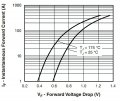
What this means for @quitenoob is that the output voltage might change during the charging process, as load changes. The voltage might creep upward as the battery reaches full charge. I don't know much about this battery chemistry; I don't know whether this bad, liveable, or maybe actually good. Here is the graph from the device I linked.

Screenshot_20220429-180055_Drive.jpg
If you follow the 175C curve to the 150A point, you will see the voltage drop is around 0.9V. In a bridge rectifier this will be multiplied by 2, so 1.8V drop. If you follow that same curve down to the 5A point, you will see the voltage drop around 0.45V (×2 = 0.9V in a bridge circuit). So nearly a whole volt of difference and the target is only a few volts, so this is a significant difference.

However, the reason why I say "the voltage might change" is that at 150A you probably would be on or near that 175C line, but at only 5A, you're much more likely to be closer to the 25C line. If you compare the voltage drop on the 175C line at 150A to the voltage drop on the 25C line at 5A (0.7V ×2 = 1.4V) then the difference (1.8V - 1.4V = 0.4V) may not be such a big deal.

So, assuming 0.4 is still a big deal with this battery chemistry, what do you do? Wind the transformer to output target voltage at full draw (fast charge, with potential overvoktage near the end) or wind it for target voltage at no load/light load (slow charge, safer for the batteries)? Or do you get over your fear of circuits and build an active rectifier that can deliver a steady DC voltage regardless of load conditions?
 

Thread Starter

quitenoob

Joined Mar 27, 2022
262
max respect for the continued discussion regarding losses in the previous posts to this thread.

In the meantime, while waiting for additional measurement gear to arrive I could not help my self and went ahead with yet another stab at optimizing the transformer.

I am soo glad I have my teeth in this project.

1651303167477.png

I am getting another 25kg of iron powder so I can totally cover the transformer with it.
This will improve (decrease) the amps drawn by primary. You can already see it happening while not fully covered yet.
 
Last edited:

MrSalts

Joined Apr 2, 2020
2,767
What kind of iron powder are you using? Brand, grade, carbon content and particle size.
do you pretreat the iron powder in any way?
 

Hymie

Joined Mar 30, 2018
1,347
As per an earlier post of mine, I’d recommend you put some insulation sleeveing over the primary tails of the enamel wire. With all that moving about, changing the configuration, you are likely to compromise what little insulation is being provided by the enamel coating on the wires – possibly leading to a short circuit.
 

Thread Starter

quitenoob

Joined Mar 27, 2022
262
As per an earlier post of mine, I’d recommend you put some insulation sleeveing over the primary tails of the enamel wire. With all that moving about, changing the configuration, you are likely to compromise what little insulation is being provided by the enamel coating on the wires – possibly leading to a short circuit.
yes sir! I have not forgotten about your advice
 

Thread Starter

quitenoob

Joined Mar 27, 2022
262
powder details in case not easily found on their website
-----
It is here the world famous CUT 150 powder
The purity is at least 99% (proven by analysis)
Sieve size distribution: <63µm 48,4% / >63µm 31% / >100µm 20,4% / >160µm 0,2%

Chemical analysis, weight %
Iron, >99.0%
Carbon, % 0.05 Leco C/S
O (H2-loss), % 0.60 DIN ISO 4491-2
Flow time s / 50g: 32.5
Bulk density: 2.79 g/cm³
Melting point: 1535 degrees
Boiling point: 2750 degrees
Chemically Stable
The particle shape is spherical
Manufacturing process: Air atomized
 

Thread Starter

quitenoob

Joined Mar 27, 2022
262
This is the one I would choose. Two diodes in 1 package, rated 175A each (continuous), with 1V drop. Two devices needed to make a full bridge rectifier. The package is a robust one that is very easy to mount to a heat sink.$25USD each, 141 in stock.
When looking at that link I see
Rectifiers 280 Amp 200 Volt
My fingers are twitching. Trigger happy when near the order button. Do I give in and get those?
 
Top