DIY Power Supply

Thread Starter

corasan

Joined Jul 18, 2023
35
I want to create a bench power supply to power general electronic circuits on a breadboard. My design incorporates a fixed 5V and two selections for variable voltage of 1.25V to 30V. Here are some of my questions in building the prototype:

1) What transformer specs should I get? What are the necessary factors to consider when buying one?
2) Is a 24V transformer enough to supply the output DC voltage up to 30V?
3) How to know the heatsink size for the voltage regulators?
4) Is there any wire thickness needed for specific connections?
5) Do I need a fuse at the output?
6) How can I improve the design for voltage accuracy and safety precautions?

The design is referenced from:1703838086348.png
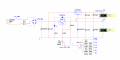
LM317 with pass transistor circuit regulators | ElecCircuit.com
 

ericgibbs

Joined Jan 29, 2010
21,413
Hi cor,
OK.
1) What transformer specs should I get? What are the necessary factors to consider when buying one?
For 1.5A at 5V for the 7805, you require a 9V 2Amp transformer

2) Is a 24V transformer enough to supply the output DC voltage up to 30V?
Not at 1.5Amps

3) How to know the heatsink size for the voltage regulators?
Heatsinks size to ensure that the dissipation of the 7805 and LM317 ratings are say at 75% limit.

4) Is there any wire thickness needed for specific connections?
Need more details on what you mean by specific?

5) Do I need a fuse at the output?
Fuses are usually in the input side of a PSU DC section.

E
 

BobTPH

Joined Jun 5, 2013
11,480
You will need around 33V to get output up to 30V using those regulators.

If you pull 1.5A at 5V, your regulator needs to dissipate (33-5) x 1.5 = 42W. You would need a massive heatsink AND a fan for that.

If you want to pull 1.5A at 1V it becomes even worse, 48W.

You can buy a very good switch mode supply for less than it would cost to build this, unless you can scavenge the parts like the transformer and heatsinks.
 

MisterBill2

Joined Jan 23, 2018
27,271
I want to create a bench power supply to power general electronic circuits on a breadboard. My design incorporates a fixed 5V and two selections for variable voltage of 1.25V to 30V. Here are some of my questions in building the prototype:

1) What transformer specs should I get? What are the necessary factors to consider when buying one?
2) Is a 24V transformer enough to supply the output DC voltage up to 30V?
3) How to know the heatsink size for the voltage regulators?
4) Is there any wire thickness needed for specific connections?
5) Do I need a fuse at the output?
6) How can I improve the design for voltage accuracy and safety precautions?

The design is referenced from:View attachment 311163
LM317 with pass transistor circuit regulators | ElecCircuit.com
1. The transformer rated watts capability SHOULD be a bit more than the intended power to be delivered by the ortion of the supply fed by that transformer.
2.A 24 volt transformer will provide more than 30 volts DC if you use a full wave rectifier, such as a bridge.
3 Heatsink math says the power capability is based on the regulator heating equal to the max voltage drop at the max current. Max voltage drop is with the output set to the lowest voltage because the voltage drop is in the pass transistor. I tend to use one bigger than that size.
4 The wire size for the current carrying wires, for 5 amps do not use smaller than #18 for the load current carrying wires.
5. Do not fuse the output. fuse the primary of the transformer.
6. the accuracy depends on how well you set the adjustment. And the accuracy of the meter used to measure the output.
 

crutschow

Joined Mar 14, 2008
38,389
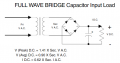
A rectifier-capacitor power supply pulls high peak RMS currents from the transformer, so you need to derate the transformer by about 40% (see below from Hammond transformer):
Thus, for 1.5Adc out of a full-wave bridge rectifier, the transformer should be rated for at least 1.5 / 0.62 = 2.4Arms

1703964087592.png
 

Jon Chandler

Joined Jun 12, 2008
1,570
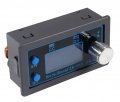
You might consider a module similar to this type. A variety of types come in this same package. Broadly, either buck or buck/boost types are available. You supply DC to the module – a laptop power brick works well.

The module regulates the voltage or current to whatever you set. The readout accurately displays voltage, the current being drawn and other parameters like power being used. You can set a current limit or use the module as a constant current source.

This module can supply 4 amps at up to 30-some volts and costs around US$15 or less. Other versions are available that can supply up to 50 volts at 5 amps or more.

SmartSelect_20231230_113233_Edge.jpg
 

ElectricSpidey

Joined Dec 2, 2017
3,316
I would suggest using the TO3 case for the regulators. (I know you didn't ask)
Multi-tap transformers can also be useful for reducing the need for overly large heatsinks.

As for #6

You should make all connections to ground as close to the same physical spot as possible.
Don't scrimp on the capacitor voltage ratings, or the current rating of the bridge.
 
Last edited:

MisterBill2

Joined Jan 23, 2018
27,271
I see not one speck of a hint as to the voltage or current capabilities of that funny blue module. Nor anything about the display accuracy, if any.
 

Jon Chandler

Joined Jun 12, 2008
1,570
I see not one speck of a hint as to the voltage or current capabilities of that funny blue module. Nor anything about the display accuracy, if any.
Since bitching and being negative is far easier than doing a 30 second Google search, let me help you. As I said, these modules are available in a number of types over a range of voltage and current capabilities.

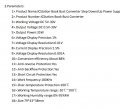
For the Zk-4KX shown, the specs are as shown here:

SmartSelect_20231230_134810_Edge.jpg

A detailed manual is available here.

The pdf below is a very concise operating guide.

These modules are amazing for the price and can be had for less than 10 bucks.
 

Attachments

Jon Chandler

Joined Jun 12, 2008
1,570
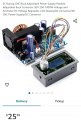
In case someone wants to say the voltage or current range is too low, here's a 50 volt, 20 amp version avaliable on Amazon. It uses a remote power supply board. Note this is a buck converter only, so to get the full range, a 55 volt 20 amp supply must be used.

If you'd like more details, Google is waiting to help you.

Screenshot_20231230_144920_Edge.jpg
 

MisterBill2

Joined Jan 23, 2018
27,271
OK, the module specifications would be adequate. But the caution was appropriate because there is also a lot of junk offered for sale. We should all be aware of that. So examining the specifications prior to making a decision is the better way to go.
Even on these forum pages we have seen product links that contained no real information, just a lot of words. Those details always matter, so really, it is not being negative or critical to ask about the details.
And I am not a big fan of following links, by the way.
 

MrAl

Joined Jun 17, 2014
13,680
I want to create a bench power supply to power general electronic circuits on a breadboard. My design incorporates a fixed 5V and two selections for variable voltage of 1.25V to 30V. Here are some of my questions in building the prototype:

1) What transformer specs should I get? What are the necessary factors to consider when buying one?
2) Is a 24V transformer enough to supply the output DC voltage up to 30V?
3) How to know the heatsink size for the voltage regulators?
4) Is there any wire thickness needed for specific connections?
5) Do I need a fuse at the output?
6) How can I improve the design for voltage accuracy and safety precautions?

The design is referenced from:View attachment 311163
LM317 with pass transistor circuit regulators | ElecCircuit.com
Hi,

As others have mentioned, there may be a problem drawing 1.5 amps at lower voltages because of the required voltage drop due to the regulator IC. The power can be quite high. This is why a front end switcher is often used that automatically adjusts the input voltage to the linear regulator so the dissipation in the linear regulator stays low for all output voltages.

You can do it with out that front end, but the regulator IC will get hot even with a heat sink, and then a secondary issue comes up that is hard to glean from the data sheet. As the temperature rises, the output voltage changes, and it can change more than expected due to the way the internal reference changes and how that reflects on the output voltage as a multiple. This would mean that after it heats up, you would have to adjust the voltage a second time if you want really accurate voltage regulation. There are ways around this by using an external reference diode, but I am not sure how complicated you want this to become nor what accuracy you are actually looking for in the end product.

When you buy a ready-made product, it may be hard to tell what the accuracy of that product is too unless you can find a schematic or at least what IC chip they are using to do the regulation control. You can then look up the data sheet for the IC being used.

Another little issue that comes up is the ease of adjusting the output voltage. Because you want a wide output voltage range, you will be using a potentiometer that is somewhat high in value, or at least has to be turned through it's whole range to adjust from 1.25v to 30v. That means one turn (which will be less than 360 degrees) takes you from 1v to 30v, which means to adjust in increments of about 0.1v you'd have to turn the pot just 1 degree (actually even less than that). That can be hard to do by hand.
To help the situation, you can wire a second pot in series with the larger value pot. To keep the power dissipation in the pot to less than 1/2 watt, you'd have to use a 2k pot, but 5k is probably more typical. In the case of the 2k pot, a 100 Ohm pot is just 5 percent of 2k, so you should be able to get better adjustment by hand with that 100 Ohm pot in series with the 2k pot. It will take a little work but then you can adjust to more precise values of output voltage. This way the 2k pot becomes a coarse adjustment while the 100 Ohm pot becomes the fine adjustment. Because the 100 Ohm is just 5 percent of 2000, that means the full rotation of the 100 Ohm pot changes the output by just around 1.5 volts, which now gives you an adjustment of about 0.01 volt per degree of shaft rotation (roughly), which is 10 times better than without the extra pot.
The adjustment procedure then allows you to adjust the 2k pot to get the output voltage in range, with the 100 Ohm pot roughly adjusted to center position. You then adjust the 100 Ohm pot to get the voltage to the level you need. Sometimes it does take some back and forth adjustment of the two pots, but at least then you can get the right output level.
An alternative, if you care to use one, is a 2k 10 turn potentiometer. That also helps get the adjustment more to the level you need. A 2k 10 turn pot and a 20 Ohm pot in series will probably be an overkill, but that would allow very fine adjustment.

We could go over some simple calculations later if you like.
 
Last edited:

MisterBill2

Joined Jan 23, 2018
27,271
The TS could also use a multi-turn potentiometer to set the voltage. They are available as ten-turn models, and even 14 turn models in some surplus markets. That would be another possible solution.
 
Top