DIY low resistance multimeter

OBW0549

Joined Mar 2, 2015
3,566
I can try pulses of a few hundred mS. That way it doesn't really get to heat up too much, but avoids issues with inductive reactance. And I could also even try using a fan or something to cool it. Additionally, I would only need this kind of resolution on VERY low resistances, where 10 amps wouldn't heat it up too much.
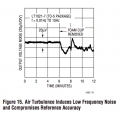
Good grief. Whatever you do, DO NOT succumb to the temptation to use a fan; it will only make things worse-- MUCH worse-- because the turbulent moving air will cause randomly fluctuating thermal gradients and lead to even greater error voltages. Nearly every voltage reference or precision op amp data sheet discusses this well-known problem. This application note from Linear Tech contains a neat little graph (see page 8) that compares the output fluctuations in an LT1021-7 voltage reference exposed to normal air circulation in the lab (right side) versus its performance when shielded from air currents by a styrofoam cup:
Untitled.png
Note that the above behavior is without the device dissipating significant power, and without blowing air on the part from a fan.

Beware!

Make life easier on yourself: do what @crutschow suggested and use AC excitation of the unknown resistance, an AC amplifier with suitably high gain to give you a useable signal level, and synchronous detection to convert the amplifier output to a DC level your multimeter can read reliably.

Otherwise, you'll be in for a very painful "Teachable Moment."
 

Hymie

Joined Mar 30, 2018
1,347
Everyone (including me) is pouring scorn on live wire’s proposal – but I have been giving the idea some thought, and would like live wire to succeed.

Obtaining a 10A supply should not be a problem (I have suggested a circuit for this).

In relation to the heating of the wire under test due to passing a current of 10A - for copper a 2.5°C rise in temperature will increase a given resistance by around 10%.

However if the circuit applies 10A for a resistance in the range of 10μΩ – 1mΩ, then the maximum power dissipation will be 0.1W. And if a current of 1A is used for a resistance range of 1mΩ - 1Ω, then the maximum power dissipation will be 1W.

The above-suggested currents/resistance’s will result in measurement voltage ranges of 100μV – 10mV and 1mV to 1V respectively.

I would recommend live wire concentrate on building a circuit able to give a stable reading in response to a 100μVdc voltage (and 0V).

A 100μVdc voltage can easily be obtained using a PP3 9V battery together with an 820KΩ resistor in series with a 9.1Ω resistor.

I invite others to suggest circuits that could achieve these measurement criteria.
 

Hymie

Joined Mar 30, 2018
1,347
I think I read that -live wire- is away on vacation.

I proposed (above) a circuit that used 308 op-amps. These are quite expensive, possibly due to their age and better alternatives being available.

Once –live wire- returns hopefully he will see this post, with a possible replacement for the 308.

I would welcome others to post cheaper op-amps that might do the job.

https://www.ebay.co.uk/itm/2PCS-10P...var=492752765432&_trksid=p2060353.m1438.l2649
 

OBW0549

Joined Mar 2, 2015
3,566
I proposed (above) a circuit that used 308 op-amps. These are quite expensive, possibly due to their age and better alternatives being available.

Once –live wire- returns hopefully he will see this post, with a possible replacement for the 308.

I would welcome others to post cheaper op-amps that might do the job.
The LM308 was introduced 49 years ago in 1969, only one year after the ancient, venerable uA741. While its specifications certainly qualified it as a "precision" op amp way back then, nowadays it would be considered mediocre at best: it has as much as 7.5 mV of input offset voltage, up to 30 μV/°C of input offset voltage drift, 30 nV/√Hz noise, and a whopping 10 nA input bias current.

There are many, MANY op amps available now that are much better than the LM308. One that I've used a lot when extreme precision was needed is an auto-zeroing op amp from Maxim, the MAX44241/44243/44246. It features a maximum of 5 μV input offset voltage, 20 nanovolts/°C maximum input offset drift, zero 1/f noise, and only 600 pA input bias current. The input common-mode range goes from the negative supply up to 1.5 volts below the positive supply, and the output swings rail-to-rail. It will operate on as little as 2.7 volts total supply voltage. It would probably perform very well in the circuit you posted.

The MAX44246 (the dual op amp version) sells for $2.21 in onesies at Digikey.
 

Hymie

Joined Mar 30, 2018
1,347
-live wire-, did you manage to take your idea further?

I recently had need to measure low ohmic values at work, fortunately the material could withstand high currents. I achieved what I believe was an accuracy down to around +/-10μΩ, however I was using a 50A (a.c.) supply and a voltmeter with a resolution to 10μV (0.01mV).
 

Thread Starter

-live wire-

Joined Dec 22, 2017
959
-live wire-, did you manage to take your idea further?

I recently had need to measure low ohmic values at work, fortunately the material could withstand high currents. I achieved what I believe was an accuracy down to around +/-10μΩ, however I was using a 50A (a.c.) supply and a voltmeter with a resolution to 10μV (0.01mV).
Unfortunately I haven't been able to. I will try to revisit it soon, though.
 

Thread Starter

-live wire-

Joined Dec 22, 2017
959
The LM308 was introduced 49 years ago in 1969, only one year after the ancient, venerable uA741. While its specifications certainly qualified it as a "precision" op amp way back then, nowadays it would be considered mediocre at best: it has as much as 7.5 mV of input offset voltage, up to 30 μV/°C of input offset voltage drift, 30 nV/√Hz noise, and a whopping 10 nA input bias current.
and only 600 pA input bias current. The input common-mode range goes from the negative supply up to 1.5 volts below the positive supply, and the output swings rail-to-rail. It will operate on as little as 2.7 volts total supply voltage. It would probably perform very well in the circuit you posted.

The MAX44246 (the dual op amp version) sells for $2.21 in onesies at Digikey.
That op amp sounds great. Many orders of magnitude better than the LM308 and other outdated/cheap op amps! So assuming I design a good amplifier, there is still the temperature issue. How much heating would cause a thermocouple effect, and could I measure the ambient temperature to still get accurate readings when it's a lot hotter or colder? Would there be any issues caused by the electromagnetic field from the large currents?


For starters, I offer this circuit – if the feedback resistor values of U2 are changed to give the required gain, it may work.

View attachment 156301
Seems simple enough. But how necessary is the low pas filter? The thing is, with the voltage follower, don't you have more noise from the op amp and double the input offset voltage? Also, what exactly does the potentiometer with resistors on the non-inverting input do? Does it just add an offset? And wouldn't that circuit only get you a gain of 2?
 

OBW0549

Joined Mar 2, 2015
3,566
So assuming I design a good amplifier, there is still the temperature issue. How much heating would cause a thermocouple effect...
ANY amount of heating will cause thermocouple effects, it's a question of how much-- and that can't be predicted due to the large number, and various kinds, of metal-to-metal contacts in the signal path.

..., and could I measure the ambient temperature to still get accurate readings when it's a lot hotter or colder?
That wouldn't do you any good unless you could somehow magically predict the thermocouple effects-- which you can't.

Would there be any issues caused by the electromagnetic field from the large currents?
I don't see how that could have any influence.

Frankly, I think your best course of action would be to get rid of thermocouple effects entirely by using AC excitation, as suggested by @crutschow in post #2. To minimize any inductance effects, I'd choose a frequency a lot lower than 1 kHz. And to minimize any form of interference, use synchronous detection.
 

Hymie

Joined Mar 30, 2018
1,347
Although you are trying to measure of the order of 10μV, noise might not be as big an issue as first imagined.

I was measuring a resistance of the order or 200μΩ – with the meter leads free, the meter was displaying many mV (due to noise pick-up), but once the leads were attached to the sample (effectively shorting the leads together) the display read <0.01mV.

I would recommend you build the amplification circuit first to see if it will allow measurement of low voltages down to the μV level – then work out how to get the 10A supply.

In relation to my proposed circuit, the potentiometer is to allow zeroing of the op-amp output – the gain (at 2) was for another circuit design. I suggest you experiment with a gain of around 100.
I was measuring of the order of 10mV (so with a x100 gain, you’d be measuring around 1V).
 

Thread Starter

-live wire-

Joined Dec 22, 2017
959
ANY amount of heating will cause thermocouple effects, it's a question of how much-- and that can't be predicted due to the large number, and various kinds, of metal-to-metal contacts in the signal path.


That wouldn't do you any good unless you could somehow magically predict the thermocouple effects-- which you can't.


I don't see how that could have any influence.

Frankly, I think your best course of action would be to get rid of thermocouple effects entirely by using AC excitation, as suggested by @crutschow in post #2. To minimize any inductance effects, I'd choose a frequency a lot lower than 1 kHz. And to minimize any form of interference, use synchronous detection.
I may want to measure steel bolts and other things made out of iron. Due to the availability and how cheap they are, they may be useful in certain high current applications. But even at a much lower frequencies, I don't see how the inductance wouldn't significantly affect it. At even 10 Hz, 1uH is an additional 60 uOhms. This is just unacceptable if the resistance is in the hundreds of uOhm range.

And I was asking if measuring the ambient temperature might help with the fact that resistance can increase with temperature.

Although you are trying to measure of the order of 10μV, noise might not be as big an issue as first imagined.

I was measuring a resistance of the order or 200μΩ – with the meter leads free, the meter was displaying many mV (due to noise pick-up), but once the leads were attached to the sample (effectively shorting the leads together) the display read <0.01mV.

I would recommend you build the amplification circuit first to see if it will allow measurement of low voltages down to the μV level – then work out how to get the 10A supply.

In relation to my proposed circuit, the potentiometer is to allow zeroing of the op-amp output – the gain (at 2) was for another circuit design. I suggest you experiment with a gain of around 100.
I was measuring of the order of 10mV (so with a x100 gain, you’d be measuring around 1V).
So the potentiometer zeroing thing is unnecessary if you have a good op amp? Or could it be used to obtain even greater accuracy if you make a solid state version of it? Could you connect the leads together through a mosfet or relay, and adjust a digital potentiometer till zero volts is read, as opposed to a few uV? Or is the input offset voltage too variable for that to work?
 

OBW0549

Joined Mar 2, 2015
3,566
But even at a much lower frequencies, I don't see how the inductance wouldn't significantly affect it. At even 10 Hz, 1uH is an additional 60 uOhms. This is just unacceptable if the resistance is in the hundreds of uOhm range.
The voltage developed across the resistor under test has two components: the resistive voltage drop itself, equal to I * R, which is in phase with the driving signal; and a reactive voltage drop equal to the inductor reactance times I. That reactive voltage drop is 90° out of phase with the driving signal and, if synchronous detection is used, does not cause an error.
 

Thread Starter

-live wire-

Joined Dec 22, 2017
959
The voltage developed across the resistor under test has two components: the resistive voltage drop itself, equal to I * R, which is in phase with the driving signal; and a reactive voltage drop equal to the inductor reactance times I. That reactive voltage drop is 90° out of phase with the driving signal and, if synchronous detection is used, does not cause an error.
What do you recommend for an inverter circuit to get high current low voltage AC? And what waveform would be best? Would a simple square wave suffice? Is there any reason it would matter?
 

OBW0549

Joined Mar 2, 2015
3,566
What do you recommend for an inverter circuit to get high current low voltage AC? And what waveform would be best? Would a simple square wave suffice? Is there any reason it would matter?
Actually, if I were doing this I wouldn't bother with "real" AC; chopped DC would do just as well (e.g., a DC voltage in series with a current-setting resistor, switched on and off with 50% duty cycle at a couple of hundred Hz) since the voltage developed across the unknown resistance will be AC-coupled into an amplifier. The amplifier's output would then go to some sort of correlated double-sampling arrangement (which could be as simple as a SPDT analog switch, two sampling capacitors and an instrumentation amplifier) which would produce your amplified DC output.
 

Hymie

Joined Mar 30, 2018
1,347
I’m recommending that you apply 10A dc – it will be much easier to obtain than some high current a.c. – although I will admit my measurements were made using 50A at 50Hz.
 
Top