Facebook
 Google
 GitHub
 Linkedin

Good grief. Whatever you do, DO NOT succumb to the temptation to use a fan; it will only make things worse-- MUCH worse-- because the turbulent moving air will cause randomly fluctuating thermal gradients and lead to even greater error voltages. Nearly every voltage reference or precision op amp data sheet discusses this well-known problem. This application note from Linear Tech contains a neat little graph (see page 8) that compares the output fluctuations in an LT1021-7 voltage reference exposed to normal air circulation in the lab (right side) versus its performance when shielded from air currents by a styrofoam cup:I can try pulses of a few hundred mS. That way it doesn't really get to heat up too much, but avoids issues with inductive reactance. And I could also even try using a fan or something to cool it. Additionally, I would only need this kind of resolution on VERY low resistances, where 10 amps wouldn't heat it up too much.
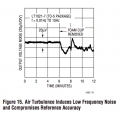
Note that the above behavior is without the device dissipating significant power, and without blowing air on the part from a fan.
Beware!
Make life easier on yourself: do what @crutschow suggested and use AC excitation of the unknown resistance, an AC amplifier with suitably high gain to give you a useable signal level, and synchronous detection to convert the amplifier output to a DC level your multimeter can read reliably.
Otherwise, you'll be in for a very painful "Teachable Moment."