Facebook
 Google
 GitHub
 Linkedin

Background and Goal:
There have been many projects where I wanted to know the resistance of a wire that is very low (low mΩ range). Actually, most projects somehow involve measuring wire resistance. Obviously a regular multimeter cannot do that directly. I have been able to get rough estimates by measuring millivolts when applying a constant current or by using a resistor. But I am not sure how accurate my multimeter is. While the quality seems great, it was pretty cheap. And this process is kind of tedious.
This means I need to get a 4 wire kelvin multimeter. I have looked around, and they seem to be insanely expensive (100s of dollars). I was able to find one or two that were about $75, but that is still a lot. I would like to make my own for under $25.
Here is the goal. Let me know if parts of it are impractical. So I want to be able to measure with an accuracy of ±10-20 μΩ. I know that means an amp for every 10 μV, and thus large currents and precise, low noise op amps are required. I also want it to have a nice display, and auto-ranging for current and op-amp gain.
My idea:
So I have a general idea of how to go about making this. I would first supply a constant current of up to 5-10 amps. I would then measure the drop across the wire with a precision op-amp. I know it needs a low input offset voltage, and it should be low noise, but other than that I am not too sure what exactly to look for. This would get fed into either a higher resolution ADC or directly into an arduino analog pin (I will need to figure out if 10 bits is enough).
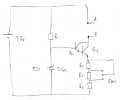
For adjusting the range of the op-amp I am thinking resistors with bypass transistors controlled by GPIOs. I could also do the same thing to make a crude digital potentiometer for adjusting the CC of a CC board.
I think I have some spare arduino nanos I could use, or I could just get one for a few dollars off of ebay. I will probably get a cheap OLED display off of amazon to display the current and measured resistance. I will have to find the right library to be able to use I2C, SPI, or whatever the display uses with the arduino.
Where I need help:
So here is where I could really use some help. I first need a precise constant current board that can supply up to 10 amps. I could use suggestions for that. I have one that can do that except it is not too precise (about ± 50-100mA based on my measurments). If I don't know the exact current, then I may have to measure it using a shunt, adding another complex op-amp circuit and more possibilities for errors.
I also imagine at such low voltages, EMI, RFI, and general noise could really get in the way. So how do I reduce noise to acceptable levels, and what will be major sources of it? What op-amp is best for this application, and what is the best setup for it? Specific part numbers would be great.
And is there a better approach here? Does anyone have comments or general suggestions?
There have been many projects where I wanted to know the resistance of a wire that is very low (low mΩ range). Actually, most projects somehow involve measuring wire resistance. Obviously a regular multimeter cannot do that directly. I have been able to get rough estimates by measuring millivolts when applying a constant current or by using a resistor. But I am not sure how accurate my multimeter is. While the quality seems great, it was pretty cheap. And this process is kind of tedious.
This means I need to get a 4 wire kelvin multimeter. I have looked around, and they seem to be insanely expensive (100s of dollars). I was able to find one or two that were about $75, but that is still a lot. I would like to make my own for under $25.
Here is the goal. Let me know if parts of it are impractical. So I want to be able to measure with an accuracy of ±10-20 μΩ. I know that means an amp for every 10 μV, and thus large currents and precise, low noise op amps are required. I also want it to have a nice display, and auto-ranging for current and op-amp gain.
My idea:
So I have a general idea of how to go about making this. I would first supply a constant current of up to 5-10 amps. I would then measure the drop across the wire with a precision op-amp. I know it needs a low input offset voltage, and it should be low noise, but other than that I am not too sure what exactly to look for. This would get fed into either a higher resolution ADC or directly into an arduino analog pin (I will need to figure out if 10 bits is enough).
For adjusting the range of the op-amp I am thinking resistors with bypass transistors controlled by GPIOs. I could also do the same thing to make a crude digital potentiometer for adjusting the CC of a CC board.
I think I have some spare arduino nanos I could use, or I could just get one for a few dollars off of ebay. I will probably get a cheap OLED display off of amazon to display the current and measured resistance. I will have to find the right library to be able to use I2C, SPI, or whatever the display uses with the arduino.
Where I need help:
So here is where I could really use some help. I first need a precise constant current board that can supply up to 10 amps. I could use suggestions for that. I have one that can do that except it is not too precise (about ± 50-100mA based on my measurments). If I don't know the exact current, then I may have to measure it using a shunt, adding another complex op-amp circuit and more possibilities for errors.
I also imagine at such low voltages, EMI, RFI, and general noise could really get in the way. So how do I reduce noise to acceptable levels, and what will be major sources of it? What op-amp is best for this application, and what is the best setup for it? Specific part numbers would be great.
And is there a better approach here? Does anyone have comments or general suggestions?