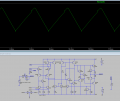
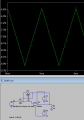
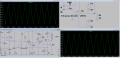
Oh I just had a great idea. It won’t be high bandwidth but I can build a few of these and create a limited differential probe which is what I wanted to build in the first place. I might be able to get 100kHz, it would be a start... then I can just drop in higherbandwidth opamps with a little tweaking.
Hey bertus thanks for pointing that out. I was aware that there are a few versions based on manufacturer.
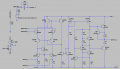
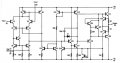
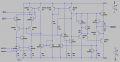
The difference that I see is additional output current protection in the 24 transistor version. Also biasing for the output transistor uses Q19, Q16 instead of the silicon resistors (two diode drops). I don’t mind about the biasing but I plan to put the current limiting back in.
You're absolutely right, the 741 rolls off quickly after 10k, I might have confused it looking at the exponents... ok it'll be a toy but it will be a good project for school, again, I plan on dropping in AD8000's (1.5GHz) for the final probe. They need FET input to speed it up a bit, but again I am not redesigning the 741, just like I won't be designing opamps in the future, just picking the right ones. This is more an exercise in building a discrete solid state device and making use of it.
Let me preface this with I hate the new Windows 10... it's fights with me just about every time I try to add something... I lost my first 741 Spice model because I ignored a warning and apparently Windows blocked saving my file... originally I wanted to save both 20 transistor and 24 transistor models. So I had to re-build it.
I still have a small offset voltage to deal with. Playing around with the values internally really gives you an idea how it's biased. So far I have noticed about 3 or 4 schematics with differing resistor values. This is annoying. Worse comes to worse I go back to the 20 transistor version which I know works... I will be puzzling this out for a while. Enough for today, I have other pressing things to get to.
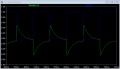
OK, the circuit works and now ready to design PCB! I know I've opened up a can of worms. I'm sure I will have to explain the current mirrors, differential amplifier, gain stages as well as the output short protection. Reading through all the excellent articles you guys have shared, we are moving in leaps and bounds compared to the pioneers who spent years coming up with these concepts that we take for granted. Yes we can now build a targeting system... I will stick with the integrator for now because of it's simplicity so I can concentrate on the parts of the opamp.
1. uA741 - consisting of 24 transistors utilizes transistor (diode drop) bias for output transistors.
2. has short circuit protection at the output. A voltage drop across one of the output resistors turns on the circuit which cuts the input into the 2nd stage.
3. There are 4 current mirrors to control current as transistors take up less space on a die
4. signal flow is: differential amplifier - to a gain stage then - output stage.
Overall like many opamps (since we can now take for granted) very simple. Just takes a lot of work and discrete components to build. I will have to dig into the calculations but we have 5 weeks to deadline.
I see this as an invaluable learning experience ... the opamp's internal circuitry itself is quite beautiful. Also, I'd like to see the implications of building it using discreet components. I'm willing to bet that even the physical spacing between transistors plays a part in its performance.
You are not wrong... I'm not entirely sure that it will have any negative impacts. I believe that diffusion process and sharing substrates are entirely another science. Many diode junctions are created and even BJT's appear while building something else. From the simulation we know the circuit (equivalent) works as intended and designed. I'm anticipating better separation and behavior from discrete components. It will be easier to isolate them from noise and unintended capacitance. I assume that there may be stray inductance added due to the longer traces.
Keep in mind that before the late 60's all op-amps were built using discrete components. This is really just going back in time using SMD (much like Kilby's original design for integrated circuits).

 Facebook
 Google
 GitHub
 Linkedin