Facebook
 Google
 GitHub
 Linkedin
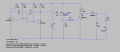
The attached circuit Q2 and Q1 form a stable oscillator which produces a square wave at the collector of Q1. I feed the collector of Q1 to the base of Q4. Q4 is actually a buffer transistor, but I can't seem to get it into saturation. The buffer transistor would provide enough current to then drive Q3 on and off. L1, C3, D1, D2, and R6 all form a boost converter circuit. My questions are as follows:
1. With the current circuit, I am measuring VCE of Q4 to be 2.8V to 0.8V, VBE of Q4 to be 0V to 0.8V. I installed a Q4 collector resistor, which I subsequently removed because once I did, the oscillation stopped. How do I get Q4 into saturation as an on/off switch while the oscillation continues? . Am I not doing something right?
2. From discrete components only, how do I build feedback control that outputs a steady 6VDC at the junction of R6 and D1? I would need a steady 6V at the junction of R6 and D1, even when I vary V1 from 9V to 3V. I can't use a discrete comparator as feedback control because one of my signals would exceed my v1 due to the boost converter, and the discrete comparator would not function. I tried the voltage divider at the output of R6, and fed the voltage divider to the base of the NPN transistor, Qx, which is now removed. The Qx collector then feeds the base of Q1. When the voltage divider signals the threshold voltage at the base of Qx, Qx closes, drawing current to ground, thus changing the duty cycle. However, the oscillation stops, and it only works for 5 seconds, after which there is no oscillation at Q1 collector. After that, the inductor would be in series with D1 and their is a constant output DC above threshold, and Qx remain close. So that doesn't work. Can someone please help me out here?
I had a similar question in a prior thread, but I didn't get the answer particular for this circuit, and that thread got too long, so I didn't want to extend it further. I tried to build it myself, but I am having the above difficulty.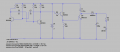
1. With the current circuit, I am measuring VCE of Q4 to be 2.8V to 0.8V, VBE of Q4 to be 0V to 0.8V. I installed a Q4 collector resistor, which I subsequently removed because once I did, the oscillation stopped. How do I get Q4 into saturation as an on/off switch while the oscillation continues? . Am I not doing something right?
2. From discrete components only, how do I build feedback control that outputs a steady 6VDC at the junction of R6 and D1? I would need a steady 6V at the junction of R6 and D1, even when I vary V1 from 9V to 3V. I can't use a discrete comparator as feedback control because one of my signals would exceed my v1 due to the boost converter, and the discrete comparator would not function. I tried the voltage divider at the output of R6, and fed the voltage divider to the base of the NPN transistor, Qx, which is now removed. The Qx collector then feeds the base of Q1. When the voltage divider signals the threshold voltage at the base of Qx, Qx closes, drawing current to ground, thus changing the duty cycle. However, the oscillation stops, and it only works for 5 seconds, after which there is no oscillation at Q1 collector. After that, the inductor would be in series with D1 and their is a constant output DC above threshold, and Qx remain close. So that doesn't work. Can someone please help me out here?
I had a similar question in a prior thread, but I didn't get the answer particular for this circuit, and that thread got too long, so I didn't want to extend it further. I tried to build it myself, but I am having the above difficulty.
Last edited: