Discrete 741 build final project

cmartinez

Joined Jan 17, 2007
8,759
Yeah that would take all day with 24 transistors and the passives... I paste and hot air or oven... they come out looking amazing... plus I have a feeling I want to make more than 1. I want to give one of them to the professor.

I only use iron for headers and thru hole.
It would be real nice if you were to post a small video of the process.
 

Thread Starter

Wolframore

Joined Jan 21, 2019
2,619
There are many online that shows the process very well... it's not hard, sometimes the paste gets messy but if you need to produce a lot of boards, it's the best way. I even build jigs for stenciling. I'm considering a small pick and place to speed up when I have to pump out 100 boards at a time. Some packages are impossible with irons... like the TQFN and some of the bluetooth chips.

Here's a good one from my friend Joe Barnard:
 

cmartinez

Joined Jan 17, 2007
8,759
There are many online that shows the process very well... it's not hard, sometimes the paste gets messy but if you need to produce a lot of boards, it's the best way. I even build jigs for stenciling. I'm considering a small pick and place to speed up when I have to pump out 100 boards at a time. Some packages are impossible with irons... like the TQFN and some of the bluetooth chips.

Here's a good one from my friend Joe Barnard:
That was beautiful, thanks... do you have info on where I could have the stencils made? and their average cost?
 

Thread Starter

Wolframore

Joined Jan 21, 2019
2,619
Most of the PCB board manufacturers have a stencil service, they use your solder mask to make it using a laser cutter. The charges vary... they use a full standard panel to create stencil... shipping can be high as well (it has to be shipped with hard material to keep from bending and creasing). Let's discuss outside of this post if you have more questions... ask for quotes from your favorite PCB house.
 

Thread Starter

Wolframore

Joined Jan 21, 2019
2,619
We are using the MMBT3904 NPN and MMBT3906. I have two separate batches of each. Here are the procedure and results for transistor matching:

Objective: measure Vbe of the transistors to be used as matched pairs for current mirrors and differential pairs. Using DMM the diode check was used to measure forward voltage of the diode junction between base and emitter. The measuring current is approximately 1 mA - please note the results will vary slightly between different meters but using the same one with a fresh battery should produce accurate results.

MMBT3904 NPN

batch 1
- the initial Vbe is 752 mV and falls to 748 mV. This indicates that the transcondance changes as the transistor warms up and stabilizes in about 8 seconds. 15 transistors were tested and all were within 1 mV so unable to detect any variation between the batch.

batch 2 - initial Vbe is 749 mV and falls at 748 mv almost immediately and holds steady (over 20 seconds). The second batch appears to be more consistent with temperature changes.

MMBT3906 PNP

batch 1
- more variations - Vbe is lower overall, initial reading is 721-718 mV and drops to about 4 mV lower after a few seconds. This batch of transistors are not consistent. They will not be used in critical areas but well within expected tolerances.

batch 2 - again more consistent measurements - initial reading starts at 720 mV and holds at 719 mV. Again very consistent.

I believe the 2nd batch is the better choice due to consistency between initial Vbe and with time for device to warm up with a 1 mA current. Our transistors will be DC biased at about 750 uA at the highest. I believe this is a reasonable match for our circuit.

The PCB is finished and pending, final design change was to make the inputs a matched differential pair with impedance matching and track pairing.

Results of the matching - unsure why the second batch is more consistent. There is no documentation and markings are the same for the transistor/package. We will use the second batch for critical areas such as the current mirror. The approximately 29 mV difference between PNP and NPN will will introduce a small crossover distortion for the class AB output stage. It is not critical for overall model and project parameters.
 
Last edited:

Thread Starter

Wolframore

Joined Jan 21, 2019
2,619
transistor matching continued:

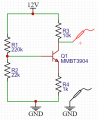
this circuit was created to test the gain - PNP circuit will have flipped polarity.
1574013156769.png

It's biased to conduct ~ 350 uA depending on β ... here we are discovering slight variations in the VC and now we are able to match the transistors to match gain.

I measured slight variations in the VC which ranged from 7.84 - 8.06 (βDC 81-112) and now we are able to match the transistors to match gain. Went through about all 200 transistors from the second batch to find 4 matched sets of at least15 needed for a complete board. The ones we will use had VC= 7.95V @ 406 uA... which is within the operating conditions of the op-amp. I measured VBE to confirmed that they all had the same base current. We have matching transistors for the entire board!

VR3 = VCC - VC or 12.01 - 7.95 = 4.06V across R3
IR3 = VR3/R3 or 4.06/10000 = .000406 or 406 uA
we have approximately 4.3 uA at the base giving us HFE of about 94.

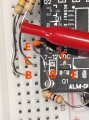
In order to test tiny SOT-23 transistors I had to use the SMT pads from another board and soldered pins and wire jumpers to attach to a PCB. Here is how this looks:
fixed test.jpg
 
Last edited:

Thread Starter

Wolframore

Joined Jan 21, 2019
2,619
Ok there are some issues with the discrete circuit.... I believe some of it is due to the multi-collector and multi-emitter transistors they can build on an IC. It should work well enough to do integration at a low frequency. I will not be highlighting the open loop gain... still working on getting this circuit working correctly to try to match the chip... the integrator is no problem. But I will try to figure out the problem and document this.

upon further testing in simulation, it may be a simulation issue not a circuit issue.

I don't trust that the Spice simulation is saying I will get higher bandwidth than the IC.

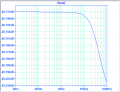
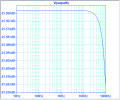
Here are the bode plots:
First is an IC model, the second is the discrete model... higher gain and higher bandwidth.

1574101847230.png 1574101866677.png
 
Last edited:

MrAl

Joined Jun 17, 2014
13,702
Hi,

I used to love doing discrete component circuits just for the fun of it. Transistor, resistors, capacitors, that's about maybe one voltage regulator chip.
The ua741 chip reproduction sounds interesting although i am not sure i would want to go with that many transistors just for the fun of it.
 

Thread Starter

Wolframore

Joined Jan 21, 2019
2,619
I spent most of today writing up the project, I’m waiting for PCBs to arrive so most of my work is on hold. We have week 14 this Thursday and projects are due 2 weeks after, should be plenty of time. @MrAl i picked this for the challenge, it’s been a lot of work. I’ve figured out the DC biasing but now I have to work through AC portion then a short slide presentation and then integrator comparison example. I really want to explore a depletion nmos transistor amplifer circuit next. I like the idea of the high input impedance... I’m not sure why their Rds is so high 10-100 Ohms...
 

KL7AJ

Joined Nov 4, 2008
2,229
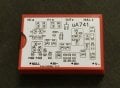
Just ordered all the parts for a discrete 741 build for my final project. Using 0805 and SOT23 transistors 3906 and 3904. To keep it simple I will not be using bigger transistors for output stage. Hopefully the transistors will match pretty closely for the current mirrors (Since they are on reels my changes are good). So then I realize it won’t be any good without a demo circuit to show the operations. Thinking simple and perhaps an integrator to change waveforms which will parallel with an actual 741 dip doing the same thing with input and output showing on a oscilloscope. I’m having fun with the project if you guys have any suggestions or hints please feel free to share. Next semester is mostly opamps and this will get me started and ready. I will document and update the post with my build. Still playing with design ideas: build a large representation on the silicon die using discrete components... or build a small board with 8DIP pins so it can be drop in replaced with an actual IC.... will only do one version.

View attachment 189579
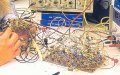
Building a 741 with discrete components will look like this: Bob Pease Breadboard.jpg
 

ci139

Joined Jul 11, 2016
1,989
figured out the DC biasing but now I have to work through AC
i hope i got you wrong . . .
// -- you can't match the DC biasing - to a random voltages - on some (other than your's) circuit presenting the 741's inner structure
// even if the dynamic hFE-s of two transistors will match their corresponding V.BE V.CE drops may vary
The case is different for the biasing of the DC currents ← here the voltage drop differences play a lesser role
 

Thread Starter

Wolframore

Joined Jan 21, 2019
2,619
The case is different for the biasing of the DC currents ← here the voltage drop differences play a lesser role
Yes it’s all based on the assumption of +15/-15 rails and you are correct it is the current we are interested in. R5 provides 733uA of current to divide up for the different areas through the use of current mirrors and widlar current sources. I’m struggling with the AC analysis, it’s been so long since deriving equations so not having fun with transfer functions so I didn’t go into detail.
 
Top