it wouldnt?Are you trying to say that the current will flow through D1?
I dont understand?You got the first part right....but you need to examine the network D1..D3 more closely.
View attachment 83622 Which of these identical silicon diodes draws the most current? Which draws the least? Explain.
Wouldnt the first diode draw the most current and the last draw the least? Since the current only has to pass 1 resistor first to get to the first diode and the last diode the least since the current has to go through all the other diodes and resistors first?
You seem to be saying that the current that goes through D1 (the "last" diode) has to first go through all of the other diodes and resistors. Is that really what you are saying?Sorry I may still be *completely* wrong but I meant D4 as my first diode and D1 as my last.
Or from most to least current : D4, (D5,D6)(same), D3, D2, D1
is my analysis still wrong?

If the current flows out of the positive terminal of the battery, then over and through D4, D5, and D6, and then up through the branch that has D3, and D2, how does that current ever get to the negative terminal of the battery?It has to go thru the first resistor and D4 D5 and D6 then the resistors around D3 D2
oh would that make D3 and D2 current the same as well? the resistor current flows around them straight to D1?
All of the current, diode current dropsView attachment 83623
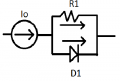
When the resistance is infinite, it's as though the resistor isn't there. Under those conditions, how much current is flowing in the diode? As the resistance decreases, what happens to the diode current?
All of the current, diode current drops
So if I have two of these circuits in series (so that both have Io going through them), and the resistance of the first is smaller than the resistance of the second, which diode has more current flowing in it?
would the current in D1 just go back thru D4 D5 and D6 to get back to negative?If the current flows out of the positive terminal of the battery, then over and through D4, D5, and D6, and then up through the branch that has D3, and D2, how does that current ever get to the negative terminal of the battery?
Remember, the current in any component in a circuit must be part of a complete, closed loop that only goes through any given component in that loop once.
couldnt the current go through it then through the resistor and to the negative terminal?Why would D3 be forward biased?
| Thread starter | Similar threads | Forum | Replies | Date |
|---|---|---|---|---|
|
|
Checking zener diodes | General Electronics Chat | 9 | |
| J | Diodes Needed for Back Feed? | General Electronics Chat | 6 | |
| N | About diodes | General Electronics Chat | 4 | |
| S | Amp Rating of Diodes | General Electronics Chat | 4 | |
| D | Dropping voltage with diodes | Power Electronics | 10 |