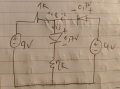
Diodes conduct when forward biased and block current when reverse biased.
So you calculate the voltage polarity across the diodes to determine which state they are in.
After you do the separate calculations, how do you interpret the results? If one of the diodes is conducting in one calculation and not conducting in the other, is it conducting in the actual circuit or not?
Superposition doesn't hold for nonlinear circuits.
Even if it did, you don't zero a voltage source by removing it, you replace it with a short.
Diodes conduct when forward biased and block current when reverse biased.
So you calculate the voltage polarity across the diodes to determine which state they are in.
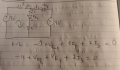
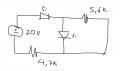
The two analyses show that 6.23 V will cause D2 to be reverse biased.
Hence D1 is forward biased and D2 is reverse biased.
I never suggested superposition.
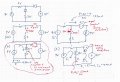
There are 4 possibilities: D1 and D2 are both reverse biased, D1 is forward and D2 is reverse, D1 is reverse and D2 is forward, and D1 and D2 are both forward. You assume one of these possibilities and analyze the circuit. If your assumption is correct (i.e., the current in a forward diode flows in the correct direction, and the voltage across a reverse diode has the correct polarity), you are done. If not, make a new assumption and repeat.
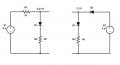
In (a), both diodes were assumed reverse biased (opens). The analysis shows that the voltage across D1 is incorrect, so the assumption was wrong.
In (b), D1 is assumed forward and D2 reverse. The analysis shows the current in D1 in the correct direction, and the voltage across D2 having the correct polarity.
You don't need to check the other possibilities after the correct one is found. Often you can look at the circuit to make a good guess as the which is the best assumption
There are 4 possibilities: D1 and D2 are both reverse biased, D1 is forward and D2 is reverse, D1 is reverse and D2 is forward, and D1 and D2 are both forward. You assume one of these possibilities and analyze the circuit. If your assumption is correct (i.e., the current in a forward diode flows in the correct direction, and the voltage across a reverse diode has the correct polarity), you are done. If not, make a new assumption and repeat.
In (a), both diodes were assumed reverse biased (opens). The analysis shows that the voltage across D1 is incorrect, so the assumption was wrong.
In (b), D1 is assumed forward and D2 reverse. The analysis shows the current in D1 in the correct direction, and the voltage across D2 having the correct polarity.
You don't need to check the other possibilities after the correct one is found. Often you can look at the circuit to make a good guess as the which is the best assumption
Here is a trickier one but much more relevant.
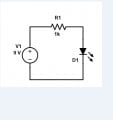
Connect a 9V voltage source in series with a 1kΩ resistor and red LED.
Calculate the voltage across the LED and the current through the LED.
I mean with diodes connected in parallel or in series or just 1 diode is eassy, but how about they are not in parrallel or in series? Can I remove these diodes initially and calculate Voltages at cathode point of them ?

 Facebook
 Google
 GitHub
 Linkedin