Hello,Dear Team,
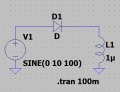
May I know how to calculate the conduction angle of the diode in the below circuit.
View attachment 274823
For ideal components, what do you think it would be?In the circuit given below Inductor used is ideal inductor, What is the conduction angle of diode
I beive 360 degree,but in negative cycle will the the diode conduct.For ideal components, what do you think it would be?
Thank you..As the source tries to reverse bias the diode, the inductor will produce whatever voltage is required to keep the current flowing. In doing so, energy will be drawn from the inductor and dumped into the supply and dissipated by the diode.
No. Imagine a very low frequency waveform such that all of the energy in the inductor is dissipated while the supply is on the negative half cycle. Why (and how) would the diode still be conducting?Thank you..
I can say that the conduction angle is 360 degree.Please correct me if I am wrong
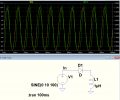
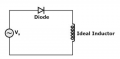
I will restate me question and circuit diagram.
In the circuit given below Inductor used is ideal inductor, What is the conduction angle of diode
View attachment 275245
Hello again,No. Imagine a very low frequency waveform such that all of the energy in the inductor is dissipated while the supply is on the negative half cycle. Why (and how) would the diode still be conducting?
Hello,Thank you..
I can say that the conduction angle is 360 degree.Please correct me if I am wrong
I'll admit that I had in mind the "ideal diode" in which which forward conducting it has a fixed voltage drop across it. But if the model is a true ideal diode with a forward drop of 0 V.Hello again,
That is a practical view that would take place anywhere on earth i believe. However, with an ideal diode there is no place for the energy to go except back into the source, and indeed this kind of problem is usually handled by the volt seconds approach. Volt seconds in, same volt seconds out.
So in the ideal case it must be 360 degree right?
Normally there is some voltage drop though then we have to integrate over the portion that is above the diode voltage but with no voltage drop it seems we have to integrate over the entire half cycle, then see it go back into the source in the second half cycle.
So the question is, does the inductor lose energy at some point.I'll admit that I had in mind the "ideal diode" in which which forward conducting it has a fixed voltage drop across it. But if the model is a true ideal diode with a forward drop of 0 V.
But I'm not positive that it must work out to a 360° conduction angle. It might -- I can see some handwavy arguments to support that. But since the current can't alternate directions it can't be sinusoidal, but the voltage of the supply it. So the waveform is not going to be the nice shifted-sinusoid whose symmetry ensures energy shuttling back and forth between supply and coil. Without the diode, each half cycle of the voltage waveform has an energy-in and energy-out portion in which the current direction is positive for one and negative for the other. Specifically, at the start of positive half of the voltage waveform, the current is at max in the negative direction, something that cannot happen here. I could imagine that it works out to a non-symmetric waveform in which energy is pumped into the the inductor during the positive half-cycle on one energy profile that is pumping energy over the entire half-cycle and then a very different energy profile on the negative half in which that energy is, perhaps, drawn out in less than half the cycle or, perhaps, not all of it is drawn out and there is a net build-up of energy in the inductor from one cycle to the next. Or it may work out that if the voltage waveform has odd symmetry that the energy balance is such that the energy pumped in on the positive voltage waveform is exactly taken out on the negative portion.
It shouldn't be too hard to run the math, but I don't know when I will have time to do it.