Analog signals mean that the signal can have any voltage in a continuum from a minimum voltage to a maximum voltage.
A digital signal is an analog signal same as above, i.e. it can have a voltage in a continuum from a minimum to a maximum voltage. The difference here is in the context that the signal is used. In the case of a digital context, one is only willing to accept signals that fall within two ranges (for binary systems).
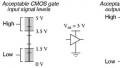
For example, for 5 V CMOS signals, only ranges from 0 - 1.5 V and 3.5 - 5 V are considered legitimate logic voltages.
A signal that falls between 1.5 V and 3.5 V is not reliable and is difficult to call as TRUE or FALSE.
Neither the circuit nor the signal know whether they are analog or digital. A circuit is a circuit and, fundamentally, all circuits and waveforms are analog.
What makes a circuit or a waveform "digital" is how it is interpreted.
In a typical 5 V CMOS "digital" interpretation, all signals that are less than 1.5 V are interpreted as being equivalent and are called a logic LO, while all signal that are above 3.5 V are also considered indistinguishable and are called a logic HI.
When we design circuits to work with these interpretations of these waveforms, we design them so that their outputs only output values that fit comfortably into one of these two ranges by ensuring that if they want to produce what will be seen as a logic LO that they output a voltage less than 0.5 V while if they want their output to be interpreted as a logic HI, they output something that is at least 4.5 V.
Now, if you are designing circuits, you can leverage the knowledge about how the signals will be interpreted in order to make it much easier to design "digital" circuits that satisfy the requirements of "digital" interpretations that designing circuits that meet the generally much more sensitive and tight requirements of "analog" interpretations.

 Facebook
 Google
 GitHub
 Linkedin